Part-time work and pension funds: the coordination deduction

The short answer
When you work part-time, you only join a pension fund once you earn more than CHF 22,680 a year with one employer (2026 figure). The fund then applies a coordination deduction of CHF 26,460 at the legal minimum, however much you work. At 50% in a job that pays CHF 70,000 full-time, only a quarter of your salary is insured. Both amounts go up in 2027.
We work with the amounts the Federal Social Insurance Office (FSIO) has published for 2026 (in German). We show how you can insure two small jobs together (an option the FSIO says few people know about), what the rejected BVG reform would have changed and what's new in 2027. Further down there's a short request to your pension fund that you can copy.
How much do you need to earn part-time to be in a pension fund?
More than CHF 22,680 a year with a single employer. That's what Article 7 of the BVG, the federal law on occupational pensions, says. Your workload plays no part. Work 40% and earn CHF 28,000, and you're in the compulsory scheme. Work 60% and earn CHF 21,000, and you're not.
What counts is the salary you pay AHV (old-age and survivors' insurance) contributions on, so a 13th-month salary, allowances and bonuses count too. If you work for the same employer for less than a year, the law scales your salary up to a full year. Earn CHF 2,000 a month from March to December and you come to CHF 24,000, which is above the threshold.
You're insured against disability and death from 1 January after your 17th birthday. Saving for retirement starts on 1 January after your 24th birthday.
Fixed-term and temporary jobs
A fixed-term contract of three months or less falls outside the compulsory scheme. That's set out in the ordinance to the BVG, Article 1j BVV 2. If the contract is extended beyond three months without a break, you're insured from the day the extension was agreed. With several assignments for the same temp agency, the assignments add up as long as no break lasts longer than three months. You're then insured from the fourth month, under Article 1k. If it's clear before your first day that the job will last more than three months, you're insured from day one.
Second jobs are an exception. If you're already in the compulsory scheme through your main job, or you're mainly self-employed, the second job isn't covered, even if it pays above the threshold. You can still insure it voluntarily, and we show how further down. First, though, the bigger problem: even people who are in often have only a small part of their salary insured.
How the coordination deduction penalises part-time work
The pension fund doesn't insure your whole salary, only the part between CHF 26,460 and CHF 90,720. The law calls this part the coordinated salary. The CHF 26,460 is the coordination deduction. It's meant to leave out the part of your salary that AHV already covers.
For a full-time job, the idea makes sense. With part-time work the maths falls apart, because the deduction is fixed. It doesn't shrink when you work less. On a full-time salary of CHF 70,000, 62% of the salary is insured. Work 50% in the same job and you earn CHF 35,000, of which only CHF 8,540 is insured: 24%.
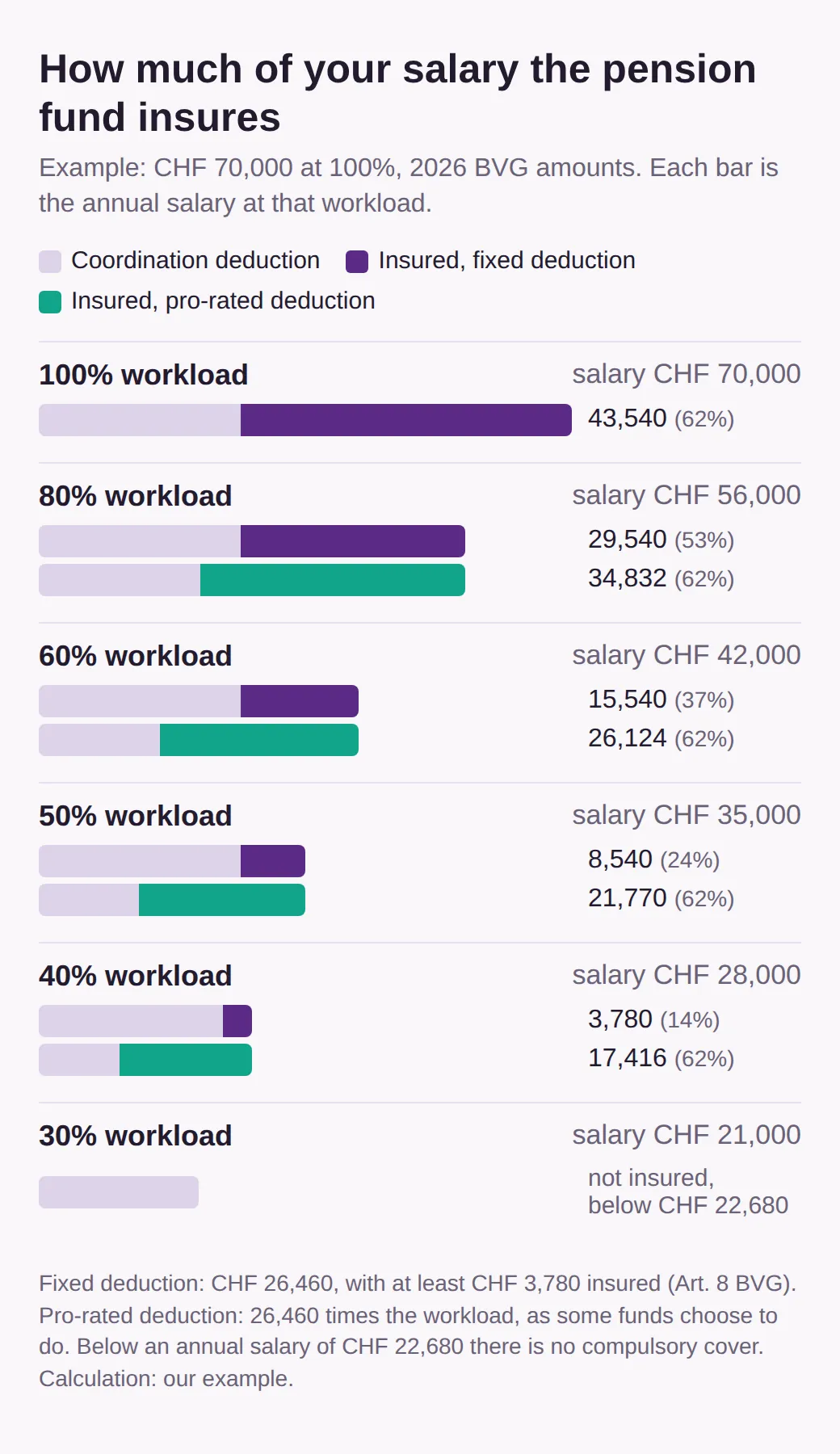
Below a certain level a safety net applies: if the coordinated salary comes to less than CHF 3,780, it's rounded up to that amount. At 40% and a salary of CHF 28,000, only CHF 1,540 would be left on paper, but CHF 3,780 is insured. That sounds like protection, but it isn't much: 14% of the salary.
The next step shows why this matters. Everything the pension fund saves for your retirement is calculated from the coordinated salary.
What it means in francs
Every year the fund adds a retirement credit to your account. The BVG sets minimum rates for it as a percentage of the coordinated salary: 7% from age 25 to 34, 10% from 35 to 44, 15% from 45 to 54 and 18% from 55 to 65. Many funds pay more; the law is the minimum.
Take one example from the chart: a 60% workload, a salary of CHF 42,000, age 40, so a 10% credit.
| Deduction | Insured salary | Credit per year |
|---|---|---|
| Full, CHF 26,460 | CHF 15,540 | CHF 1,554 |
| Pro-rated, CHF 15,876 | CHF 26,124 | CHF 2,612 |
| For comparison: 100%, CHF 70,000 salary | CHF 43,540 | CHF 4,354 |
The gap between the first two rows is CHF 1,058 a year, or CHF 10,580 over ten years before interest. In return, a higher insured salary also means higher contributions taken from your pay. But your employer has to pay in at least as much in total as all its employees together, as Article 66 BVG requires. So a large part of the difference doesn't come out of your salary.
The FSIO's own figures show how small the pension gets at the bottom end. Someone who has only ever been insured on the minimum coordinated salary since 1985 and reaches the reference age in 2026 gets a pension of CHF 1,548 a year from the compulsory BVG scheme; for a woman born in 1962 it's CHF 1,535. That's about CHF 128 a month. Whether your deduction is fixed or follows your workload isn't decided by the law, though. It's decided by your fund.
Can the pension fund adjust the deduction to your workload?
Yes, it can. The BVG only sets minimum rules. In its answers on part-time work (in German), the FSIO writes that funds may set a lower coordination deduction depending on the level of employment, or insure the whole salary. They're not obliged to.
For you, that means two jobs with the same salary and the same workload can look very different when it comes to your pension. You can see how your fund calculates on the pension certificate you get every year. If it shows an insured salary exactly CHF 26,460 below your annual salary, the fund applies the full deduction. If the gap is smaller, it adjusts the deduction or drops it, unless your salary is so low that the minimum of CHF 3,780 kicks in. If in doubt, the pension fund regulations will tell you; the fund sends them on request.
If you're looking for a job right now, it's worth asking about the pension plan at the interview. The answer can show whether an offer with a lower salary is worth more in the end.
The fixed deduction only gets really expensive, though, when you have more than one part-time job.
Two or more part-time jobs
Each job is assessed on its own. The threshold applies per employer, and each fund only counts the salary it insures itself. Earn CHF 20,000 at a daycare centre and CHF 16,000 in a shop, and you come to CHF 36,000 but still aren't in the compulsory scheme anywhere. This affects women more often. According to an FSIO overview from 2024 (in German), women split their work across several jobs almost twice as often as men: 10.7% compared with 5.9%.
There is a way out, though, and it has been in the law for a long time. If your total annual salary is above CHF 22,680, you can insure yourself voluntarily under Article 46 BVG, either with the Substitute Occupational Benefit Institution or with the pension fund of one of your employers, if its regulations allow it. All your salaries then count together, and the coordination deduction is taken only once (Article 29 BVV 2).
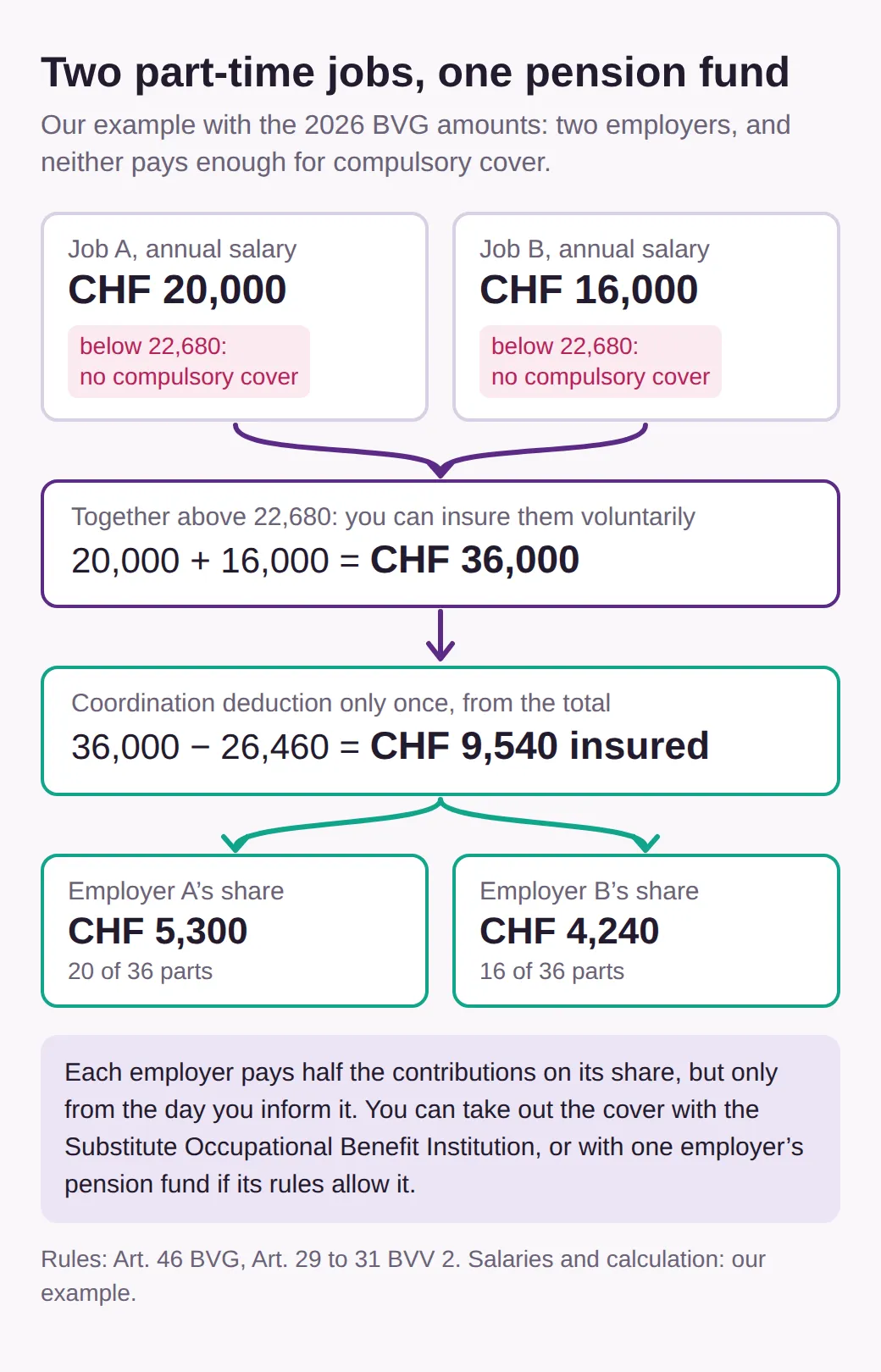
Your employers have to contribute. Each one owes you half of the contributions on the salary it pays you. For this, the insured salary is split in proportion to the salaries (Article 31 BVV 2). The catch: an employer only pays from the day you've told it about the insurance, not retroactively (Article 30 BVV 2). So tell all of them in writing straight away. If you ask, the fund will collect the contributions from your employers itself, but you bear the cost of that.
At the Substitute Occupational Benefit Institution, this cover is called the MA plan. You join with a questionnaire that lists all your salaries, and you have to report every pay change and every new employer yourself. The institution has to accept you; Article 60 BVG requires it. Other funds rarely offer this cover because it takes a lot of work, according to an FSIO report to the National Council's Social Security and Health Committee (in German). The same 2021 report shows how few people use it: at the time, 284 people were insured this way with the Substitute Occupational Benefit Institution, four times as many as ten years earlier and still very few. The FSIO gives these reasons: hardly anyone knows the option exists, the reporting is a chore, some people fear an employer might stop hiring them because of the contributions, and on a small income your own contributions weigh heavily too.
One job insured, the other not
A more common case: you're insured through your main job and have a small job on the side. Article 46 helps here too. You can insure the salary from the second job with your fund, if its regulations don't rule it out, or with the Substitute Occupational Benefit Institution.
This can be worth more than you'd think. Earn CHF 40,000 in your main job and CHF 13,540 of it is insured there. Add CHF 15,000 from the side job, and the ordinance calculates the insured salary from the total: 55,000 minus 26,460 gives CHF 28,540. Take away the 13,540 your main job already covers and CHF 15,000 is left. So the whole second salary is insured, because the deduction was already taken in your main job.
What the rejected BVG reform would have changed
This is exactly what the reform put to the vote on 22 September 2024 set out to fix. Voters rejected it (in German), with 67% voting no according to the official results. For part-time workers it would have changed two things, in 2024 amounts:
- The entry threshold would have dropped from CHF 22,050 to CHF 19,845. According to the FSIO, about 70,000 people would have been newly insured in the second pillar.
- Instead of a fixed deduction, then CHF 25,725, 20% of the salary would have been deducted. Part-time salaries would always have been 80% insured.
On a salary of CHF 35,000, that means: under the 2024 rules, CHF 9,275 of it was insured; with the reform it would have been CHF 28,000. On a salary of CHF 21,000 there was no cover at all in 2024; with the reform CHF 16,800 would have been insured. But the reform also included a lower conversion rate of 6.0% instead of 6.8%. That's the rate the fund uses to turn your savings into a pension: CHF 100,000 would have paid a pension of CHF 6,000 a year instead of CHF 6,800.
Since then the old system has stayed in place. If you work part-time and want better cover, you depend on your fund or have to act yourself. Only the amounts get adjusted, usually every two years, and the next time is 1 January.
What changes on 1 January 2027
On 2 October 2026 the Federal Council decided to raise AHV pensions by about 1.6% for 2027, and since the BVG limits are tied to them, they go up too. The FSIO press release (in German) gives the new figures.
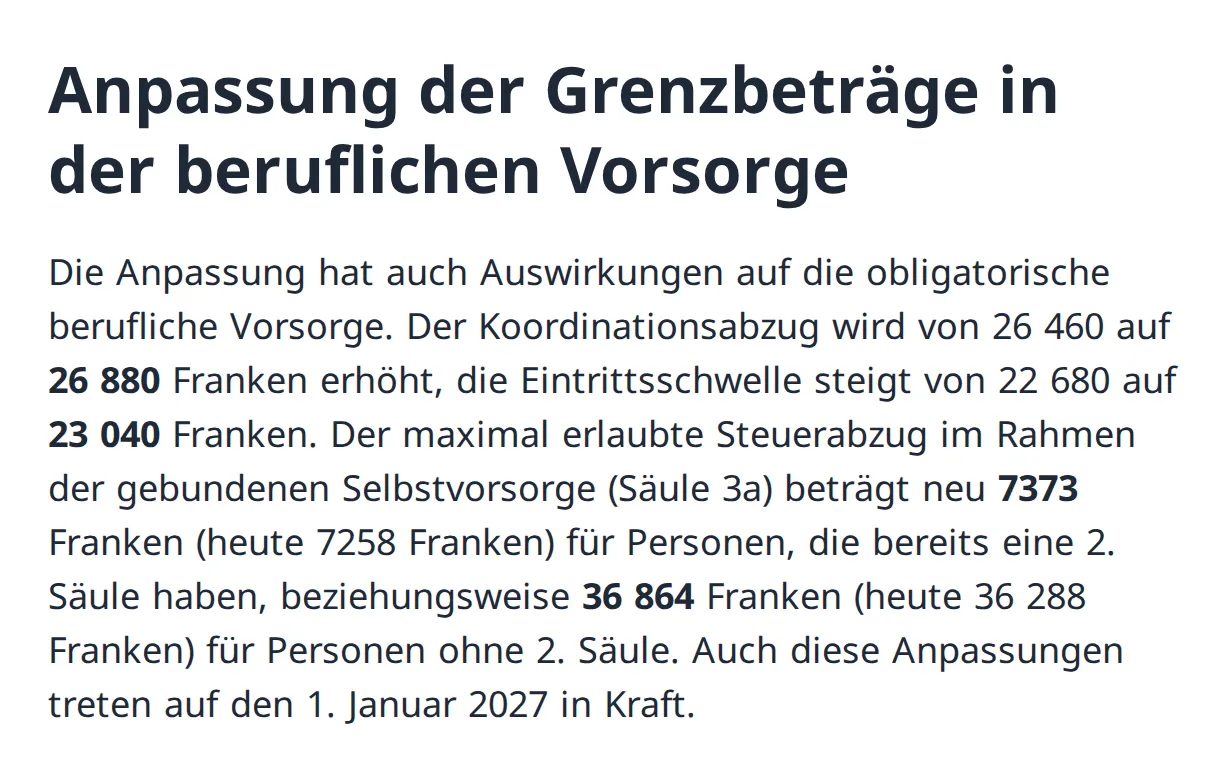
At a glance, with today's figures alongside:
| Amount | 2026 | From 2027 |
|---|---|---|
| Entry threshold | CHF 22,680 | CHF 23,040 |
| Coordination deduction | CHF 26,460 | CHF 26,880 |
| Pillar 3a with a pension fund | CHF 7,258 | CHF 7,373 |
| Pillar 3a without a pension fund, max. | CHF 36,288 | CHF 36,864 |
There's one consequence many people miss. If you earn between CHF 22,681 and CHF 23,040 with one employer and don't get a pay rise, you drop out of the compulsory scheme in 2027, unless your pension plan also insures lower salaries. You keep your savings as vested benefits. If you want to keep paying in, you can continue the insurance under Article 47 BVG with your current fund, if it allows it, or with the Substitute Occupational Benefit Institution. If you choose the Substitute Occupational Benefit Institution, it must receive your application within three months. So check your salary for next year now, while a few extra francs are still up for discussion.
What you can do yourself
The first step usually pays off most, and it costs nothing: find out how your fund calculates.
Ask your pension fund
The address is on your pension certificate. A short email is enough, for example:
Dear Sir or Madam
I work [percentage]% for [employer] and am insured with your pension fund (insured person number [number]). Could you please tell me the following:
- In my pension plan, is the coordination deduction adjusted to my level of employment, or does the full amount apply?
- What is the minimum annual salary the plan will insure from 2027?
- I have a second job with an annual salary of CHF [amount]. Can I insure this salary with you as well under Article 46 BVG?
Kind regards, [Name]
If the fund says no to question 3, there's still the Substitute Occupational Benefit Institution. If it says no to question 1, it's worth talking to your employer. The employer sets the pension plan with its fund, not you.
Pillar 3a: how much you can pay in
How much you can pay into pillar 3a and deduct from your taxes depends on whether you're in a pension fund. If you are, it's up to CHF 7,258 a year in 2026, even if your insured salary is small. If you're not in a fund, a different limit applies: 20% of your earned income, up to CHF 36,288 (Article 7 BVV 3). If you earn CHF 18,000 a year in total and have no pension fund, that's at most CHF 3,600.
Since 2025 you can make up for missed years. If you paid in less than the maximum in a year, you can close the gap later, going back up to ten years, with up to CHF 7,258 extra in each year you catch up (Article 7a BVV 3, in German). Three conditions apply: you've already paid in the full amount for the year you make the extra payment; you were allowed to pay into pillar 3a in the gap year, meaning you had earned income subject to AHV; and the gap arose in 2025 or later. Older gaps can't be filled. For part-time workers whose income goes up and down, this is a real help: pay in little in a tight year and catch up in a better one.
Buying into your pension fund
If you're insured, you can make voluntary buy-ins to your pension fund, up to the benefits your regulations provide for (Article 79b BVG). How much is possible is usually shown on your pension certificate. With a small insured salary, this amount is usually small too, because the fund measures the gap against your insured salary, not your whole salary. And a buy-in is locked in for three years: during that time you can't withdraw the resulting benefits as a lump sum.
Adjust your workload or your plan
The most effective levers are the least comfortable ones. If your salary is just under the threshold, a small increase in your workload makes the difference between having a pension fund and not having one. And when you change jobs, a plan with a pro-rated deduction can be worth more than slightly higher pay: in our 60% example it came to CHF 1,058 of retirement credits a year.
Before the year ends
Dig out your latest pension certificate and compare the insured salary with your annual salary. If the difference is CHF 26,460, send the email above. If you have two jobs, add both salaries together: if you're above CHF 22,680, or above CHF 23,040 from 2027, you can insure yourself under Article 46. And if your 2027 salary sits just below the new threshold, talk to your employer before January.
If you're looking for a new job anyway, you'll find current part-time jobs across Switzerland here. When you apply, ask about the coordination deduction as well as pay and workload.
Common questions
- Does the 13th-month salary count towards the BVG threshold?
- Yes. What counts is the annual salary you pay AHV on, and that includes a 13th-month salary, discretionary and other bonuses. Earn CHF 1,800 a month plus a 13th-month salary and you reach CHF 23,400, above the 2026 threshold of CHF 22,680. A fund may leave out some occasional pay components in its regulations; if it does, it says so there.
- Can a pension fund insure me if I earn below the BVG threshold?
- Yes, if its regulations provide for it. The law only sets the minimum. A fund may insure lower salaries, reduce the coordination deduction or drop it altogether. It doesn't have to, so ask your employer or the fund directly about the pension plan.
- What happens to my pension savings if my salary falls below the threshold?
- You leave the pension fund, and your savings are transferred as a vested benefit to a vested benefits account or policy. Instead, you can keep your pension cover going with your previous fund if its regulations allow it, or with the Substitute Occupational Benefit Institution. If you choose the Substitute Occupational Benefit Institution, it must receive your application within three months of leaving.
- Am I covered for disability and death if I work part-time?
- In the pension fund, only if your salary with one employer is above the threshold. You're then covered for disability and death from 1 January after your 17th birthday, and for retirement from 1 January after your 24th birthday. Benefits depend on the insured salary, so a small coordinated salary also means a small disability pension. Disability insurance (IV) and AHV cover you regardless.