Holiday pay on hourly wages in Switzerland: the 8.33% rule

The short answer
If you're paid by the hour, the supplement for four weeks of holidays is 8.33% on every hour you're paid, 10.64% for five weeks and 13.04% for six. But that holiday pay may only be included in your wage if your hours are irregular and the share is stated in your contract and on every payslip. If any of that is missing, your employer owes you the holiday pay a second time.
The Federal Supreme Court has applied this rule in several cases, including against employers who showed 8.33% on every single payslip. The maths behind the percentages is simpler than it looks, and the rulings show quite precisely what to look for on your payslip.
Where the 8.33% comes from
The supplement is calculated so that over the year you collect exactly the pay for your holiday weeks. The law gives you at least four weeks of holidays a year, and five until your 20th birthday (Art. 329a of the Code of Obligations, CO, in German). During your holidays you must get the full wage you would have earned in that time (Art. 329d CO).
With four weeks of holidays, you work 48 weeks. The pay for 4 weeks is spread over those 48 weeks, so 4 divided by 48. That's one twelfth, or 8.33%. The obvious guess would be 4 divided by 52, or 7.69%. That would be too little, because the supplement is only added to hours you work, and there are no hours in your holiday weeks.
Here's an example. You work 10 hours a week at CHF 25 an hour. In 48 weeks you earn CHF 12,000. One twelfth of that is CHF 1,000, which is exactly what you would have earned in four weeks of 10 hours.
| Holidays per year | Calculation | Supplement |
|---|---|---|
| 4 weeks | 4 ÷ 48 | 8.33% |
| 5 weeks | 5 ÷ 47 | 10.64% |
| 6 weeks | 6 ÷ 46 | 13.04% |
By law, five weeks only apply until your 20th birthday. Anything more comes from your contract or a collective employment agreement (GAV, short for Gesamtarbeitsvertrag). According to the answers on holidays from the State Secretariat for Economic Affairs (SECO, in German), employees aged 50 and over often get five weeks under GAVs and contracts. So find out what applies to you before you check the rate on your payslip. Working part-time, by the way, doesn't change the percentage, only the number of days.
Holidays when you work part-time: same weeks, fewer days
Part-time, you get as many weeks of holidays as you would full-time, but each week counts as many days as you normally work. Basel-Stadt's Office of Economy and Labour works it through on its page about holidays (in German): if you work 40% on two days of 8 hours each, four weeks of holidays come to 8 days off, or 64 hours.
If you work three days a week, it's 12 days. If you work a few hours every day, it's 20 shorter days. What matters is that you end up with four full weeks off. Two of them must be consecutive (Art. 329c CO). If you start or leave during the year, you get your holidays pro rata.
It gets trickier when your hours vary. Then a day of holiday is worth what you earn on average. SECO names the average wage over the last twelve months, or another suitable period, as the yardstick. Regular allowances, for shift work for example, are included.
And what about public holidays? If a public holiday falls during your holidays, it doesn't count as a day of holiday. If it falls on a day you don't work anyway, you don't get a day off in lieu. So your holidays don't get any longer just because Easter Monday lands in your week off and you never work Mondays. Basel-Stadt sets this out on the same page.
With fixed hours and a monthly salary, all of this is simple: your pay keeps running while you're on holiday. It only gets tricky when your holiday pay is meant to be built into your hourly wage already.
Can holiday pay be included in an hourly wage?
In principle, no. As long as you're employed, holidays may not be replaced by money; that's in Article 329d paragraph 2 CO. SECO's answers give the reason: holidays are there for rest, so they should actually be taken. If you get your holiday pay with every wage, you're tempted to just keep working.
The Federal Supreme Court allows an exception, but only under three conditions. In its leading decision BGE 129 III 493, it sums up its case law: where work is irregular, in particular in part-time jobs, holiday pay may exceptionally be paid with the ongoing wage. There has to be an objective need for it, because your hours are irregular. And both the employment contract and every payslip must make clear which part of the wage pays for your holidays. The court publishes its rulings in the language of each case, so the ones we link are in German or French.
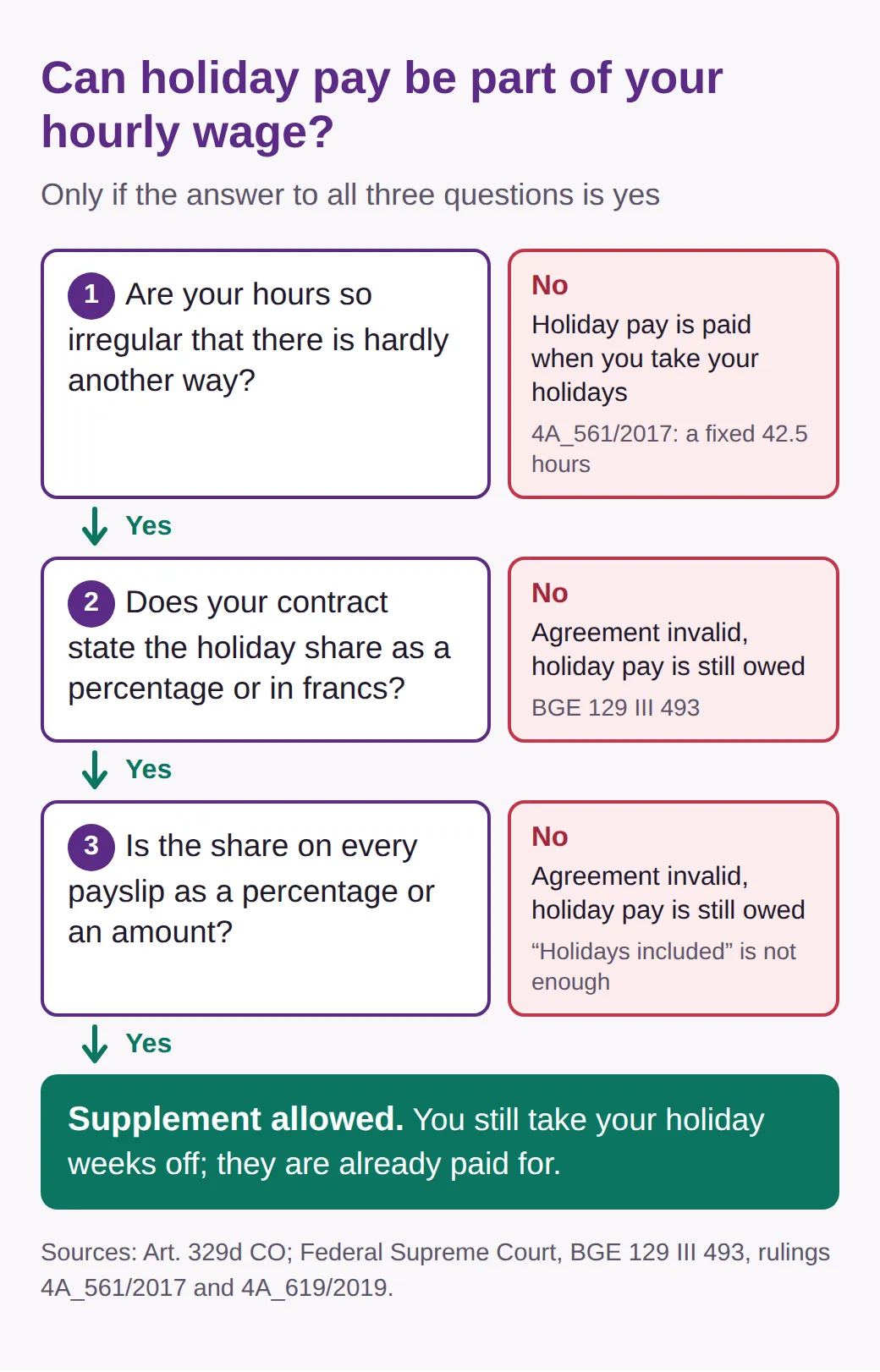
Each of these conditions has already decided a case in court.
Irregular doesn't mean few hours
A joiner in the canton of Vaud worked a fixed 42.5 hours a week from 2008, for CHF 28 and later CHF 31.50 an hour. His payslips showed 8.33% for holidays. He took his holidays but wasn't paid while he was away, and claimed the holiday pay after the job ended. The Federal Supreme Court found in his favour in ruling 4A_561/2017. If you work the same hours every week, your work isn't irregular, and then there's no reason to make an exception for holiday pay. The employer had to pay CHF 26,517.20 gross plus interest.
The reverse is also true: a full-time job doesn't rule the exception out. A refuse collection driver worked an average of 41.9 hours a week on an hourly wage, but his monthly pay varied widely. The cantonal court found that full-time work couldn't be irregular. The Federal Supreme Court overturned that in ruling 4A_619/2019 and sent the case back: you can work irregular hours in a full-time job too. What counts is whether your hours really vary from week to week, not how many there are.
The share must be in your contract
Something else was missing in the Vaud case: the contract didn't state a holiday share. It didn't help the employer that the payslips showed 8.33% or that the joiner said nothing for years. The share has to be in the contract, as a percentage or in francs. If you have a written contract, the share must be set out in it in writing. Only if you agreed nothing in writing at all is an oral agreement enough, and then the payslips must confirm it.
The employer in the 2003 leading decision fell at this hurdle too. A facade insulation worker was paid partly by the hour and partly by performance. His written contract from 1996 set a holiday and public holiday supplement of 11.5% for the hourly wage, but none for the performance-related pay, and his payslips showed no holiday share for it either. The cantonal court awarded him CHF 35,828 plus interest, and the Federal Supreme Court upheld it. Claiming the holiday pay only after the job had ended was not an abuse of rights, the court said.
And on every payslip
With the third condition, too, the detail counts. A note such as «Ferien inbegriffen» ("holidays included") isn't enough, not even in the contract. SECO's answer, shown here in the original German, could hardly be clearer: the payment must be listed specifically in the employment contract and on every payslip, as a percentage or an amount in francs, and an employer who leaves this out risks paying for the holidays twice.
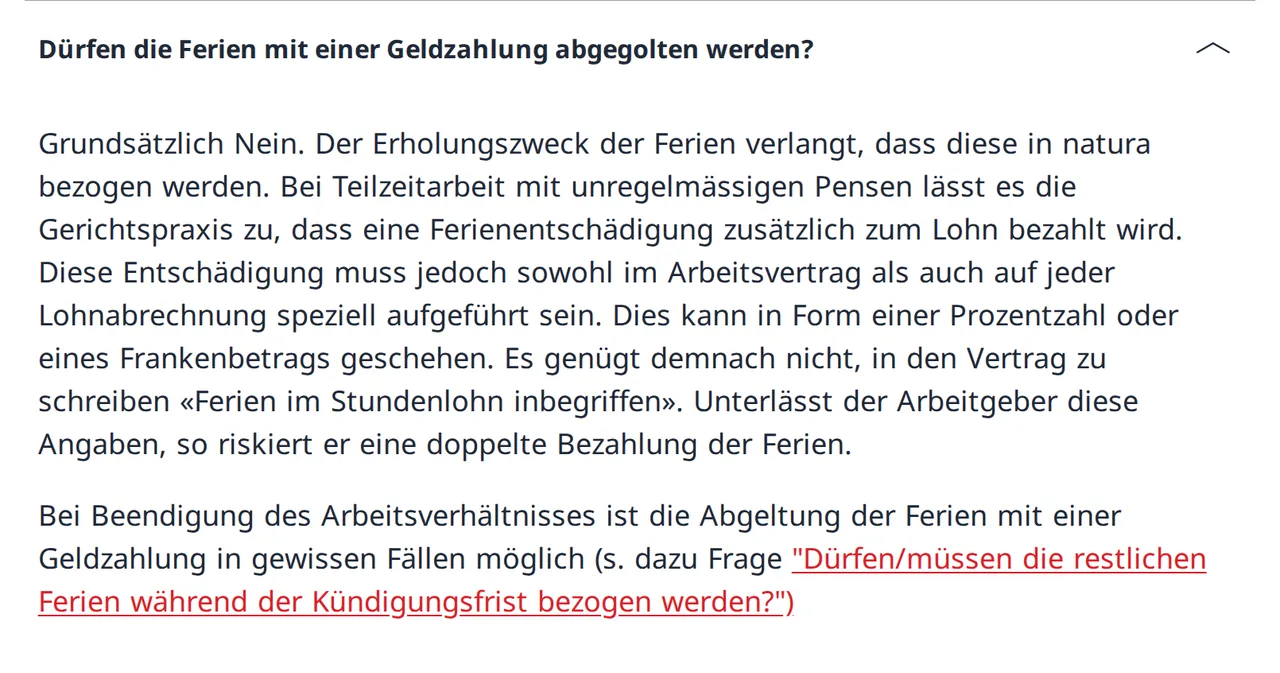
Three typical payslip lines show what yours needs to say:
| Your payslip says | Is that enough? |
|---|---|
| Holiday pay 8.33%: CHF 83.30 | Yes, if your contract states the rate too and your hours are irregular |
| Hourly wage CHF 27.08 incl. holidays | No, the share is missing |
| "Holidays and public holidays included" | No |
If your employer meets all three conditions, the supplement is fine. If one is missing, you have a claim you can pursue.
If a condition is missing: claiming your holiday pay
Then your employer still owes you the holiday pay, even if it paid a supplement every month. Because the agreement was invalid, that supplement doesn't count as holiday pay. SECO calls this, in so many words, the risk of paying twice.
You have time to act. Claims arising from employment become time-barred after five years (Art. 128 no. 3 CO). The Federal Supreme Court confirmed this for holiday entitlement in BGE 136 III 94, separately for each year of service. Anything older than five years is usually lost. So don't wait too long, even if you're still in the job.
A written claim is enough as a first step, for example:
I worked for [company] on an hourly wage from [month year] to [month year]. My employment contract does not state a holiday share as a percentage or in francs, so my holiday pay for this period has not been validly paid (Art. 329d CO). I claim CHF [amount], which is 8.33% of my gross pay of CHF [amount], and ask you to transfer it by [date].
If your employer doesn't pay, you go to your canton's conciliation authority. In employment disputes up to CHF 30,000 there are no court costs, neither at the conciliation stage nor in court (Art. 113 and Art. 114 of the Civil Procedure Code). A lawyer still costs money. You can also get advice from a trade union or, in some cantons, from the labour office; Basel-Stadt, for example, offers legal advice.
Public holidays are a different story, and that's where hourly workers often lose out.
Public holidays on an hourly wage: mostly unpaid
On a monthly salary, a public holiday is paid, because your salary simply keeps running. On an hourly wage, no public holiday is paid by law, with one exception: 1 August, the Swiss National Day. The Federal Constitution, in Article 110, treats it like a Sunday and makes it a paid day.
The Federal Supreme Court ruled on this in BGE 136 I 290, the case of a teacher in Geneva who was paid by the hour and claimed pay for several years of public holidays. Her claim failed. Only 1 August is paid, and only if it falls on a day you would otherwise have worked. In 2027 it falls on a Sunday. So if you don't work Sundays, you have no public holiday paid by law in 2027.
The cantons may treat up to eight more public holidays like Sundays (Art. 20a of the Labour Act, in German). As a rule you may not work on those days. But they're only paid if your contract, a GAV or established practice at your workplace provides for it.
A GAV can do that, and then a flat public holiday supplement is subject to the same strict rules as holiday pay. Ruling 4A_72/2018 was about the GAV for the metalworking trades. A side agreement only said that public holidays were included in the hourly wage, with no amount or percentage, and most payslips showed no public holiday share at all. That wasn't enough: the employer had to pay for the public holidays from 2010 to August 2014.
The canton of Zurich shows how big a public holiday supplement can get, in the rules for its own staff, where it pays for holidays and rest days with a percentage supplement. Its directive on the percentage supplement (in German) works with 25 days of holidays and 10 rest days and arrives at 15.55%: 11.11% for holidays and 4.44% for rest days. At 11.11%, the holiday part is above the 10.64% for five weeks, because Zurich also takes the public holidays out of the working hours. The logic is the same as above: hours off divided by the hours that are left.
Temp work: what the staff leasing GAV says
If you work through a temp agency, you're often covered by the GAV for staff leasing, the GAV Personalverleih, and it's stricter than the courts. Under Article 13 of the GAV Personalverleih 2024–2027 (in German), holiday pay may only be paid out directly with your wage on one-off assignments of three months at most, and even then shown separately on the payslip. In every other case it's only paid out when you take holidays or the job ends for good. Until then, your holiday balance must appear on every payslip.
The GAV gives you 20 days of holidays, so 8.33%. Until your 20th birthday and from age 50, it's 25 days, which the GAV puts at 10.6%. For public holidays, after 13 weeks you're entitled to pay for all official public holidays that are treated like Sundays and fall on a working day. For 1 August that applies from your first day. Your employer may pay for public holidays with a flat 3.2% (Article 14).
What's interesting is the order in which the GAV adds things up. Each supplement is calculated on the total before it, not just on the base wage:
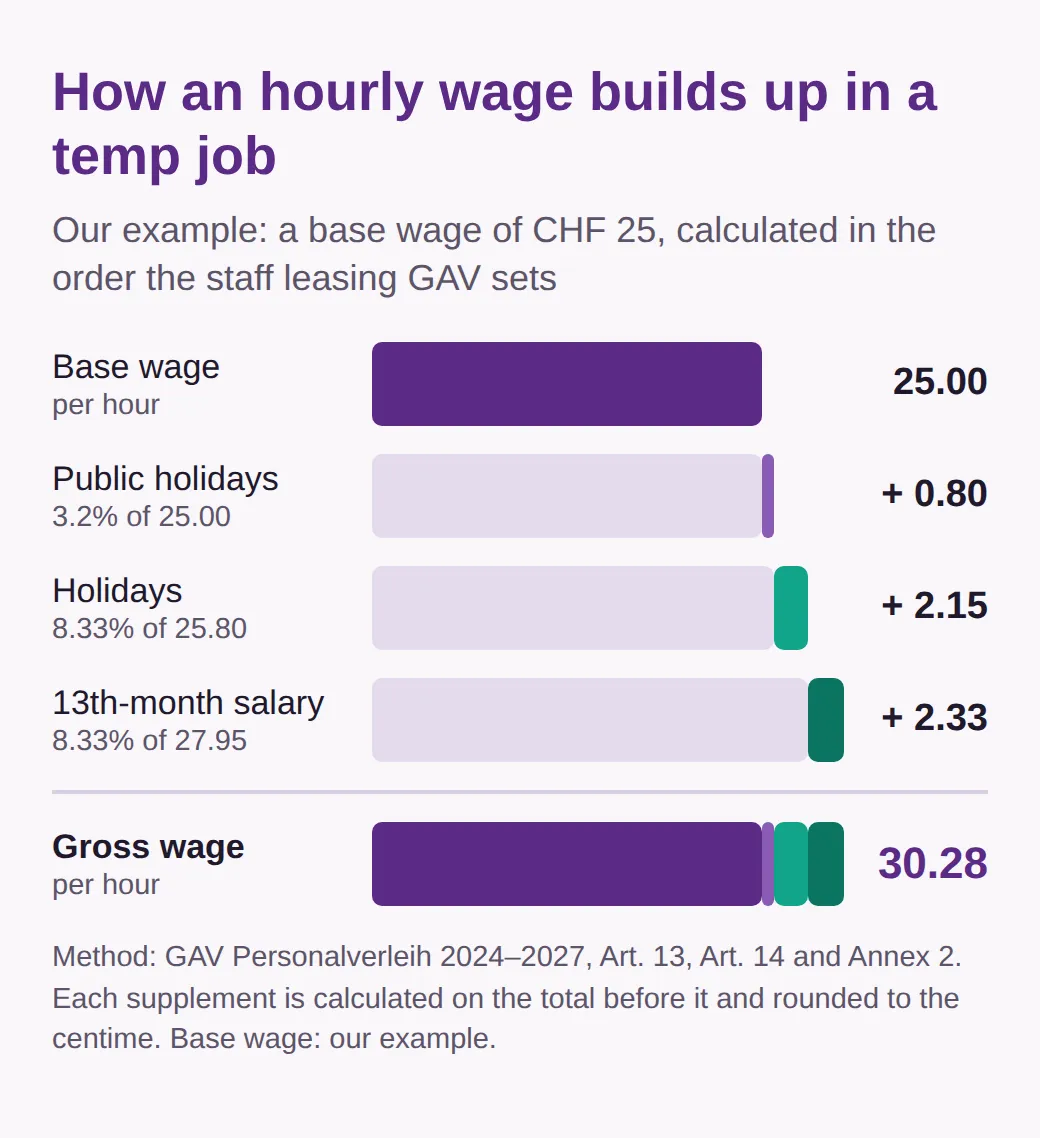
That turns CHF 25 into CHF 30.28 gross an hour. If you only took 8.33% of the base wage, your holiday pay would come to CHF 2.08 instead of CHF 2.15. Over 1,000 hours a year that's a difference of CHF 70, with more on top for public holidays and the 13th-month salary. On short assignments in particular, like jobs over the Christmas season, it's worth checking the sums on your payslip.
Before you file away your next payslip
Put your contract and your latest payslip side by side. Does the contract state a holiday share as a percentage or in francs? Does the payslip show the same share? Does the rate match your age and your GAV, so 10.64% if you're under 20? And are your hours really irregular, or do you work the same shifts every week?
If any answer is no, work out how much holiday pay you're owed for the last five years and write to your employer. If everything is in order, put the supplement into a separate account every month. Then you'll have the money when you take your four weeks off, and you're entitled to those weeks whatever the supplement.
If you'd rather have a job with fixed hours where your pay simply keeps running while you're on holiday, you'll find current part-time jobs all over Switzerland on our board. Ask at the interview how holidays are paid before you sign.
Common questions
- Do I get my holiday days back if I'm sick on holiday?
- Yes, if the illness or accident stops you from resting, as SECO explains. According to Basel-Stadt's Office of Economy and Labour, minor complaints are not enough, and you have to tell your employer straight away. If you already know beforehand that you won't be fit for a holiday, you can ask for it to be moved.
- How much holiday pay do I get if I'm under 20?
- Until your 20th birthday you're entitled to five weeks of holidays, so 10.64% instead of 8.33%. Check on your payslip that the higher rate is actually applied, especially in summer jobs and casual work.
- Do I still have to take holidays if my holiday pay comes with my wage?
- Yes, that's the whole point. The supplement pays for your holidays in advance; it doesn't replace them. Your employer has to give you the weeks off, and at least two of them must be in one block. If you keep working instead, you don't get the rest you need, and the money for your weeks off may already be spent by then.
- Is holiday pay added on top of a monthly salary too?
- Usually not. On a fixed monthly salary, your pay simply keeps running during your holidays, even if you work part-time. The supplement is an exception for jobs where pay for the holiday weeks is hard to work out any other way, which mainly means irregular work paid by the hour.
- What happens to my unused holidays when I resign?
- Whatever you couldn't take by your last working day, your employer must pay out at the end. That's the one moment when holidays are paid out in cash. If you get a 13th-month salary, the pro rata share of it is included. If you had a valid holiday supplement, your holidays are already paid and there's nothing more to pay out.
More posts
All posts
Part-time work and pension funds: the coordination deduction
How much you need to earn part-time to join a Swiss pension fund, what the 2026 coordination deduction costs you, the rules for two jobs and what you can do.

Part-time salary in Switzerland: hours, pay and hourly rate
How to calculate a part-time salary in Switzerland: what 60% or 80% means in hours, how to convert monthly to hourly pay and check an offer with Salarium.

Part-time accident insurance in Switzerland: the 8-hour rule
Under 8 hours a week, your job doesn't cover accidents outside work. How hours are counted, when your health insurer pays and what applies after a job ends.