Christmas Jobs in Switzerland 2026: Pay, Contracts, Sundays

The short answer
Christmas jobs in Switzerland run from November to January, mostly in retail, parcel centres and restaurants, and are usually fixed-term and paid by the hour. The law guarantees you a 50% supplement for up to six Sundays a year, 25% for occasional night work, and holiday pay, which usually comes as a supplement on every hour. It does not guarantee sick pay on contracts this short.
One detail from the calendar is worth knowing early: in 2026, St Stephen's Day falls on a Saturday. In 13 cantons that Saturday therefore counts as a Sunday; in the rest it is an ordinary working day. What that means for your pay is explained further down.
Where extra staff are needed in December
Many Christmas jobs are in three sectors, and each follows its own rules. Which sector you work in decides more about your hours and supplements than the hourly rate in the ad.
Retail
In a shop you work the till, restock shelves, advise customers and wrap gifts, often with long Saturdays and late-night opening. Here the Labour Act matters most: shops may only put staff to work on a few Sundays without a permit. More on that below. Exceptions apply to shops in railway stations and other businesses that an ordinance exempts from the Sunday ban.
Parcel centres and courier services
Parcels are sorted, loaded and delivered, and that runs in shifts, often early in the morning or at night. Here the rules on night work matter more than those on Sundays. If you deliver, also check whether you need your own car and who covers the mileage.
Restaurants and hotels
Christmas dinners, company events and New Year's Eve need extra staff front of house and in the kitchen. Restaurants may have staff work at night and on Sundays without a permit (Art. 23 ArGV 2, explained in SECO's guidance on the Labour Act, in German). On top of that, the hospitality industry's collective labour agreement applies to every employer in the sector: the L-GAV, published in German, French and Italian. For 2026 it sets a minimum wage of CHF 3,713 a month for a full-time job for staff aged 18 and over without a vocational qualification, rising to CHF 3,735 from 2027, and casual staff get it pro rata. If it is in the contract in writing, pay may be up to 8% lower during an induction period. Students over 18 who are enrolled full-time at a Swiss school or university are exempt: the minimum wage does not apply to them, according to the same article.
Whatever the sector, you will almost always sign a fixed-term contract, and that works differently from a normal job.
What a fixed-term contract means
A fixed-term contract ends on the agreed date without anyone having to give notice (Art. 334 CO). That is convenient, but there is a flip side: as a rule, neither side can end it early. If you find a better job in mid-December, you can't simply hand in your notice, unless the contract provides for it, as the federal portal ch.ch points out. You can still end it by mutual agreement, meaning the employer has to say yes. Leaving with immediate effect is only possible for good cause (Art. 337 CO), and the law sets a high bar for that.
A fixed-term contract also has a probation period only if one is agreed. In hospitality, the commentary on the L-GAV says this needs a written agreement.
A written contract is not required (Art. 320 CO). If the job lasts longer than a month, though, the employer must tell you in writing, at the latest one month after you start, who the parties to the contract are, when you started, what your role is, how much you are paid and with which supplements, and how many hours a week you work (Art. 330b CO). For a three-week job, even that duty falls away. So before your first day, ask for a short written confirmation, along these lines:
Hello
Thank you for offering me the job. Could you please confirm the following in writing: the start and end date, the hourly wage and holiday pay, any planned Sunday or night shifts, and roughly how many hours a week I will work.
Kind regards
The reply takes a minute to write and saves you arguments about the final payslip in January.
Through a temp agency
Many Christmas jobs go through temp agencies. In that case the agency is your employer, and the collective labour agreement for staff leasing (GAV Personalverleih) applies, in force across Switzerland since 2012. It sets minimum wages by sector and qualification, which you can look up in tempdata's minimum wage calculator. In return, 0.4% of your pay is deducted as a contribution to the agreement. One advantage: the agreement requires daily sickness benefit insurance. Why that matters on short jobs is explained below.
What a Christmas job pays in francs
Pay is usually by the hour. Holiday pay is added to the base wage, plus statutory supplements depending on when you work. The law gives you at least four weeks of paid holiday a year, five until your 20th birthday (Art. 329a CO). On short, irregular jobs this holiday is usually not given as days off but paid out as a supplement on every hour. With four weeks that is 8.33%, with five weeks 10.64%. The L-GAV recommends this only for short and irregular work and uses 10.65% for five weeks of holiday. Make sure the supplement is shown separately in the contract and on every payslip.
A 13th-month salary is not required by law; you only get one if your contract or a collective agreement provides for it. Hospitality does: if you are paid by the hour, the L-GAV pays it as 8.33% on every hour. If the job is ended during the probation period, you lose this entitlement.
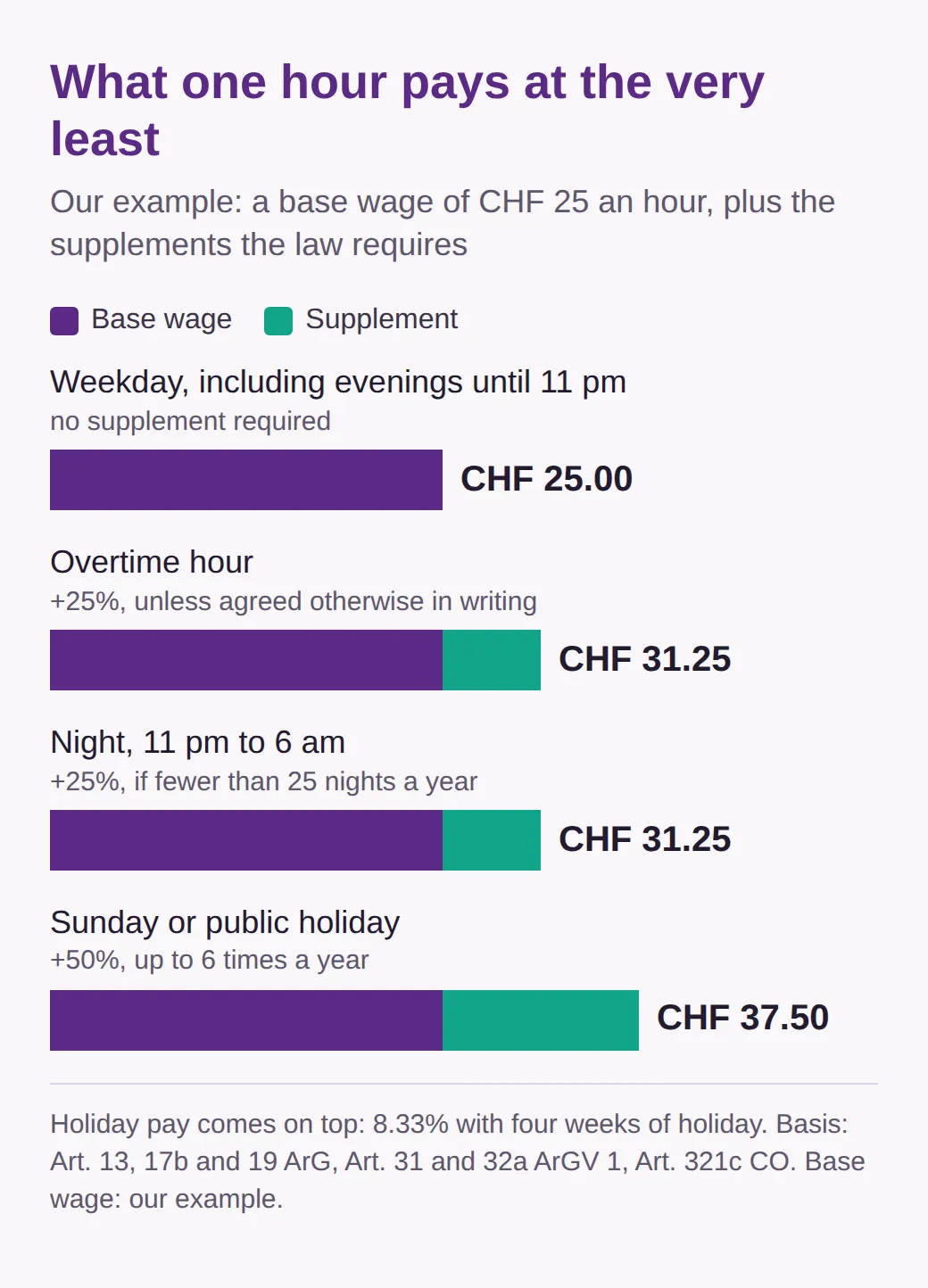
A worked example shows how it adds up. You work in a shop for six weeks, 20 hours a week, at a base wage of CHF 25. That makes 120 hours and CHF 3,000. Two shifts fall on Advent Sundays, six hours each: the 50% supplement adds CHF 150 for those twelve hours. Then there is holiday pay of 8.33% on the base wage, CHF 249.90. That comes to CHF 3,399.90 gross.
Social security contributions come off that, but perhaps less than you think. If your pay from one employer stays at CHF 2,500 or less over the whole calendar year, AHV contributions are deducted only if you ask for it. The exceptions are work in private households and certain arts and media employers, where you always pay. In our example you are above that, so the employer deducts 5.3% for AHV, IV and EO (old-age and survivors', disability and loss-of-earnings insurance) and 1.1% for unemployment insurance, around CHF 218 in total. Because you work at least eight hours a week, the employer also deducts the premium for insurance against accidents outside work. By law you pay that yourself, unless your contract is more generous (Art. 91 UVG, the Accident Insurance Act, in German). You have to pay AHV contributions from 1 January after your 17th birthday.
The biggest supplement comes on Sundays, and that is exactly where the rules are tightest.
Do you have to work on Sundays?
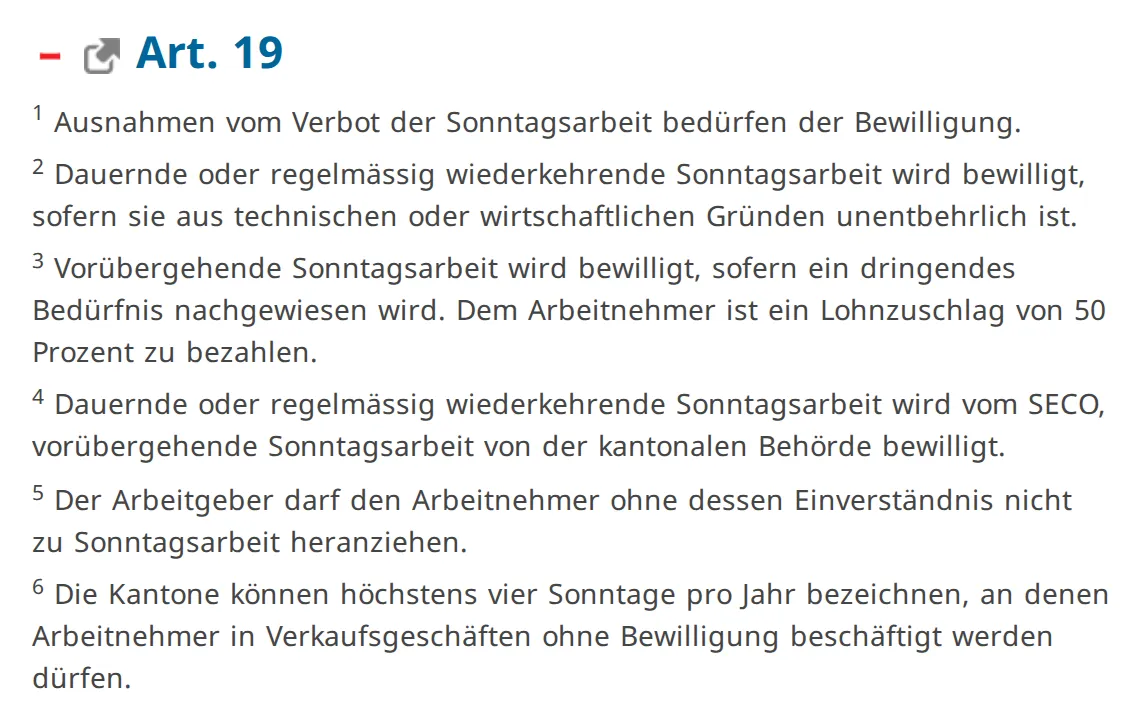
No, not against your will. Your employer may not make you work on a Sunday without your consent (Art. 19 para. 5 ArG, the Labour Act, which is not published in English). But that consent can already be in the contract, SECO writes in its guidance on the Labour Act. If the contract says you will be scheduled on Advent Sundays, you agreed when you signed. So read that line before you sign.
In principle, work is banned from 11 pm on Saturday to 11 pm on Sunday (Art. 18 ArG). For shops there is an exception aimed squarely at Advent: each canton may name up to four Sundays a year on which sales staff may work without a permit. Whether a shop actually opens on those days is a matter for the cantonal shop opening laws. In the canton of Zurich, for example, the municipality allows shops to open on at most four public rest days a year, major holidays such as Christmas excluded (§ 5 Ruhetags- und Ladenöffnungsgesetz). Which Advent Sundays apply where you live is therefore published by your municipality or canton, and the shop can tell you at the interview.
50% more, and a day off
For temporary Sunday work you get a 50% supplement, so 150% of your wage. Temporary means at most six Sundays per calendar year, public holidays included. That is set out in Article 32a of Ordinance 1 to the Labour Act (ArGV 1). According to SECO's guidance the supplement is mandatory, whether you are paid by the hour or by the month. If it only becomes clear during the year that there will be more than six shifts, it is still owed for the first six.
On top of that comes compensatory rest. If you work up to five hours on a Sunday, you must get that time back as time off. If the shift is longer, you are owed a full working day off of at least 24 hours in the week before or after, directly following your daily rest period (Art. 20 ArG). And within every two weeks, at least one whole Sunday must stay free.
In a restaurant, by contrast, Sunday is a normal working day and needs no permit. According to the guidance, all the other rules on Sunday work still apply, compensatory rest for example. If you are under 18, you may generally work neither on Sundays nor at night (Art. 31 ArG). Exceptions are set by an ordinance, mainly in the interest of vocational training.
Night shifts at the parcel centre
Night work normally starts at 11 pm and ends at 6 am. The hours from 8 pm to 11 pm count as evening work, which is allowed without a permit and without a statutory supplement (Art. 10 ArG). Night work also needs your express consent, which, as with Sundays, can be written into the contract.
How you are compensated for nights depends on how many there are. If you work fewer than 25 nights per calendar year, you get a wage supplement of at least 25% (Art. 17b ArG). From 25 nights the work counts as regular, and instead of money you get extra time off: 10% of the time you worked at night. That can apply to a Christmas job. Sorting five nights a week for six weeks adds up to 30 nights. If that is planned from the start, the extra time applies from the first night. If it only becomes clear along the way, the guidance says the employer must switch at the 25th night at the latest, and you keep the supplements for the nights before. If the job ends before you could take the time off, it may be paid out instead, as SECO notes on its page on night and Sunday work (in German). There is no extra time if shifts in the business last seven hours or less on average, breaks included, or if you only work four nights a week.
A night shift may last at most nine hours and, with breaks, must fit within ten hours (Art. 17a ArG). Ten hours of work are only allowed under extra conditions; among other things, you may then work at most three nights out of seven. If your rota shows more, ask.
Christmas, St Stephen's Day, New Year: the 2026 calendar
In 2026, 25 December falls on a Friday, the 26th on a Saturday and New Year's Day on a Friday again. For you as a casual worker this is more than a calendar question, because under the Labour Act public holidays count as Sundays (Art. 20a ArG), and each canton decides which days those are.
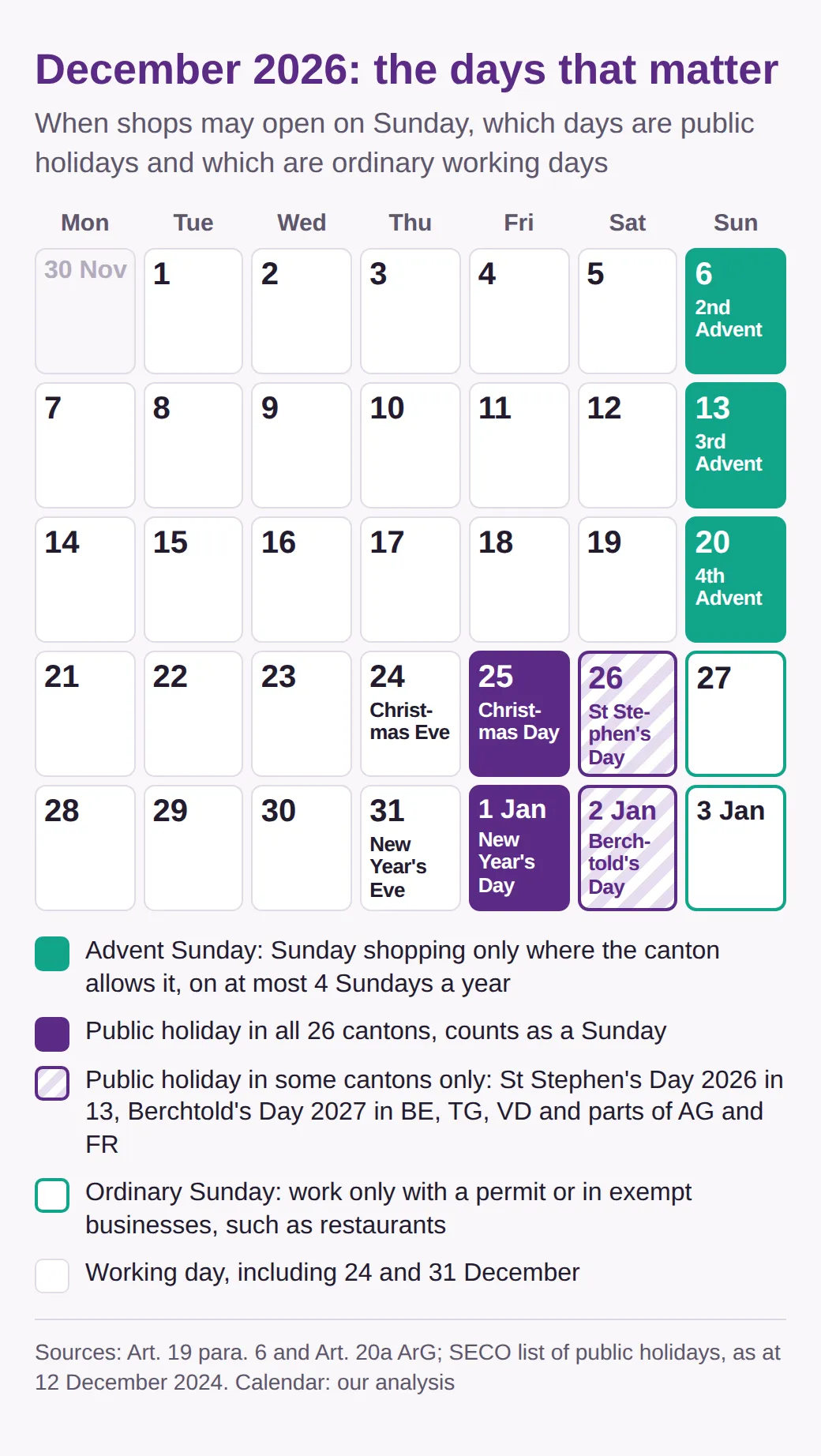
According to SECO's list of public holidays (in German), Christmas Day is a public holiday in all 26 cantons. St Stephen's Day is more complicated. The list shows it in 16 cantons, but three have special rules that apply in 2026: Appenzell Ausserrhoden does not observe it when Christmas falls on a Friday, Appenzell Innerrhoden not when it would otherwise mean three rest days in a row, which Friday, Saturday and Sunday would be, and Neuchâtel only when it falls on a Monday. That leaves 13 cantons where Saturday 26 December counts as a Sunday: Bern, Basel-Landschaft, Basel-Stadt, Glarus, Graubünden, Lucerne, St. Gallen, Schaffhausen, Thurgau, Ticino and Zurich, plus Aargau except the districts of Laufenburg and Muri and some municipalities in the district of Rheinfelden, and Fribourg in its Protestant municipalities. In Geneva, Vaud, Valais or Zug, the 26th is an ordinary Saturday.
If you are paid by the hour, a public holiday often means no pay. SECO states in the same list that federal law does not require pay for public holidays. Only 1 August is paid by law. Whether you get anything for 25 and 26 December and for New Year's Day depends on your contract or a collective agreement. The L-GAV, for example, gives you six paid public holidays a year, for casual staff pro rata as 2.27% on your pay (Art. 18 L-GAV). If you work on a public holiday, the 50% Sunday supplement applies, as long as it is no more than your sixth Sunday or holiday shift of the year.
Christmas Eve and New Year's Eve, on the other hand, are not public holidays in any canton. For the law they are working days like any other.
If you fall ill or get injured
This is the biggest gap in short contracts. Under the Code of Obligations, your employer only owes you pay while you are ill if the employment has lasted more than three months or was agreed for more than three months (Art. 324a CO). A contract from mid-November to the end of December doesn't meet that. Catch flu in week three and you earn nothing for those days, unless something else was agreed.
It's different with a collective agreement that requires daily sickness benefit insurance. In hospitality the employer must take out such insurance, which pays 80% of your wage. During a waiting period of up to 60 days, the employer pays 88% itself (Art. 23 L-GAV). At a temp agency, the staff leasing agreement also requires this insurance. In retail without a collective agreement, only what is in your contract helps. Ask about it before you sign.
As an employee in Switzerland you are always insured against accidents at work (Art. 1a UVG). Against accidents outside work, say skiing on your day off, only if you work at least eight hours a week for that employer (Art. 13 UVV, the Accident Insurance Ordinance, in German). Below that, accidents on the way to and from work also count as work accidents and are covered through your employer. If you work fewer hours, check whether your health insurance policy includes accident cover.
You don't pay into a pension fund on a contract of three months or less (Art. 1j BVV 2, in German). What applies to longer jobs is explained in our post on part-time work and the pension fund.
Before you sign
A Christmas job only lasts a few weeks, and there is no time to renegotiate. So settle five things before you say yes: the end date and whether you can leave earlier; the hourly wage with holiday pay shown separately; whether Sunday or night shifts are planned, and how many; what you are paid on public holidays; and what happens if you fall ill. With those answers in writing, you can check your payslip line by line in January.
You'll find fixed-term jobs, including for the festive season, among our temporary jobs across Switzerland.
Common questions
- Can I get a Christmas job in Switzerland at 15 or 16?
- Yes, from your 15th birthday. Until you turn 16 you may work until 8 pm at the latest, after that until 10 pm. Overtime, meaning work beyond the legal maximum hours, is not allowed before 16. Sunday and night work are generally banned for everyone under 18, with exceptions set out in an ordinance, mainly for apprentices. From 13, younger teenagers may only run errands and do light work under the rules of an ordinance.
- What happens if I keep working after my fixed-term contract ends?
- The fixed-term contract becomes a permanent one. Article 334 paragraph 2 of the Code of Obligations says so when the employment tacitly continues past the end date. From then on notice periods apply, one month to the end of a month in the first year of service. If you only want to stay until mid-January, agree a new end date in writing.
- Do I get a work reference (Arbeitszeugnis) for a short-term job?
- Yes. Under Article 330a of the Code of Obligations you can ask for a reference at any time, even after six weeks. If you only want a confirmation of the type and length of the work, without an assessment, you can ask for that instead. Ask on your last day, while your managers still remember you.
- Do I pay into a pension fund with a Christmas job?
- Not on a fixed-term contract of three months or less. Article 1j of the BVV 2 ordinance exempts such jobs from compulsory occupational pension cover. If the contract is extended past three months without a break, you are insured from the day the extension was agreed, as long as your pay is above the entry threshold.
- Do I have to work until closing time on 24 and 31 December?
- If your rota says so, yes. Christmas Eve and New Year's Eve are not public holidays in any canton, so under the Labour Act they are ordinary working days. Evening work until 11 pm needs no permit and carries no statutory supplement. What you work on those days is set by your contract and your rota.
More posts
All posts
Part-time accident insurance in Switzerland: the 8-hour rule
Under 8 hours a week, your job doesn't cover accidents outside work. How hours are counted, when your health insurer pays and what applies after a job ends.

Job sharing in Switzerland: contract, pay and who offers it
How job sharing works in Switzerland: which contract protects you, what happens if your job-share partner quits, how pay works and who offers it.

Holiday pay on hourly wages in Switzerland: the 8.33% rule
Paid by the hour or part-time in Switzerland? Where 8.33%, 10.64% and 13.04% holiday pay come from, when it may be in your wage and how public holidays work.