Part-time accident insurance in Switzerland: the 8-hour rule

The short answer
If you work fewer than 8 hours a week for an employer, that employer only covers you for accidents at work and on your way to and from work. For accidents in your free time, you need the accident cover in your health insurance. At 8 hours or more, you're also covered outside work and can suspend that cover with your health insurer, which cuts your premium by at most 7%.
That's the rule. In everyday life it's less clear-cut. What applies if you work 2 hours one week and 20 the next? Or if you have two small jobs? And what happens to your cover when the job ends? We go through the questions one by one, with a court ruling that shows how much depends on the way the hours are averaged, and with what to check before the end-of-November deadline for switching health insurer.
What's covered under 8 hours, and what isn't
At work itself you're always covered, however small your workload. Every employee in Switzerland is compulsorily insured under the Accident Insurance Act (UVG) (in German, as Fedlex has no current English version of the laws we cite), and the employer pays the premium for occupational accidents. The 8-hour threshold only affects cover outside work. That's what Article 13 of the Accident Insurance Ordinance (UVV) says: if you work at least eight hours a week for one employer, you're also insured against non-occupational accidents, NBU for short (from the German Nichtberufsunfall).
Below that, there's a small consolation. Accidents on your way to and from work then count as occupational accidents (Art. 7 para. 2 UVG). So if you slip on your way to a shift, your employer's accident insurance pays, even for a job of three hours a week.
| Accident | 8 hrs a week or more | Under 8 hrs a week |
|---|---|---|
| At work, on a break on the premises | Employer's accident insurance | Employer's accident insurance |
| On the way to or from work | Employer's accident insurance | Employer's accident insurance |
| In your free time, playing sport, at home | Employer's accident insurance | Health insurer |
| After your last working day | 31 more days, then interim insurance or health insurer | Health insurer |
The difference is bigger than it looks. Accident insurance under the UVG pays for treatment with no deductible or co-payment, and it pays a daily allowance: 80% of your insured salary from the third day after the accident (Art. 16 and 17 UVG). Your health insurer pays the same benefits for an accident as for an illness (Art. 28 of the Health Insurance Act, KVG). That means you pay your deductible and then a 10% co-payment on the costs, up to CHF 700 a year (Art. 103 of the Health Insurance Ordinance, KVV). Basic health insurance pays no daily allowance for lost earnings.
You can often tell from your payslip whether you're over 8 hours. You pay the premium for non-occupational accidents yourself, and your employer deducts it from your pay, unless your contract offers something better (Art. 91 UVG). If there's an NBU deduction, the company is treating you as insured. That's a good sign, but no proof. The real decision only comes after an accident, and separately for each employer.
Two small jobs don't add up to a big one
The hours from several jobs aren't added together. The ordinance speaks of working time "for one employer", and the Federal Supreme Court has confirmed this, as the Administrative Court of the Canton of Schwyz notes in its 2024 decision. If you work 6 hours in a café and 6 hours for a cleaning company, you're working 12 hours a week and still aren't covered outside work through either employer. For accidents in your free time, that leaves your health insurer.
It's different if one of the jobs reaches the threshold. With 10 hours in the first job and 5 in the second, the first one covers you outside work too. If you have a skiing accident, the insurer of the employer you last worked for while insured against non-occupational accidents pays (Art. 99 UVV). If you're injured at work in the second job, that job's insurer pays.
One detail makes this combination valuable: the daily allowance is based on your pay from all your jobs together, including the one that only covers you at work (Art. 23 para. 5 UVV). If the skiing accident keeps you off work completely, you get 80% of both salaries, not just the larger one. What your employer can say about a second job is covered in our post on second jobs.
That leaves the question of how the 8 hours are counted when every week looks different.
How irregular hours are counted
If your hours vary, the insurer works out an average after the accident, based on the hours you actually worked. The law itself says nothing about this. Insurers rely on Recommendation No. 7/87 of the UVG ad hoc claims committee (Ad-hoc-Kommission Schaden UVG), revised in 2008 and 2019. It isn't binding on the courts. The Federal Supreme Court has still approved it, at the time in its 2008 version, because its criteria are easy to apply. Under the recommendation, you're insured if you work an average of at least 8 hours a week, or if weeks with at least 8 hours are in the majority. This is how it's calculated:
- The insurer looks at the last 3 or the last 12 months before the accident, whichever works out better for you.
- Only full weeks count.
- If you worked in more than half of the weeks in that period, only those weeks count, even a week with a single hour. If the weeks without work are in the majority, the average is taken over all weeks.
- At first, only the hours you worked count. If they aren't enough, days you missed through illness or accident are filled in with your average working time per day. Holidays, public holidays and military service aren't filled in.
Point 3 is the tricky one. In the 2008 version, weeks without work were always left out. Since 2019 they count once they're in the majority, and then the average drops fast. If you work on call or for a seasonal business, you can land right in this zone. A case from the hospitality industry shows how much the result depends on details like these.
The waitress's case: 4.42 or 15.5 hours
A waitress worked at a hotel on an open-ended contract with irregular shifts, some weeks not at all, others up to 29 hours. On 3 September 2023 she tripped while hiking and broke her left wrist. AXA, which insured her employer, refused to pay: on average she had worked less than 8 hours a week, it said, so she wasn't covered outside work. AXA also rejected her objection.
The Administrative Court of the Canton of Schwyz ruled in her favour on 4 December 2024 (decision I 2024 54, in German). Her timesheets weren't disputed. The dispute was only about the arithmetic. In the year before the accident she had worked in 24 weeks and not in 27, for 372 hours in total. Because the weeks without work were in the majority, AXA spread the hours over all 51 weeks under point 3 of the recommendation and arrived at 7.29 hours. Over the last three months it was 53 hours in 12 weeks, or 4.42.
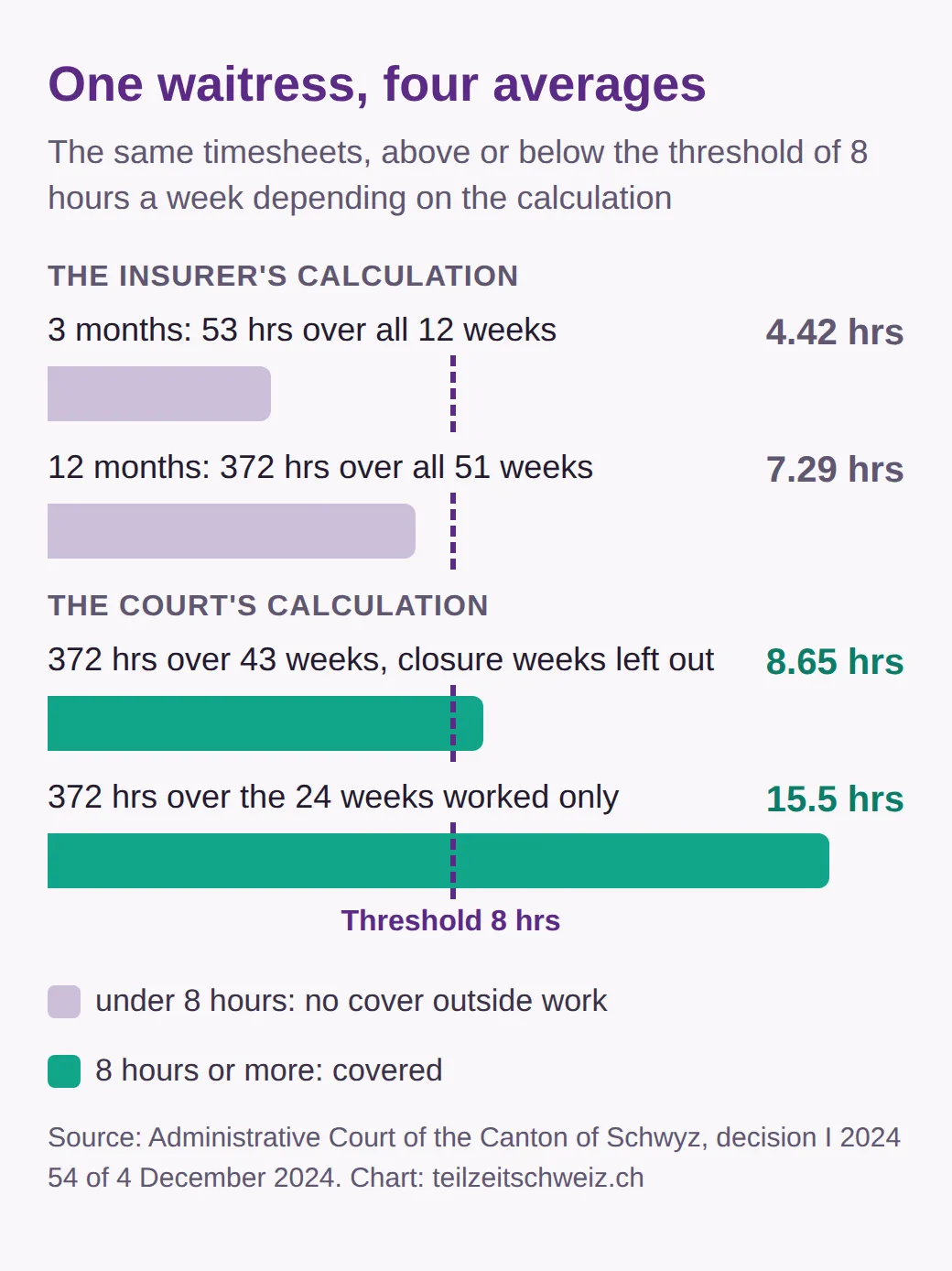
Eight weeks decided the case. The hotel closed between seasons, in the relevant year from 12 to 26 December 2022 and from 13 March to 25 April 2023. Nobody could work during that time. According to the court, such weeks may count neither when comparing weeks with and without work nor in the average, or she would be worse off than staff who can work all year round. That left 43 possible working weeks, and she had worked in 24 of them. The weeks with work were in the majority, so only they counted: 372 hours over 24 weeks makes 15.5 hours a week. Even over all 43 weeks, it would have been 8.65.
AXA had to reassess the case and pay her CHF 1,000 towards her lawyer's costs. There were no court fees. The court expressly left one question open: whether the Federal Supreme Court's leading decision, which was based on the 2008 version of the recommendation, also applies to the stricter 2019 version. It's a cantonal ruling, and other courts may decide differently, but the reasoning is easy to follow and fits any seasonal business.
What to take from it, especially in hospitality
If you work in hospitality or another seasonal business, you could end up in the same position as the woman from Schwyz. So keep your own record of your shifts, with dates and hours, and hold on to the rotas. In her case the hours were documented and undisputed, so the court only had to deal with the arithmetic. Note down when the business is closed, too. If the insurer refuses to pay and you disagree, it has to issue you a formal written decision (Art. 49 ATSG, the Federal Act on the General Part of Social Insurance Law). The woman from Schwyz first got only a letter from AXA and then asked for a formal decision she could challenge. You can lodge an objection to that decision within 30 days, and it costs nothing (Art. 52 ATSG).
And because you never know before an accident how the arithmetic will turn out, the next question follows: what do you do with the accident cover in your health insurance?
Accident cover in your health insurance: keep it or suspend it?
The rule is simple. If an employer insures you fully under the UVG, outside work too, you can have the accident cover in your health insurance suspended, and your premium goes down (Art. 8 KVG). Under 8 hours you're not fully insured, so accident cover stays included in your basic insurance. The Federal Office of Public Health (FOPH) explains both on its page on when accident insurance cover begins and ends.
The Health Insurance Ordinance sets how much the premium goes down: by the share for the accident risk, but by no more than 7%.
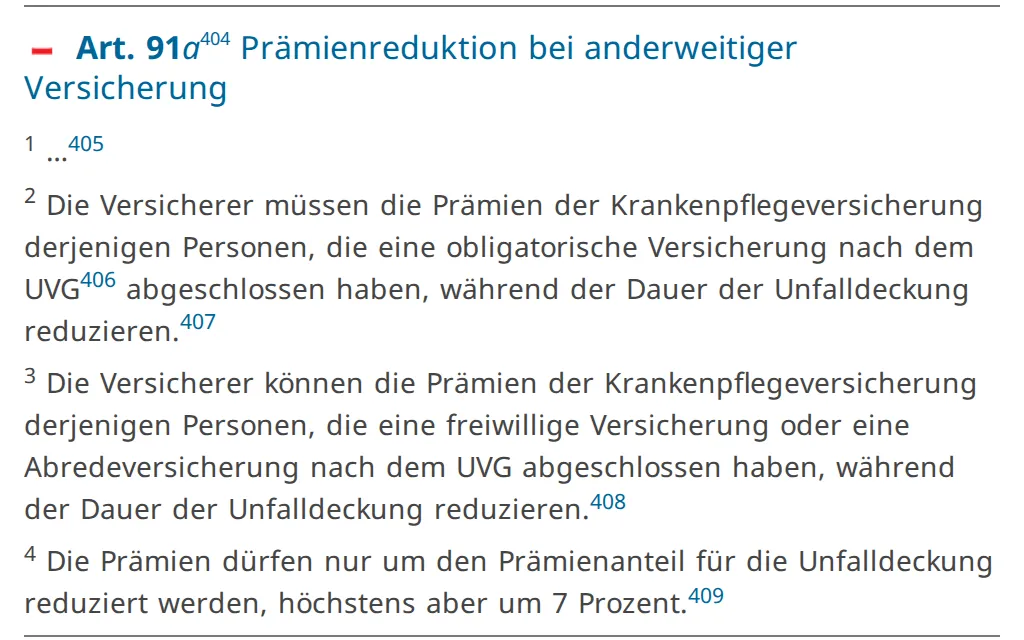
With the average adult premium of CHF 487.60 a month in 2027 (FOPH press release, in German), 7% comes to CHF 34.13 a month, or around CHF 410 a year. Your insurer may deduct less, as the rate is a ceiling. You apply to your health insurer in writing, and the suspension starts on the first day of the following month at the earliest (Art. 11 KVV). You have to show that you're fully insured under the UVG, for example with a confirmation from your employer.
If your hours are close to 8
If you suspend accident cover and it turns out after an accident that you were under 8 hours, you're not left uninsured. The KVG says that accidents are covered by your health insurer again as soon as UVG cover ends in full or in part (Art. 8 para. 2 KVG). Your insurer then pays as it would for an illness, with deductible and co-payment. If you didn't tell it that your UVG cover had ended, it can charge you the premium share for accident cover retroactively, plus default interest, up to the day it finds out (Art. 10 KVG).
So the risk of suspending isn't suddenly finding yourself without cover. At worst it's a back payment, plus what your health insurer doesn't pay but UVG insurance would: the deductible, the co-payment and the daily allowance. If you have a steady 8 hours or more, suspending clearly pays off. If your hours hover around the threshold, work them out with the four rules above. If you're only just over, you're better off keeping accident cover and paying the premium share as a safety net.
Before 30 November: what to check when you switch health insurer
If you want to switch health insurer for 2027, your notice must reach your current insurer by 30 November at the latest. The postmark isn't enough: the federal premium portal priminfo (in German) recommends sending your notice by registered post by 15 November. The deadline applies because insurers notify you of your new premium, and you can then switch at the end of the year with one month's notice (Art. 7 para. 2 KVG).
For accident cover, that means two things. First, compare like with like. A premium without accident cover looks cheaper than one with it, even if that insurer is actually more expensive. Second, tell the new insurer what's right for you. If you work under 8 hours, accident cover belongs in the new policy. If you have a job of 8 hours or more, you can leave it out from the start.
The suspension itself doesn't depend on the November deadline. You can ask your current insurer for it in writing at any time, and it then applies from the following month at the earliest. If your cover through work ends, your health insurer's accident cover applies again automatically, but you still have to tell it. If your workload has changed, send your insurer a short message along these lines:
Dear Sir or Madam,
Since [date] I have been working [hours] hours a week for [employer], where I am also insured against non-occupational accidents. Please find my employer's confirmation attached. I would like to suspend the accident cover in my basic insurance from the earliest possible date and have my premium adjusted.
Kind regards, [name], insurance number [number]
The same message works the other way round, asking to include accident cover again, if you drop below 8 hours. You have to report it when the job ends at the latest.
When the job ends: 31 days and interim accident insurance
At 8 hours a week or more, your cover for accidents outside work runs on for 31 days after the job ends. The period starts on the last day you were entitled to at least half your pay (Art. 3 para. 2 UVG). This also applies during long unpaid leave. Under 8 hours, there's no such extension. According to the FOPH, your cover then ends as soon as you've completed your journey home on your last working day.
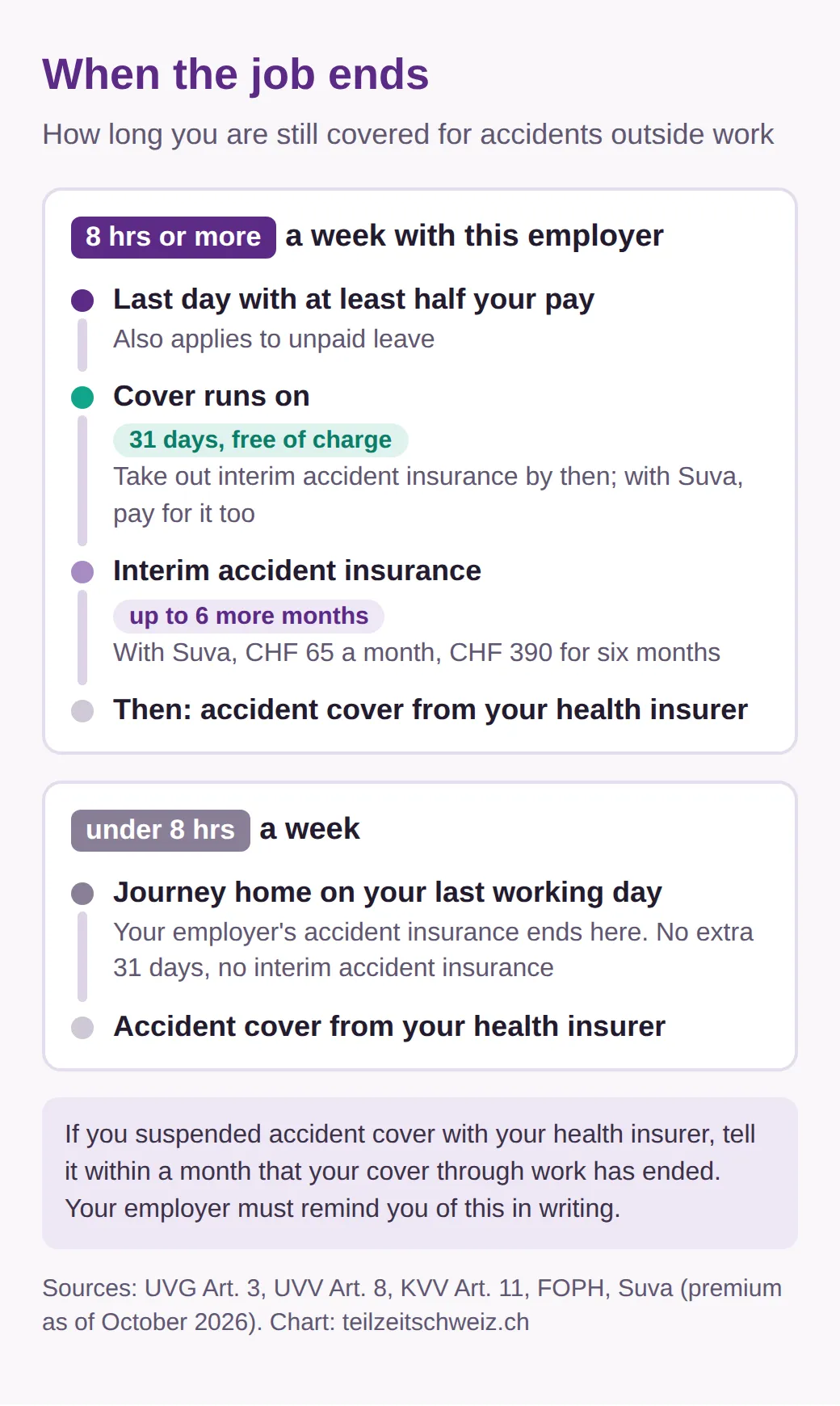
Within those 31 days, you can extend your cover by up to six months with interim accident insurance (Abredeversicherung). Every accident insurer has to offer it (Art. 3 para. 3 UVG), and you take it out with the insurer your employer used. The deadline is strict: the insurance has to be agreed before your cover runs out (Art. 8 UVV). With Suva, it also has to be paid by then. After that, it's too late.
Suva publishes its terms. You can take it out if you've worked at least 8 hours a week for a company insured with Suva. One month costs CHF 65, six months CHF 390. The minimum term is one month, and you can extend it month by month up to six months, but you can't cancel it, and premiums you've paid aren't refunded. The cover also applies abroad, with no deductible or co-payment, and a daily allowance is possible. If your employer was with a private insurer, ask them for the price. HR will know the insurer's name.
Whether it's worth it depends on the gap. If you start a new job in six weeks, one month of interim insurance bridges the time after the 31 days with the better cover, especially if you travel or do sport in between. If you need cover for longer than six months, Suva itself recommends adding accident cover to your health insurance. And if you're entitled to unemployment benefit, you're insured against accidents with Suva anyway.
If you've suspended accident cover with your health insurer, don't forget to tell it. Before the job ends, your employer has to inform you in writing that you must report the end of your accident cover to your health insurer. From that notice, you have one month (Art. 11 para. 2 KVV). If you miss it, you're still covered, but your insurer can charge you the premium for accident cover retroactively, with interest.
What you can do now
Put your latest payslip next to your health insurance policy. If you work a steady 8 hours or more for one employer and accident cover is still included in your policy, you're paying for accident cover twice: through the NBU deduction on your pay and through your health insurance premium. Then the message to your insurer above is worth sending. If you're under 8 hours, accident cover belongs in your policy, including any new offer for 2027. And when a job ends, put the 31st day in your calendar straight away.
If you're looking for a job with more hours, so that your work covers you outside work too, you'll find new part-time jobs across Switzerland all the time. In the interview, ask how many hours you're guaranteed and whether the business closes for part of the year.
Common questions
- Can my employer deduct non-occupational accident insurance (NBU) if I work under 8 hours?
- No. You only pay the premium for non-occupational accidents if that job also covers you for accidents outside work. Under 8 hours a week it doesn't, so there's no deduction for it either. If your payslip still shows an NBU deduction, ask about it: either the company is counting on more hours, or it's deducting the premium wrongly.
- Am I covered for accidents during unpaid leave?
- For 31 days, yes, provided you work at least 8 hours a week. The period runs from the last day you received at least half your pay. If your leave lasts longer, you can extend your cover with interim accident insurance from your employer's insurer, which you have to take out before the 31 days are up. With Suva, you also have to have paid for it by then.
- Who do I report an accident outside work to?
- If your job covers you for accidents outside work, tell your employer or its accident insurer straight away about any accident that needs medical treatment or keeps you off work. If you work under 8 hours a week, your health insurer is responsible for accidents outside work. Tell your employer anyway if you can't work.
- Does the 8-hour rule apply to apprentices and interns?
- Yes. Apprentices, interns and trainees are compulsorily insured against accidents like all employees, and the same threshold of 8 hours a week applies to a small workload. So if you're doing a full-time internship, you're automatically covered outside work too.
More posts
All posts
Job sharing in Switzerland: contract, pay and who offers it
How job sharing works in Switzerland: which contract protects you, what happens if your job-share partner quits, how pay works and who offers it.

Part-time salary in Switzerland: hours, pay and hourly rate
How to calculate a part-time salary in Switzerland: what 60% or 80% means in hours, how to convert monthly to hourly pay and check an offer with Salarium.

Second job in Switzerland 2026: what your employer can ban
Second job in Switzerland: when your employer can say no, the working-time limits for both jobs together, and what changes for AHV and tax.