On-call work: what Switzerland's Federal Supreme Court says

The short answer
On-call work is allowed in Switzerland. What matters is whether you can turn down an assignment. If you can't, it's genuine on-call work: your employer must also pay for the time you spend waiting and may not suddenly stop calling you in. If it does, it owes you pay at your previous average until the end of your notice period.
Plenty of people are affected. According to the Federal Statistical Office, 8.1% of employees (excluding apprentices) worked on call in 2025, women more often at 9.4% than men at 6.9%. Among 15- to 24-year-olds the figure was 13.7%, and among people working past retirement age 23.9%. Even so, the term doesn't appear anywhere in the Code of Obligations. The rules come from the rulings of the Federal Supreme Court, and we go through them here case by case: a security guard whose assignments dried up, a psychotherapist who got no new patients after complaining about her pay, and a company hiring out healthcare staff that a court provisionally barred from using contracts that pay too little, or nothing, for on-call time.
Is on-call work legal in Switzerland?
Yes. The Federal Supreme Court decided this in 1998 in the case of a labourer at a steel-fixing firm (BGE 124 III 249). The court publishes its rulings in the language of each case, so the ones we link are in German or French. The labourer had argued that a contract without fixed hours was invalid, because working time had to be determinable. The court disagreed: the law does not rule out flexible working hours as such. Arrangements where each assignment is agreed by both sides are allowed, and so are ones where the employer can call you in unilaterally.
That's not a free pass. On-call work must comply with the mandatory rules of employment contract law, the ones that even a signed contract cannot override (BGE 125 III 65). And a collective labour agreement (GAV, short for Gesamtarbeitsvertrag) can set tighter limits. In the labourer's case, the national collective agreement for the construction industry didn't ban on-call work. But its minimum wages only covered the work itself, not the time he spent waiting for an assignment. That time therefore had to be paid separately. Whether and how long he had actually waited was left for the cantonal court to establish afterwards.
Which rules apply to you comes down to a single distinction.
Genuine or non-genuine on-call work
With genuine on-call work (echte Arbeit auf Abruf), you have to turn up when your employer calls you. With non-genuine on-call work (unechte Arbeit auf Abruf), you can say no: an assignment only comes about if you both agree. That's how the Federal Supreme Court sums it up in ruling 4A_509/2009. Often a framework contract then sets the terms such as pay, holidays and notice, and each assignment is a small contract of its own.
Ordinary part-time work is something else again. The law speaks of part-time work when you commit to working regularly by the hour, the half day or the day (Article 319 paragraph 2 of the Code of Obligations, CO, in German). If your hours are set in advance, even irregular ones, you're not working on call.
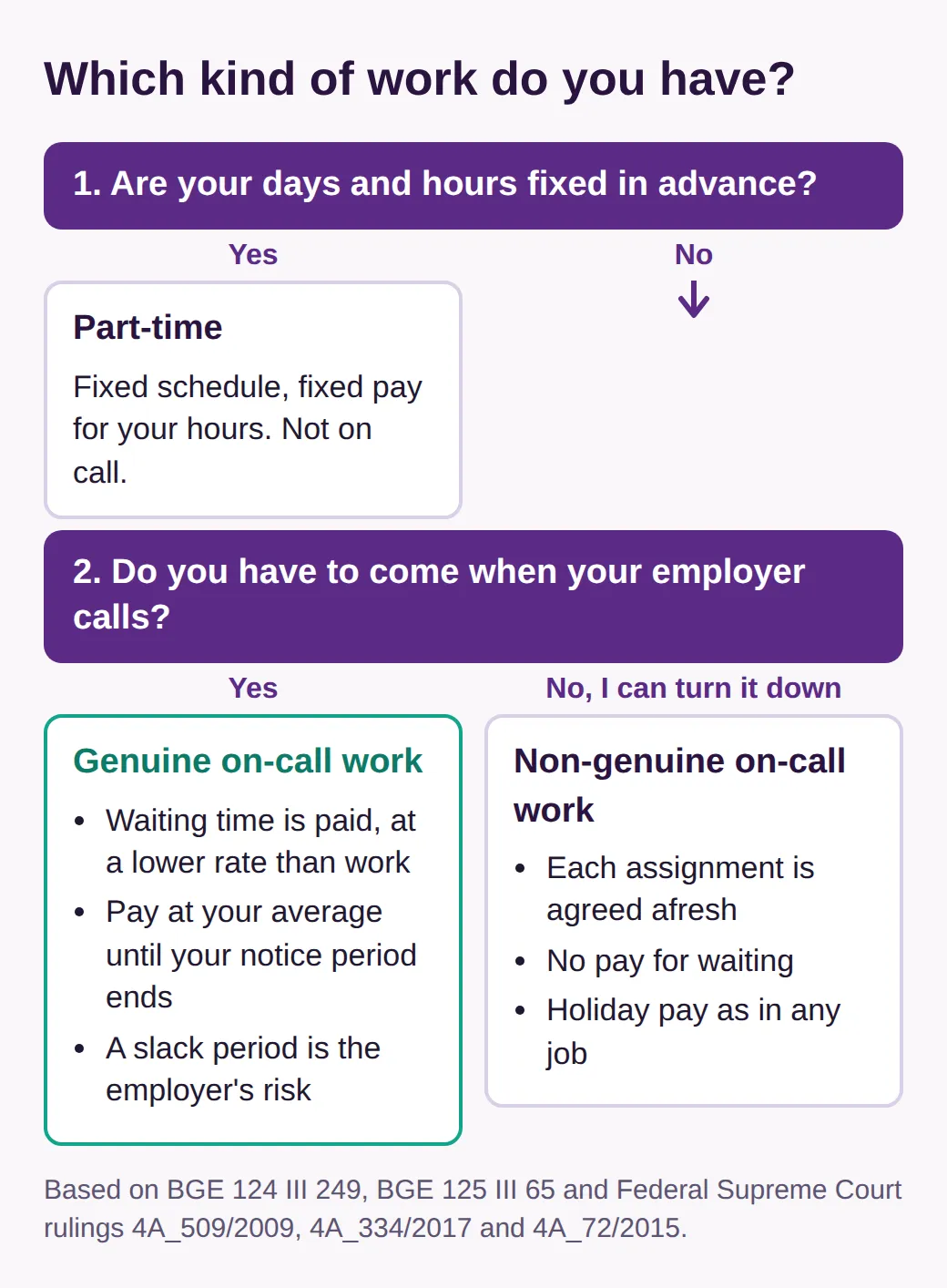
The case of a teacher in Lucerne shows how much hangs on this distinction. She taught at a private business school for over nine years without a break, for CHF 47 an hour. Her teaching load was agreed afresh before each school year. For 2008/2009 she first offered 15 to 18 lessons, then cut that to about 10 because she could work more for a municipality. The school then didn't give her any lessons at all that year. Her claim for CHF 25,740 failed. Someone who freely decides how many hours to offer can't demand that the school accept every offer, the Federal Supreme Court held. This was non-genuine on-call work, and the school had not been in default.
What's on paper isn't the only thing that counts, though. A telephone operator in the canton of Lucerne only had an oral agreement. From July 2013 she got no more work and no more pay. The company argued it was non-genuine on-call work with no entitlement to a set number of hours. The cantonal court accepted the operator's account that eight hours a day, Monday to Friday, had been agreed, and awarded her the CHF 16,684.65 she had claimed. The Federal Supreme Court declined to hear the company's appeal (4A_414/2016). In another case, the contract said "Part time on demand (20-30 %)". The Federal Supreme Court sent the case back, because it first had to be established whether genuine or non-genuine on-call work was meant (4A_334/2017).
So what counts is how you actually work together, and what you can prove. With genuine on-call work, the first question is the waiting.
Does your employer have to pay for waiting time?
Yes, if it's genuine on-call work. If you wait for work at your workplace, that's normal working time and is paid like work, unless something else has been agreed. If you wait at home, it's called on-call time (Rufbereitschaft). That's work too, because your being available benefits the employer. But on-call time may be paid at a lower rate than the work itself, since you can partly use the time for yourself. Both points come from the 1998 ruling on the labourer.
If neither your contract nor the GAV says how much you get, your employer owes you what is customary (Article 322 CO). If that can't be established, the court decides on the basis of equity, meaning what is fair in the individual case. The pay for on-call time may be included in your hourly wage. But a GAV minimum wage that only covers the work can't also cover the waiting time.
How much being available restricts you only affects the amount, not your entitlement. The Federal Supreme Court made this clear in 2017 in the case of the "on demand" part-time contract: a slight restriction should be reflected in the amount, but doesn't remove the duty to pay. With non-genuine on-call work, on the other hand, there's nothing for waiting, because you don't have to be available at all.
There's no percentage set by law. Two figures from court cases give you an idea.
In October 2025, the High Court of the canton of Zug provisionally barred a company that hires out healthcare professionals from concluding assignment contracts for genuine on-call work from 1 January 2026 that pay less than 10% of the gross hourly wage for on-call time. A competitor had sued for unfair competition. Before the Federal Supreme Court, the company said that from 2026 it would therefore have to pay its temporary staff this 10% or give them another right to refuse after every booking. In March 2026 the Federal Supreme Court declined to hear its appeal (4A_592/2025). The ban isn't final: it's a provisional measure, and the case itself will only be decided by a court in ordinary proceedings.
The second figure concerns a coach driver who waited for his passengers at their destination, sometimes for several hours. The Federal Supreme Court found it reasonable that 20% of this waiting time was counted as working time (4C.407/1999). He was, however, free to spend the time as he liked and didn't have to expect to be called on at any moment.
A ruling from August 2026 shows how far working time can reach (4A_50/2026). A domestic worker in the canton of Vaud looked after two small children, cooked and cleaned. She was on duty from 7 am to 7.30 pm, with a 45-minute lunch break, and often had quiet hours in the afternoon. Because she never knew in advance what would come up, all of her time on duty counted as working time, whether she had to step in or not. The employers have to pay her for those hours after the fact.
The bigger bills, though, usually come when the calls stop altogether.
What if your employer stops calling you in?
Then your employer still has to pay you. Article 324 CO says: if the employer doesn't accept your work, it must pay your wage anyway, and you don't have to make up the hours. Lawyers call this default of acceptance. The risk of there being too little work lies with the employer. A contract may not depart from this to your disadvantage (Article 362 CO), and while you're employed and for one month after, you can't validly waive this pay either (Article 341 CO).
The Federal Supreme Court made the landmark decision on this in December 1998, in the case of a security guard. He had worked for a security company since September 1994, at first on the side, around 26 hours a month. When he lost his main job as a sales assistant, the company became his most important employer. In 1996 he worked an average of 157 hours a month, because the company was guarding a large building site. Then the building site was finished.
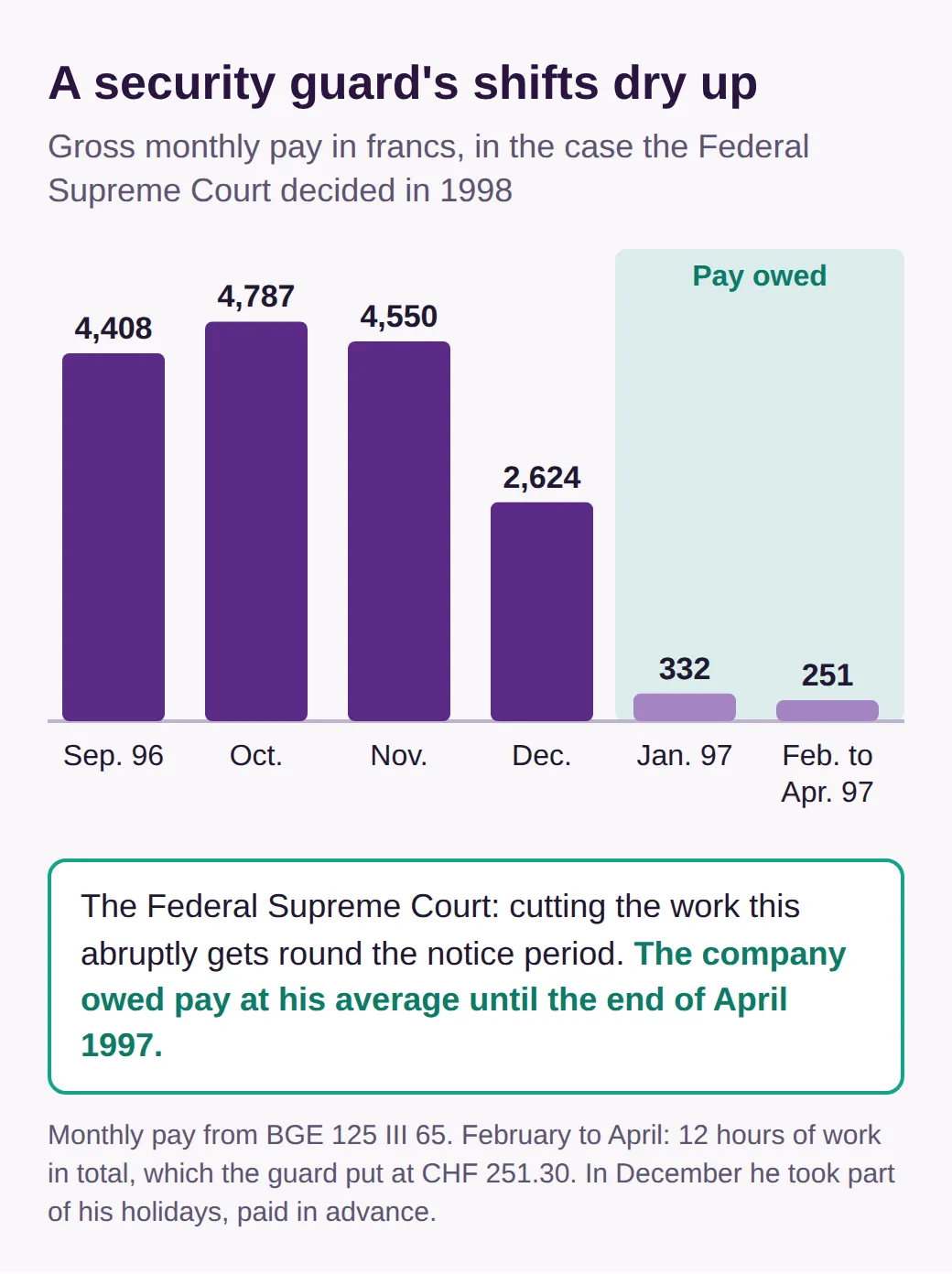
In January 1997 his pay dropped to CHF 332.10. The company sent him to the unemployment insurance fund, but it paid nothing, because he hadn't been dismissed. Notice only came on 26 February, effective at the end of April. The Fribourg cantonal court found that he had known the risk and that the company had never guaranteed him a minimum number of hours. The Federal Supreme Court overturned that judgment. Cutting assignments this abruptly defeats the purpose of the notice period, which is to let you look for a new job without your income collapsing. If the company had no more work, it should have given notice in December for the end of February. As it was, it owed him pay until the end of April, calculated on his average over a fairly chosen period.
Your average as the yardstick
The law doesn't specify a period. As a guide, the Federal Supreme Court referred to the rules of unemployment insurance. Today these use the average of the last six months of contributions, or of the last twelve if that is higher (Article 37 of the Unemployment Insurance Ordinance, in German). The same case shows how much depends on that choice. The first court had based its calculation on 1995 and 1996, including the months when the guard only worked on the side. That gave it just under CHF 2,000 a month, and it awarded him CHF 7,631.70 for the four months, after deducting his January pay. Taking only September to November 1996, his average was CHF 4,582. So keep a record of which months were typical for your job.
A case from Vaud shows that the reason for the slack period makes no difference (4A_89/2022). A psychotherapist worked at a group practice from August 2017 for CHF 80 an hour, and under her contract her workload depended on the practice's needs. After she and others had queried their payslips, she got no new patients from February 2018. In June the doctor gave her notice for the end of September. The therapist took her average from September to December 2017, CHF 7,914.30 a month, multiplied it by 14 months and deducted what she had received. The courts awarded her the difference of CHF 24,941.20, plus CHF 5,057.80 for unfair dismissal. The Federal Supreme Court confirmed this in 2022: an employer may not set the length and pay of the work unilaterally according to its own needs, and whether it has economic or other reasons makes no difference.
How to offer your work
You're entitled to pay for default of acceptance if you "properly offer" your work, according to the Federal Supreme Court (BGE 124 III 346). Do it in writing as soon as your assignments fall well below your average, and keep a copy. Something like this:
Dear Sir or Madam,
Over the past few months I have worked an average of around [hours] hours a month. Since [month] I have been given considerably fewer assignments. I remain willing to work to the same extent as before and hereby expressly offer my work. I am claiming my wages for the lost hours under Article 324 CO.
Kind regards, [name]
You have time: wage claims only become time-barred after five years (Article 128 CO). If it comes to a dispute, there are no court costs for claims of up to CHF 30,000, neither at the conciliation stage (Article 113 of the Civil Procedure Code, CPC) nor in court (Article 114 CPC). Lawyers' fees are another matter. Before it gets that far, it often helps if your assignments are fixed in good time.
How much notice of a shift does your employer have to give?
As a rule, two weeks. That's what Article 69 of Ordinance 1 to the Labour Act (ArGV 1, in German) requires: employees must be consulted on work schedules and changes to them, and informed as early as possible, as a rule two weeks before an assignment with new working hours.
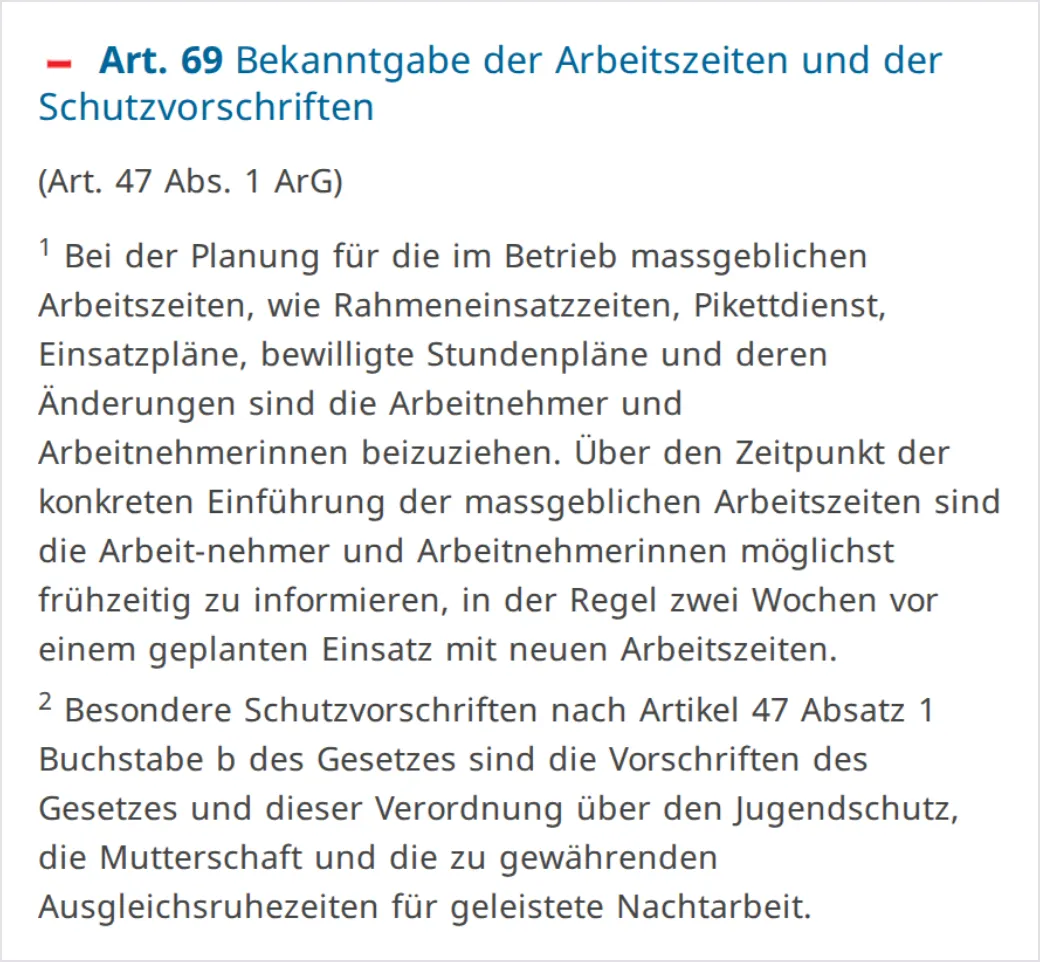
In its guidance on Article 69 (in German), the State Secretariat for Economic Affairs (SECO) explains what the notice period is for: you should be able to plan your time between family, work and leisure. It may not be shortened without a compelling reason. Short notice is only possible for compelling reasons, for example when overtime becomes necessary in an urgent case. Under this rule, a call to come in tomorrow morning is the exception, not the norm.
The catch: the Labour Act doesn't apply everywhere. It doesn't apply to private households, farms or federal, cantonal and municipal administrations, among others (Article 2 of the Labour Act, in German), nor to teachers at private schools (Article 3). There, what counts is your contract, the GAV or public staff regulations. And with non-genuine on-call work you have a simple answer to short-notice requests anyway: you say no.
Holidays and sick pay on an on-call contract
You're entitled to holidays on call too. On an hourly wage they're often paid as a supplement, and strict formal rules apply to that. A flight simulator pilot who worked on a non-genuine on-call basis for almost five years won his case before the Federal Supreme Court (4A_72/2015). The holiday share was in his contract, but not on his individual payslips. That meant the company could be ordered to pay his holiday pay retroactively. We explain how the supplement is calculated in our post on holiday pay on hourly wages.
If you fall ill or have an accident, your employer continues to pay your wage for a limited time, provided the employment has lasted more than three months or was entered into for more than three months (Article 324a CO). That applies to on-call work too. The law doesn't say how much pay your sick days are worth if your hours vary. Ask your employer how it calculates this and whether it has taken out daily sickness benefits insurance.
Unemployment insurance: only temporary cover
On an on-call contract, unemployment insurance only pays for a while. As a rule, it only counts lost hours if normal working hours had been agreed. There's an exception if your assignments stayed roughly the same over a longer period. If you lose a permanent job and then bridge the gap with on-call work, unemployment insurance can count the hours you're missing compared with your previous job. In 2020, however, the Federal Supreme Court limited this to the first two-year benefit period (BGE 146 V 112). If you keep working on call after that, it no longer pays for the fluctuating hours. In the security guard's case in 1997, the fund had already refused earlier, because his contract was still running. He had to get the missing pay from his employer.
That makes it all the more important to know what's in the contract before you start.
Before you sign an on-call contract
On-call work can be a good fit, as a side job, while studying or after retirement. To make sure it doesn't become a trap, read the contract with these questions in mind:
- Can you turn assignments down? That decides everything else.
- Is a minimum number of hours guaranteed, and how many?
- Is on-call time paid, and how much? A separate amount on your payslip is clearer than "included in your wage".
- How much notice do you get of assignments? Two weeks is the rule under the Labour Act.
- Is the holiday supplement shown on every payslip?
If the job is permanent or lasts more than a month, your employer must inform you in writing of your pay and weekly working hours no later than one month after you start (Article 330b CO). Also note down every call-out, every period of waiting and every cancellation, with the date. In the cases above, the people who won were the ones who could prove their hours. A painter in Geneva, on the other hand, gave contradictory accounts of the days he had worked. So the courts relied only on his payslips, and by those he had already received more than he was owed (4A_534/2017).
And if you realise you'd rather work hours you can plan: a set number of hours on fixed days isn't on-call work. We list current part-time jobs all over Switzerland, and if you'd like to share a demanding role with someone, our post on job sharing shows another route to fixed, reduced hours.
Common questions
- What's the difference between on-call work and standby duty?
- Standby duty comes on top of your normal work, for example to fix faults or help in emergencies. Ordinance 1 to the Labour Act allows it on at most seven days in four weeks, with exceptions up to 14 days. If you're on standby away from your workplace, only the time you're actually called out, plus your travel there and back, counts as working time. With on-call work, by contrast, the waiting is the heart of the job.
- Does the two-week notice rule apply to domestic workers?
- No. The Labour Act and its ordinances don't apply to private households, so neither does the rule on giving notice of your hours. The Code of Obligations does apply, though. In 2026 the Federal Supreme Court confirmed that a domestic worker's time on duty counts as working time if she doesn't know which tasks will come up.
- How long do I have to claim unpaid wages in Switzerland?
- Wage claims from employment become time-barred after five years. While you're employed and for one month after the job ends, you can't validly waive wages you're entitled to by mandatory law, not even by signing something. In disputes worth up to CHF 30,000 there are no court costs, neither at the conciliation stage nor in court.
- Does my employer have to tell me my working hours in writing?
- Yes, if the job is permanent or lasts more than a month. No later than one month after you start, your employer must inform you in writing of your role, your pay and your weekly working hours, and must also tell you about any changes in writing. On an on-call contract, that's a good reason to ask for the agreed rules in black and white.
More posts
All posts
Part-time salary in Switzerland: hours, pay and hourly rate
How to calculate a part-time salary in Switzerland: what 60% or 80% means in hours, how to convert monthly to hourly pay and check an offer with Salarium.

Part-time accident insurance in Switzerland: the 8-hour rule
Under 8 hours a week, your job doesn't cover accidents outside work. How hours are counted, when your health insurer pays and what applies after a job ends.

Second job in Switzerland 2026: what your employer can ban
Second job in Switzerland: when your employer can say no, the working-time limits for both jobs together, and what changes for AHV and tax.