Part-time salary in Switzerland: hours, pay and hourly rate

The quick maths
You can work out your part-time salary in three steps. Your workload percentage times your employer's full working week gives your hours, and in Switzerland that week averages 41.6 hours, not 40. To get the hourly rate, divide the monthly salary by your weekly hours times 52 divided by 12. And an hourly wage only compares fairly once holidays, public holidays and any 13th-month salary are built into it.
Many part-time salary calculators online come from Germany. They assume a 40-hour week and use German taxes and deductions. We use Swiss figures instead: the working hours the Federal Statistical Office (FSO) records for each industry, the conversion the canton of Basel-Stadt sets out for its minimum wage, and the two federal salary calculators you can use to check an offer.
What 60% or 80% means in hours
Your workload is a share of your employer's full week, not of 40 hours. How long that full week is depends on the company: it's set in your contract, in the staff regulations or through a collective employment agreement (GAV, short for Gesamtarbeitsvertrag). Across all industries, it came to 41.64 hours in 2025, or about 41 hours and 39 minutes. That's in the FSO's statistics on normal working hours in companies (the table itself is in German and French).
The gap between industries is almost three hours. The full week is long in hotels, at 42.67 hours, in land transport and in restaurants, and it reaches 43.27 hours in agriculture and forestry. It's short in the pharmaceutical industry and in electronics and watchmaking, at just under 40.5 hours. So in the industries in the chart, a 60% workload means between 24.3 and 25.6 hours a week.
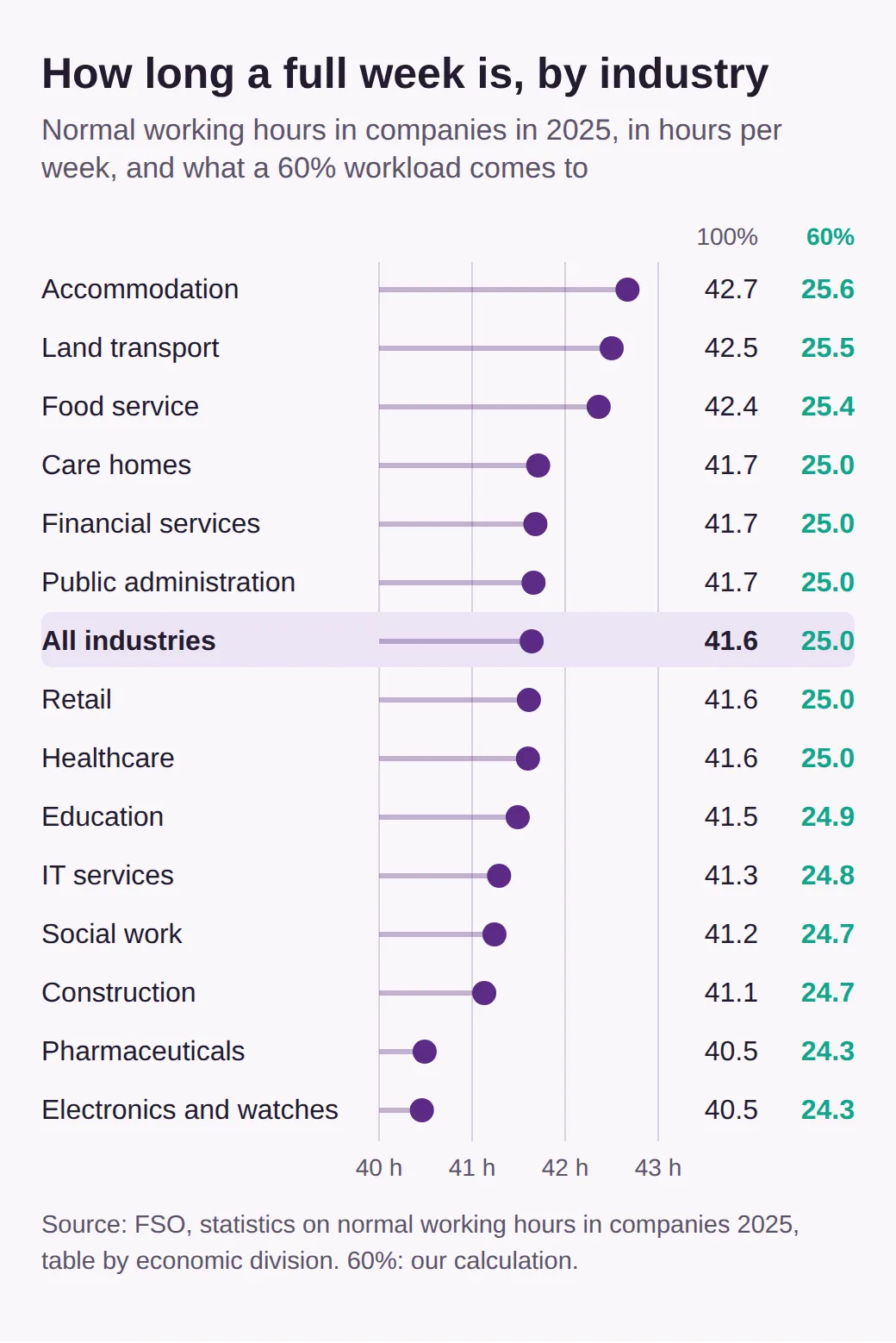
The Labour Act sets an upper limit. For office staff, technical staff, employees in industrial companies and sales staff in large retail businesses, the maximum working week is 45 hours, and for everyone else it's 50 (Art. 9 ArG, in German). A full week of 42.5 hours is therefore allowed, and if you work 60% of it, you work an hour and a half more than you would with a 40-hour week.
So always ask about the hours, not just the percentage. If the job lasts more than a month, your employer has to tell you the weekly hours and the salary in writing anyway, no later than one month after you start (Art. 330b of the Code of Obligations, CO, in German). The table shows what a workload means with three different full weeks:
| Workload | 40-hour week | 41.6-hour week | 42.5-hour week |
|---|---|---|---|
| 20% | 8 h | 8.3 h | 8.5 h |
| 40% | 16 h | 16.7 h | 17 h |
| 50% | 20 h | 20.8 h | 21.3 h |
| 60% | 24 h | 25 h | 25.5 h |
| 80% | 32 h | 33.3 h | 34 h |
How you spread the hours, over three full days or five mornings, doesn't change your pay. It does decide how many days of holiday you get and whether a public holiday does you any good. If your hours change from week to week, different rules apply, which we explain in our post on on-call work. Once you know your hours, you can turn to the pay.
From a full-time to a part-time salary
Your part-time salary is the full-time salary times your workload. A job that pays CHF 6,000 a month at 100% pays CHF 3,600 at 60%. But that only holds as long as both figures are based on the same full week. If you change employer, the same percentage can mean more or fewer hours, and then your pay per hour is different too.
Salary statistics assume a 100% workload. The median salary of CHF 7,024 that the FSO reports for 2024 (in German) applies to a full-time job. If you want to compare your part-time salary with a figure like that, divide it by your workload first.
Then there's the 13th-month salary. The Code of Obligations doesn't require one. What you're owed is the pay that was agreed, is customary or is set by a GAV (Art. 322 CO), and a 13th-month salary is part of it if that's what you agreed. It's common all the same: according to the FSO, three out of four employees got one in 2024, 75.9% to be exact. So when you compare two offers, always work with the annual salary. CHF 3,600 times 13 is CHF 46,800, while CHF 3,800 times 12 is only CHF 45,600.
To get to an hourly wage, you need one more conversion, and that's where the most common mistake happens.
How do I convert a monthly salary into an hourly wage?
Divide the monthly salary by the hours you work in an average month, which you get from your weekly hours times 52 divided by 12. That's exactly how the canton of Basel-Stadt puts it in its answers on the cantonal minimum wage (in German). The office also works through an example: 42 hours a week are 2,184 hours a year and 182 hours a month. A monthly salary of CHF 4,100 therefore comes to CHF 22.53 an hour.
The mistake is to count four weeks per month. A year has 52 weeks, so a month has 4.33 on average. If you count four weeks, your hourly wage comes out a good 8% higher than it really is. For our example of 60% in a company with a 42-hour week and a monthly salary of CHF 3,600, the calculation goes like this:
- Weekly hours: 60% of 42 is 25.2 hours.
- Hours per month: 25.2 × 52 ÷ 12 is 109.2 hours.
- Hourly wage: 3,600 ÷ 109.2 is CHF 32.97.
The length of the full week feeds straight through. The same monthly salary of CHF 4,000 gives CHF 23.08 an hour with a 40-hour week, but only CHF 21.72 with 42.5 hours. That's just under 6% less for the same figure in your contract.
If there's a 13th-month salary, you count 13 monthly salaries instead of 12. CHF 3,600 then becomes CHF 35.71 an hour: 3,600 × 13 ÷ 12 ÷ 109.2. You get the same result by dividing the annual salary by the annual hours, so 46,800 by 25.2 × 52.
The other way round: from hourly wage to monthly salary
To go the other way, multiply the hourly wage by your weekly hours times 52 divided by 12. At CHF 28 and 24 hours a week, that's CHF 2,912 a month. The catch: this only works if the CHF 28 is a base wage, meaning it doesn't yet include a supplement for holidays or public holidays. If supplements are already in it, take them out first. The next section shows why.
Why an hourly wage has to include more
A monthly salary is still paid when you're on holiday or a public holiday falls on one of your working days. An hourly wage only pays the hours you work. For the two to be worth the same, the hourly wage has to pay for your days off as well. Basel-Stadt states this explicitly for its minimum wage: holidays and public holidays are included in a monthly salary, while with an hourly wage the supplements come on top. Geneva says the same on its page on the minimum wage (in French): «Pour le personnel payé à l'heure, les indemnités pour vacances et jours fériés s'ajoutent au salaire minimum», meaning that for staff paid by the hour, the allowances for holidays and public holidays are added to the minimum wage.
The overview shows which supplements these are:
| What | Supplement | When |
|---|---|---|
| Holidays, 4 weeks | 8.33% | always |
| Holidays, 5 weeks | 10.64% | until your 20th birthday |
| 1 August | 0.39% | required by law |
| Other public holidays | e.g. 3.2% | only under your contract or a GAV |
| 13th-month salary | 8.33% | if agreed |
Holidays are compulsory. For your holidays, your employer owes you your full pay (Art. 329d CO), and on an hourly wage that's 8.33% for four weeks. Whether this supplement may already be included in the hourly wage is strictly regulated; we cover that in our post on holiday pay for part-time and hourly work. Only one public holiday is paid by law, 1 August, for which Basel-Stadt sets 0.39%. An hourly wage only pays you for other public holidays if your contract or a GAV provides for it. The collective employment agreement for staff leasing (GAV Personalverleih, in German) allows a flat rate of 3.2% for this in its Article 14.
This GAV also adds the supplements in a fixed order, each on top of the total before it: public holidays first, then holidays, then the 13th-month salary. In its Annex 2, a base wage of CHF 20.55 becomes CHF 24.89 an hour this way.
A comparison shows how much this matters. Offer A is our example from above: 60%, CHF 3,600 a month, paid 13 times. Offer B pays CHF 34 an hour for the same 25.2 hours, "holidays included". B looks better, because CHF 34 is more than CHF 32.97. But it actually pays a good deal less.
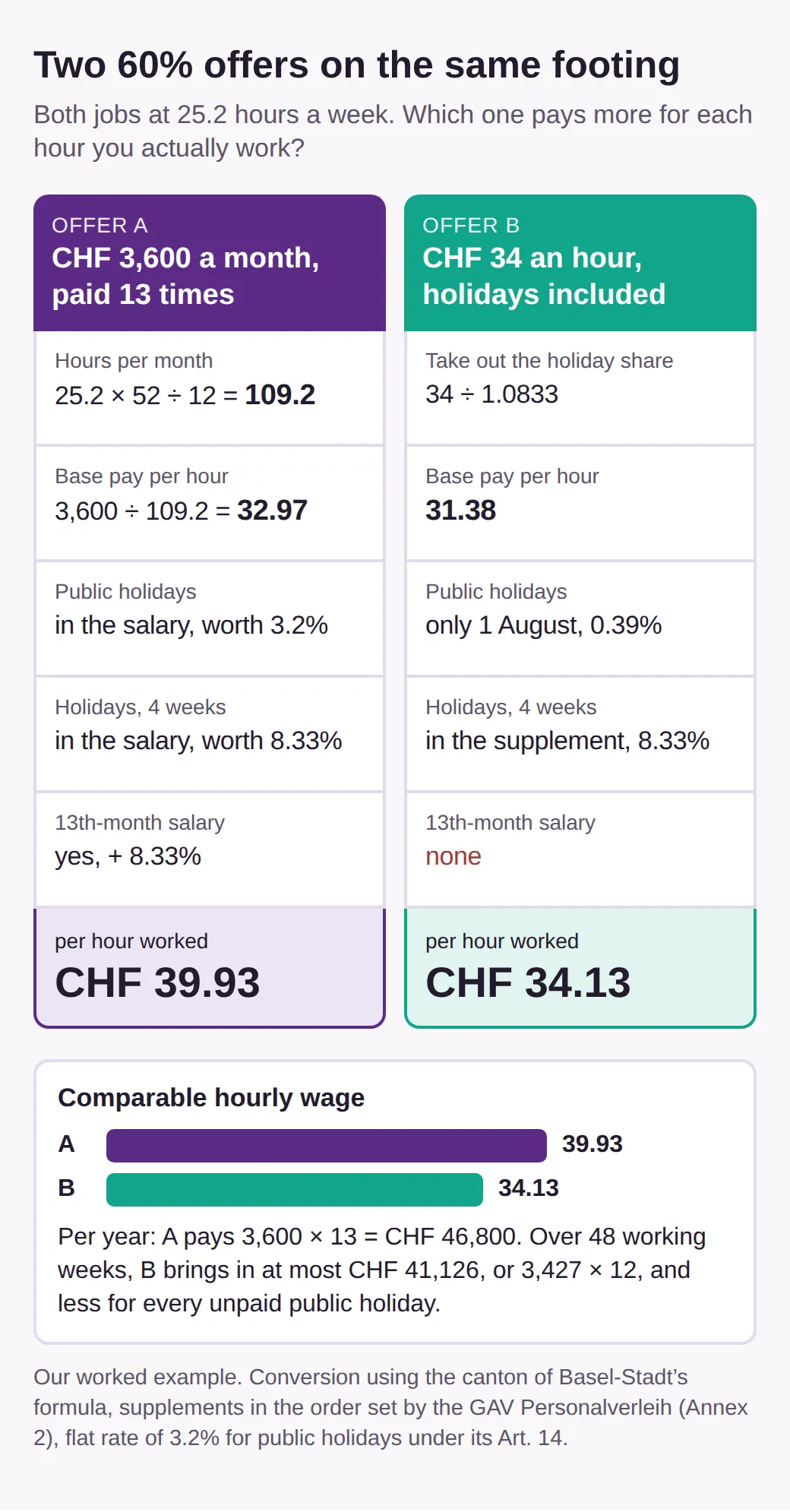
Put on the same footing, meaning francs per hour actually worked, A pays CHF 39.93 and B pays CHF 34.13. For A, we valued public holidays at the flat rate of the GAV Personalverleih. How many public holidays a monthly salary really pays you for depends on your canton and your working days. It makes little difference to the result: even with no public holidays at all, A would come to CHF 38.69.
Over a year, A pays CHF 46,800. With 48 working weeks, B brings in at most CHF 41,126, and less for every public holiday on which you would otherwise have worked. So when you weigh an hourly offer against a job with a monthly salary, always ask which supplements are included in the figure, and have them listed one by one. Basel-Stadt even explicitly advises employers against agreeing an all-in wage («Totallohn»), because they risk having to pay the supplements a second time in court.
Whether the figure you end up with is in line with the market is a separate question. That's what the federal calculators are for.
Checking an offer with the federal salary calculators
Two federal calculators use the Swiss Earnings Structure Survey (ESS) to estimate what people with your profile earn. What matters for part-time work: in both, you enter your weekly hours. Salarium then shows the monthly salary for exactly those hours, not for a full-time job.
The better known of the two is the FSO's Salarium. It's based on the 2024 ESS, covering 1.7 million private-sector employees, and estimates pay with a model of 14 characteristics, including industry, region, occupation, age, education, weekly hours and sex. What you get is a gross monthly salary: the median, plus the limits below and above which a quarter of salaries fall. One sentence in the help text is crucial for comparisons: if the 13th salary is selected, one twelfth of it is included in the monthly salary shown, and for the annual salary you multiply by 12.
Here's an example. A sales assistant who has completed her retail apprenticeship gets an offer in Zurich for 60% in a shop with a 41-hour week: CHF 2,800, paid 13 times. In Salarium she picks retail trade, Zurich and the occupation "retail trade saleswoman", which the calculator assigns to the sales workers group. She leaves the other fields on their default values and sets the weekly hours to 24.6, which is 60% of 41.
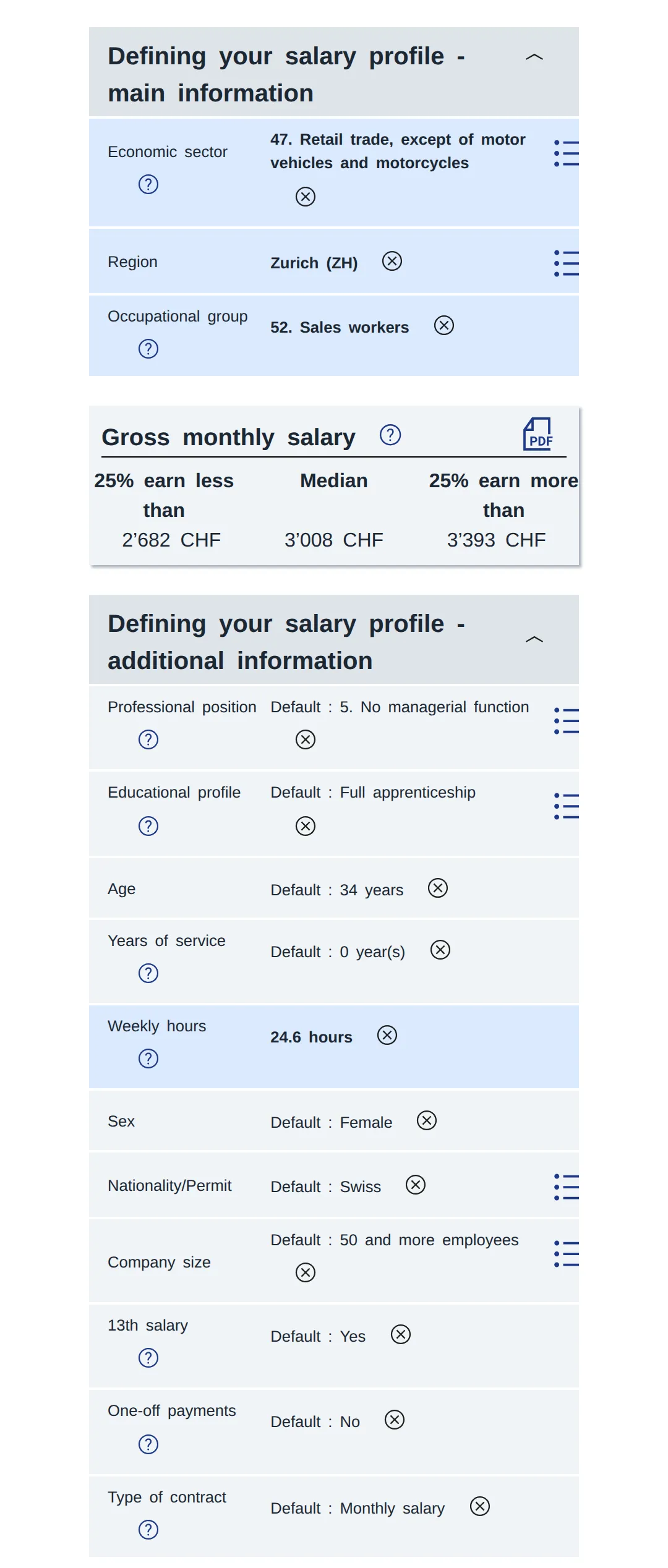
Salarium shows a median of CHF 3,008, and CHF 2,800 looks low next to it. But the offer is paid 13 times, and Salarium spreads the 13th salary over twelve months. Compared correctly, it's 2,800 × 13 ÷ 12, or CHF 3,033. That puts the offer just above the median, right in the middle of the range from CHF 2,682 to CHF 3,393. So for Salarium, always use your annual salary divided by 12.
Two things stand out when you work with the calculator. It doesn't scale strictly in proportion: at 41 hours it shows CHF 4,926 for the same profile, and 60% of that would be CHF 2,956, yet for 24.6 hours it estimates CHF 3,008. So enter your real hours rather than converting a full-time figure. And the result remains an estimate from a model. The FSO itself says on its page about Salarium that the figures are not salary recommendations.
The second calculator is the national wage calculator from the State Secretariat for Economic Affairs (SECO). It was built for the accompanying measures, to show foreign companies that send staff to work in Switzerland the wages that are customary here. It's still based on the 2022 ESS, deliberately leaves out sex and nationality, and shows figures by canton. A wage range only appears when at least 10 companies and 150 salaries are behind it. Because the models differ, the two calculators come up with different figures. If your offer falls in the bottom quarter in both, that's a good reason to ask questions.
If a GAV that's been declared generally binding covers your industry, your pay must not fall below its minimum wage, whatever the statistics say. SECO's minimum wage calculator shows which GAV or standard employment contract applies to an activity at a given place of work. It's meant for companies posting workers to Switzerland, but the minimum wages it lists also apply to Swiss businesses covered by the agreement. Some cantons also have their own minimum wage; in Basel-Stadt, it has been CHF 22.20 an hour as a base wage since January 2026, or CHF 24.14 with the supplements for holidays and 1 August. Once you have your figure, what's left is the contract.
What your contract should say
For the calculation to still hold after you've signed, your contract needs four details: your workload, the full working week it refers to, the salary, and whether there's a 13th-month salary. If you're paid by the hour, add the supplements for holidays and public holidays, each listed separately, as a percentage or in francs.
Your weekly hours also count for overtime. If you work more than agreed, that's overtime, even if you stay well below a full week. It's compensated with time off of at least the same length if you agree. Otherwise it's paid with a supplement of at least 25%, unless you've agreed something else in writing or a GAV says otherwise (Art. 321c CO).
If any of these details is missing, ask before you sign. A short email will do, something like this:
Hello,
Thank you for the offer. So that I can assess it properly, could you give me three details? How many hours make up a full week at your company, and how many hours is that at a workload of [workload] percent? Is the salary paid 12 or 13 times a year? And if the job is paid by the hour: which supplements for holidays and public holidays are included in the hourly wage, and at what rate?
Kind regards, [Name]
Before you sign
Bring every offer down to two figures: the hours per week and the pay per hour actually worked, with all supplements. Then a 60% job with 13 monthly salaries and an hourly job with a holiday supplement can really be compared. Check the result against Salarium, using your real weekly hours and your annual salary divided by 12.
Think about what doesn't appear on your payslip too. A lower workload can mean you drop out of the pension fund or have only a small part of your salary insured; our post on part-time work and pension funds explains how that works. And if you're looking right now, you'll find new part-time jobs across Switzerland all the time. In the first interview, ask how many hours a full week has before you talk about percentages.
Common questions
- How much of my part-time salary will I take home?
- From your gross salary, 5.3% goes to AHV, IV and EO (old-age, disability and loss-of-earnings insurance) and 1.1% to unemployment insurance, which is your half of the 2.2% contribution. If you work at least 8 hours a week for one employer, you're also insured against accidents outside work. By law you pay that premium yourself and it's deducted from your wage, unless your employer covers it. If your salary is high enough, pension fund contributions come on top. Only your first payslip shows the exact amount.
- How many days of holiday do I get if I work 60%?
- You get as many weeks of holiday as you would full-time: at least four, or five until your 20th birthday. If you work three days a week, four weeks come to 12 days off. The canton of Basel-Stadt works it through for 40% on two days of 8 hours each: 8 days of holiday, or 64 hours.
- How do I convert an annual salary into an hourly rate?
- Divide the annual salary by your weekly hours times 52. With CHF 46,800 and 25.2 hours a week, that's 46,800 divided by 1,310.4, or CHF 35.71. That's your pay per paid hour, with holidays and public holidays already counted in. To compare it with an hourly wage that pays holidays separately, you still have to spread it over the hours you actually work.
- Why do part-time salary calculators from Germany give different numbers?
- They often assume a 40-hour week and use German taxes and social security deductions. In Switzerland, a full week averages almost 42 hours, and the deductions are different. For your gross salary, you don't need a calculator: your workload, the weekly hours and the formula times 52 divided by 12 are enough.
More posts
All posts
Part-time accident insurance in Switzerland: the 8-hour rule
Under 8 hours a week, your job doesn't cover accidents outside work. How hours are counted, when your health insurer pays and what applies after a job ends.

Second job in Switzerland 2026: what your employer can ban
Second job in Switzerland: when your employer can say no, the working-time limits for both jobs together, and what changes for AHV and tax.

Part-time after maternity leave in Switzerland: how to ask
No right to part-time after birth in Switzerland, except for federal staff. How to negotiate and what 16 weeks' job protection and paid breastfeeding bring.