Second job in Switzerland 2026: what your employer can ban

The answer first
There's no general ban. Your employer can only stop you from taking a second job if it competes with them, if your work suffers, or if it damages their reputation. Your contract can require you to report a second job or to get approval for it. And where the Labour Act applies, both jobs count together: 45 or 50 hours a week at most, and 11 hours of rest in a row.
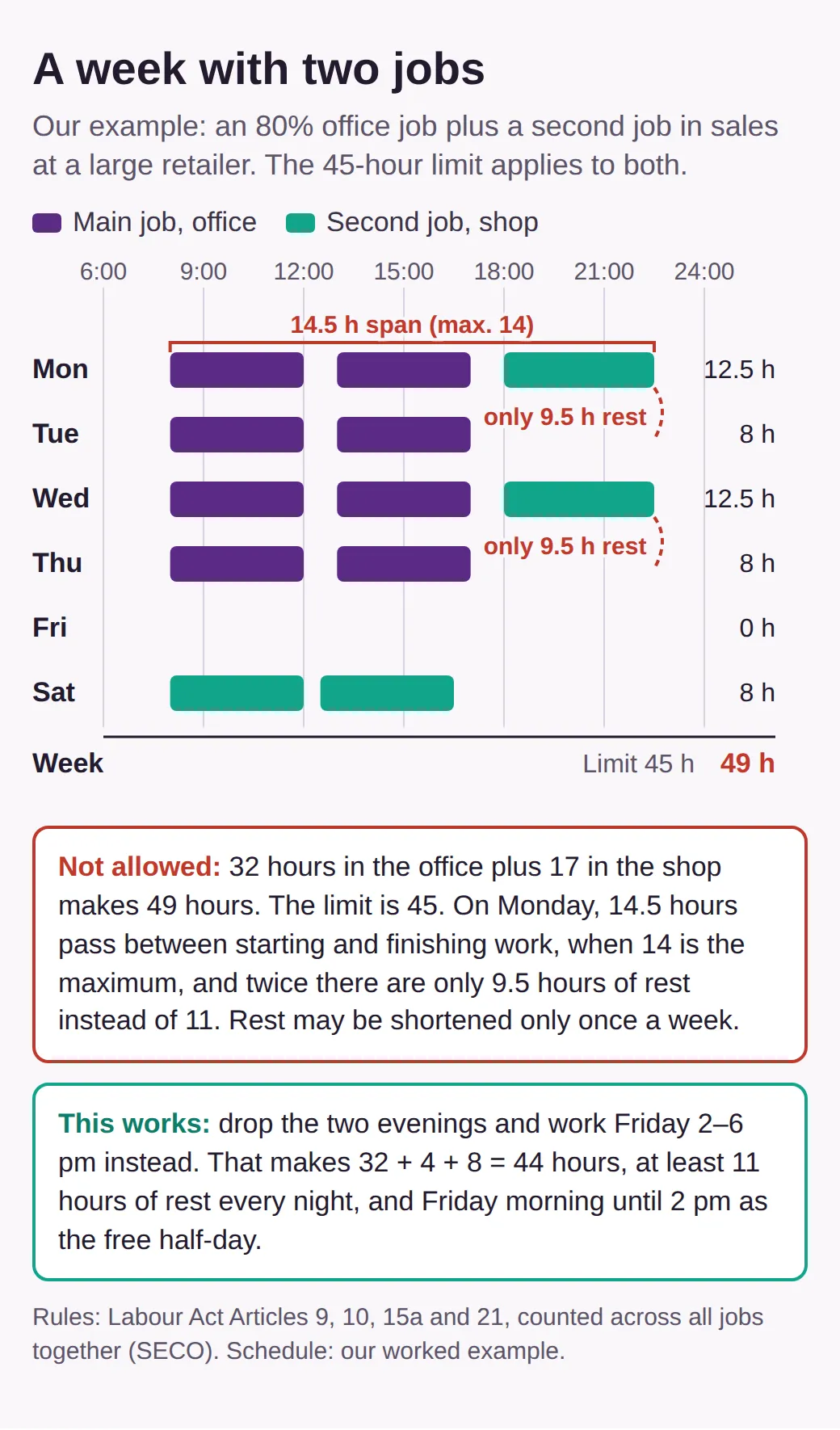
Two rulings of the Federal Supreme Court show exactly where the line runs. And further down, we work through an example of how quickly an ordinary week with two jobs gets too full.
Can your employer ban a second job?
Only if the second job breaches your duty of loyalty. That's the duty to protect your employer's legitimate interests for as long as you work for them. Article 321a of the Code of Obligations (CO; the law texts we link are in German) says that, in the words of the official English translation, an employee "must not perform any paid work for third parties in breach of his duty of loyalty, in particular if such work is in competition with his employer".
In practice, that means three things. First, no competing: if you work for a hairdresser, you don't cut the same clients' hair privately at the weekend. Second, your work mustn't suffer. If you work nights in a bar and fall asleep at your desk the next morning, you're breaching your duty of loyalty, even though the bar isn't a competitor. Third, a second job that harms your employer's reputation can become a problem, because the first paragraph of Article 321a requires you to loyally safeguard their legitimate interests. Since that paragraph always applies, even unpaid work can become an issue if it takes so much out of you that your main job suffers.
Everything else is, in principle, none of your employer's business. And it affects a lot of people: in 2025, 377,000 people in work in Switzerland had more than one job, 8.1% of everyone employed (excluding apprentices), according to the Federal Statistical Office (FSO). In 1991 it was 4.1%. Women hold several jobs almost twice as often as men, and the most likely to do so are women aged 40 to 64.
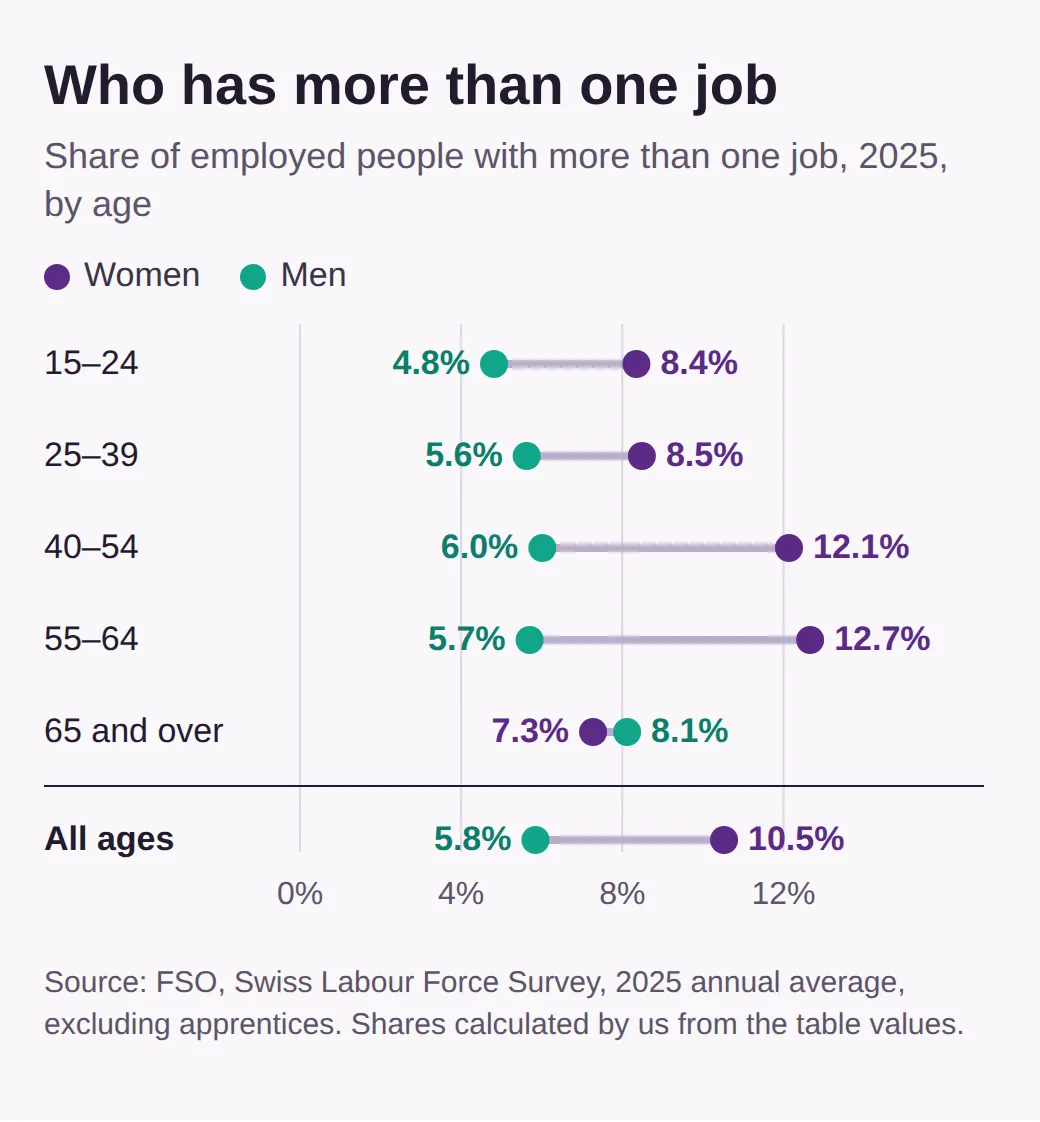
Whether a particular second job is allowed, though, often depends not on the law alone but on what you signed.
What your contract can say
More than many people think. The rule in Article 321a isn't mandatory: it appears in neither of the two lists of provisions that a contract may not depart from (Articles 361 and 362 CO). So an employment contract, staff regulations or a collective labour agreement (GAV, short for Gesamtarbeitsvertrag) can be stricter than the law.
Two forms are common. A duty to report means you tell your employer what you do on the side and how much of it. An approval requirement goes further: you need their consent before you start. Both are allowed. The employers' association Swissmem writes in its guidance for member companies (in German) that side jobs can't be banned as such, but that clauses requiring approval are entirely permissible.
What about a contract that bans every second job even though you only work 50%? We haven't found a Federal Supreme Court ruling that expressly struck down such a clause in a part-time job. Only the direction is clear: your employer pays you for half the week, and the smaller your workload, the harder it is to justify an interest in the rest of your time. Before you build a dispute on this question, a conversation and a written go-ahead are almost always the better route.
Things get tighter with on-call work. If you have to come in whenever your employer calls, your time is already spoken for, and a second job is hard to fit in on a fixed schedule. What you're owed for being available is covered in our post on on-call work.
Working for the federal government, a canton or a municipality
The public sector has its own rules, and they're stricter. Federal employees must report any paid activity outside their job, and unpaid activity where a conflict of interest is possible. They need approval if the second job could reduce their performance or risks a conflict with the interests of their service. If a conflict of interest can't be ruled out, approval is refused (Article 91 of the Federal Personnel Ordinance). Cantons and municipalities set their own rules in their staff legislation. If you work for one, check the staff law or ask HR before you say yes.
How the courts draw the line in individual cases is shown by two disputes that went all the way to the Federal Supreme Court in Lausanne.
Two rulings that show where the line is
In the first case, an employee was dismissed without notice; in the second, an employee got to keep her side business. What made the difference each time was what had been agreed and when the work was done.
A client adviser in the canton of Vaud started breeding cats in 2016. His collective agreement required him to report any side business. He did send an email to his whole team about his "chatterie familiale", a family cattery, but the website showed more: kittens for CHF 1,670, home delivery, payment by credit card and PayPal. From 21 March 2016 he was signed off sick at 100%, and during that time he travelled several times to cat shows in France and Italy. He used his work phone for the cattery. On 7 June 2016 his employer dismissed him without notice. The Federal Supreme Court upheld the dismissal (ruling 4A_379/2021, in French). Being unfit for work isn't free time you can use as you please, the court said, whatever activity the doctor's certificate covers. For a breach like this, no prior warning was needed.
The second case took place in Valais. An employee worked full time as head of a wound and foot care centre. A written agreement allowed her to offer cosmetic foot care on her own account on Tuesdays and Thursdays, in the practice's rooms, in return for 15% of her takings. But she also treated clients on other days, during her working hours. The Cantonal Court counted 41 such days between October 2021 and April 2022. The takings from those days belonged to the employer, and after deducting what she had already handed over, she still owed CHF 3,321.85. The employer wanted CHF 23,956.50 and took the case to the Federal Supreme Court. It lost (ruling 4A_552/2025 of 25 February 2026, in German). The Federal Supreme Court backed the lower court: a side business is only unlawful if it clashes with the duty of loyalty, and the employer had shown neither competition nor poorer performance.
The lesson from both cases is simple. A written agreement protects you, but only as far as you stick to it. And the riskiest moments aren't your normal working weeks but the exceptions.
Holidays, sick leave, overtime: the tricky moments
The two jobs are most likely to collide in three situations, and the law has a separate answer for each.
Holidays. If you do paid work for someone else while on holiday and that harms your employer's legitimate interests, your employer can withhold your holiday pay and claim back what it has already paid (Article 329d paragraph 3 CO). This rule is mandatory: no contract can change it. The law doesn't say when your work starts to harm their interests. But holidays are there for you to recover, and the more you work in your second job while on holiday from your main one, the bigger the risk. How holidays are paid in the second job itself, if you're paid by the hour there, is explained in our post on holiday pay supplements.
Sick leave. Here the cattery ruling is clear. If you're signed off sick and still pursue a side business, you risk being dismissed without notice. If your certificate only covers certain work, say because you mustn't lift things but could work at a desk, talk to your doctor and inform both employers before you carry on in the other job.
Overtime. You have to work overtime to the extent that you're able to and can reasonably be expected to (Article 321c CO). Whether a regular second job in the evening is enough reason to say no isn't spelled out in the law. So tell your main employer early on which days and times you're tied up. Then they can plan, and you won't face a last-minute choice.
With overtime, a second limit also comes into play, one that isn't in your contract but in the Labour Act.
How many hours can you work with two jobs?
As many as the limits of the Labour Act allow, for both jobs together. The State Secretariat for Economic Affairs (SECO) writes on its page on multiple employment (in German) that the rules must be met taking all employment relationships together. So each employer also has to count the hours you work for the other.
These are the main limits:
- 45 or 50 hours a week. 45 hours apply in industry, to office staff, technical staff and sales staff in large retail businesses, and 50 hours to everyone else (Article 9 of the Labour Act). More is only allowed as an exception, as extra hours for urgent work, at most two hours a day and 170 or 140 hours a year (Article 12).
- A daily span of 14 hours. No more than 14 hours, breaks included, may pass between starting your first job of the day and finishing your last (Article 10).
- Eleven hours of rest. There must be at least 11 hours in a row between two working days. Once a week this can drop to eight hours, as long as the average over two weeks stays at 11 (Article 15a).
- A free half-day. If your work is spread over more than five days, you're entitled to a free half-day every week (Article 21), meaning a morning from 6 am to 2 pm or an afternoon from noon to 8 pm without work.
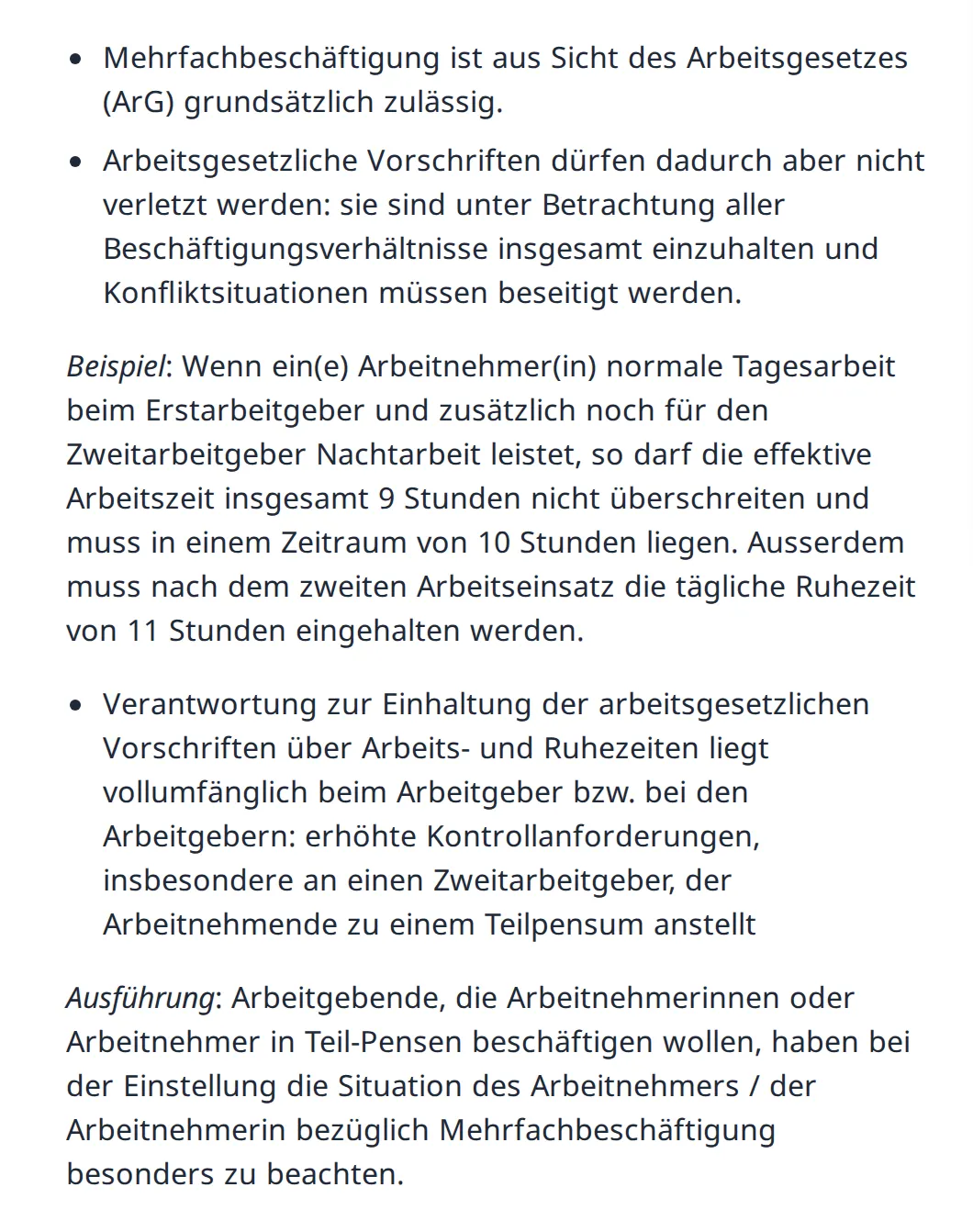
Night work makes it tighter. SECO gives the example of someone who works days for their first employer and nights for the second: in total, at most nine hours of work are allowed, and they must fall within a span of ten hours. Our worked example shows how quickly an ordinary week with a second job breaks the limits.
The Code of Obligations contains no express duty for you to report a second job on your own initiative. But employers are responsible for keeping to working and rest times, and SECO expects the second employer in particular, the one hiring you part time, to look closely. So expect to be asked about your other job when you're hired, and be honest about your hours.
The Labour Act doesn't apply everywhere. For example, it doesn't cover private households or the administrations of the Confederation, cantons and municipalities (Article 2). If you work there, your hours are governed by your contract, a standard employment contract or staff law. For social insurance and tax that makes no difference, and there, to begin with, each employer is treated separately.
AHV, unemployment and accident insurance with two employers
Each employer deals with social insurance on the pay it gives you, as if the other didn't exist. For AHV, the old-age and survivors' insurance, that's no disadvantage; for accident and unemployment insurance, it has consequences.
| Insurance | What applies with two jobs | Limit |
|---|---|---|
| AHV, IV, EO | Each employer deducts 5.3% from you and adds 5.3% | Up to CHF 2,500 a year per employer: only if you ask |
| Unemployment insurance | 1.1% each for you and the employer | On pay up to CHF 148,200, per job |
| Accidents outside work | Covered through a job of at least 8 hours a week | Counted per employer |
| Pension fund | Each job is assessed on its own | See our post on the pension fund |
The rates are in leaflet 2.01 on salary contributions and leaflet 2.08 on unemployment insurance (in German). For a small second job paying up to CHF 2,500 a year, the employer doesn't have to pay AHV contributions unless you ask for it. Once you've accepted the full pay without deductions, you can't ask for this later (Article 34d of the AHV Ordinance). This limit doesn't apply to work in private households, or to jobs with theatre and dance producers, orchestras, choirs, radio, television and other media, design firms, museums and art schools. There, contributions are due from the first franc. Households have one small exception: until the end of the year you turn 25, pay of up to CHF 750 per employer is only subject to contributions if you ask.
For accident insurance, the hours are what count. At work itself, you're compulsorily insured in every job. But against accidents in your free time, only through an employer you work for at least eight hours a week (Article 13 of the Accident Insurance Ordinance). If you're below that in one job, at least an accident on your way to or from that job counts as an occupational accident. If you have two small jobs of under eight hours each, neither covers you for accidents in your free time. Then your health insurer steps in (Article 1a of the Health Insurance Act). If you had suspended accident cover there because you were insured through a job, it resumes as soon as that cover ends (Article 8). You still have to report the change, or the insurer can charge you the premium for accident cover retroactively, with interest (Article 10).
For unemployment insurance, pay from one or more jobs counts. Extra income you earn outside your normal working hours, however, isn't insured (Article 23 of the Unemployment Insurance Act). Two jobs at 50% each together make up your normal working hours. An evening job alongside a full-time position doesn't, and it isn't part of your insured earnings. For the case in between, the Federal Supreme Court ruled on an employee with an 80% job and a second job as an ice hockey player: the pay from the main job counts in full, and from the second job only the part missing up to 100% (BGE 126 V 207, in German). Whether and how two small jobs are insured in a pension fund is worked out in our post on part-time work and the pension fund.
Tax: your second job counts in full
There's no separate tax rate and no tax-free allowance for a second job. All income from employment is taxable (Article 17 of the Federal Act on Direct Federal Taxation), and each employer must give you a salary certificate. Both certificates go into your tax return. Because the salaries are added together, a second job also raises the tax rate on your whole income.
You get some of it back through work expenses. For direct federal tax, you can deduct a flat 20% of your net income from a second job, at least CHF 800 and at most CHF 2,400 a year, according to the annex to the ordinance on work expenses. If your costs are higher, you can deduct those instead, with proof. For cantonal and municipal tax, your canton's rules apply; its guide to the tax return sets them out.
If you're taxed at source, for example on a B permit, one point matters in particular. Under Circular No. 45 of the Federal Tax Administration (in German), you must tell each employer whether you have other jobs. If you give neither your workload nor your pay from the other job, each employer scales its share up to 100% to set the tax rate. With small workloads, that can mean a bigger deduction than necessary. If you give both employers your total workload, they calculate with the right figure. If the deduction is still wrong, you can ask for a recalculation or a subsequent ordinary assessment by 31 March of the following year.
That leaves the question of how to tell your employer about all this without it sounding like you're about to quit.
How to tell your employer about your second job
Briefly, factually and in writing. First check your contract, the staff regulations and any collective agreement for a duty to report or an approval requirement. Even if there's none, telling your employer is still wise. It makes clear you're not hiding anything, and you have a record if anyone asks later. An email is enough, something like this:
Dear [name],
For your information: from [date] I'll be taking on a second job as [activity] at [type of business], around [number] hours a week, on [days and times]. The work doesn't compete with our business, and my working and rest times stay within the limits overall.
If this needs approval, I'd be grateful for a short confirmation in writing.
Kind regards, [name]
The email is neutral enough to suit any workplace, whether you're on first-name terms with your manager or not. Keep the reply. In the Valais case, a written agreement like this was the reason the employee could keep her Tuesday and Thursday takings, less the agreed 15%.
Before you say yes
Before you sign, map out a full week with both jobs: weekly hours, daily span, rest between evening and morning, and the free half-day. Check whether you work at least eight hours a week in one of the jobs; if not, you need your own accident cover for your free time. And if you're taxed at source, give both employers your total workload.
Still looking for the right second job? You'll find new part-time jobs across Switzerland all the time, and short-term assignments under temporary jobs. In the interview, ask straight away which days and times you'd be needed. The answer tells you whether the job fits alongside your first one at all.
Common questions
- Do I have to tell my employer how much I earn from my second job?
- The Code of Obligations doesn't require it. The employers' association Swissmem recommends reporting clauses on the type, scope and content of a second job, not on the pay. Tax at source is different: there you must tell each employer whether you have other jobs, and it pays to give your total workload, because otherwise each job is scaled up to 100% for the tax rate.
- Can I start working for my new employer during my notice period?
- Your duty of loyalty lasts as long as the employment does, so until the last day of your notice period, even if you've been put on garden leave. If the new employer is a competitor, paid work for them before then is risky. Ask your old employer and get their agreement in writing.
- Does the non-compete clause in my contract apply to a side job?
- A contractual non-compete clause under Article 340 of the Code of Obligations covers the time after the job ends. While you're still employed, it isn't needed at all: your duty of loyalty already bars you from competing with your employer. A side job in a different line of business is affected by neither.
- Do I pay AHV twice if I have two jobs?
- No. Each employer deducts 5.3% from the pay it gives you and adds the same amount on top. It all goes into the same AHV account and counts towards your pension later. The only extra work is the second salary certificate in your tax return.
- Do I need permission to be self-employed on the side?
- As far as your employer is concerned, the same limits apply as for a second job as an employee: no competition, no harm to your work, no damage to its reputation, and whatever else your contract requires. For AHV, if you earn up to CHF 2,500 a year from self-employment on the side, you only pay contributions if you ask to. Above that, you register with a compensation office.
More posts
All posts
Part-time salary in Switzerland: hours, pay and hourly rate
How to calculate a part-time salary in Switzerland: what 60% or 80% means in hours, how to convert monthly to hourly pay and check an offer with Salarium.

Part-time accident insurance in Switzerland: the 8-hour rule
Under 8 hours a week, your job doesn't cover accidents outside work. How hours are counted, when your health insurer pays and what applies after a job ends.

Part-time after maternity leave in Switzerland: how to ask
No right to part-time after birth in Switzerland, except for federal staff. How to negotiate and what 16 weeks' job protection and paid breastfeeding bring.