Part-time after maternity leave in Switzerland: how to ask

The short answer
In Switzerland you have no right to cut your hours after giving birth. The Code of Obligations contains no such right. If you work for the federal administration, however, you're entitled to up to 20 per cent less. Anywhere else, part-time is something you negotiate. On the other hand, your contract carries on unchanged, and once your probation period is over you can't be dismissed until 16 weeks after the birth.
Wanting fewer hours puts you in good company. According to the Federal Statistical Office (FSO), between 2016 and 2021 two in five women worked part-time shortly before having their first child, and four in five did when they went back. What the law gives you along the way isn't much, but it is clearly set out. Several of the laws below have no English translation, so some links open the German text.
Do you have a right to part-time work after the birth?
No, not in the private sector. If you want to work less after maternity leave, you need your employer's agreement. The Canton of Zurich's equality office says so plainly (in German): a lower workload is possible, but you can't insist on it.
Parliament has already ruled on this once. In 2019, National Councillor Nadine Masshardt submitted parliamentary initiative 19.461. It wanted to write into the Code of Obligations what already applies to federal staff: after a birth, parents may cut their workload by up to 20 per cent, but not below 60 per cent. The National Council rejected it on 16 September 2020, by 117 votes to 71 with 4 abstentions. The matter has been closed since.
What you do have is your employment contract. It carries on after the birth exactly as before, with the same workload and the same pay. That protects you both ways: your employer can't lower your hours on its own, and neither can you. Fewer hours only come with a change to the contract that you both agree to. Still, check your collective labour agreement or your employer's staff regulations. Some go further than the law, and that's where you'll find it.
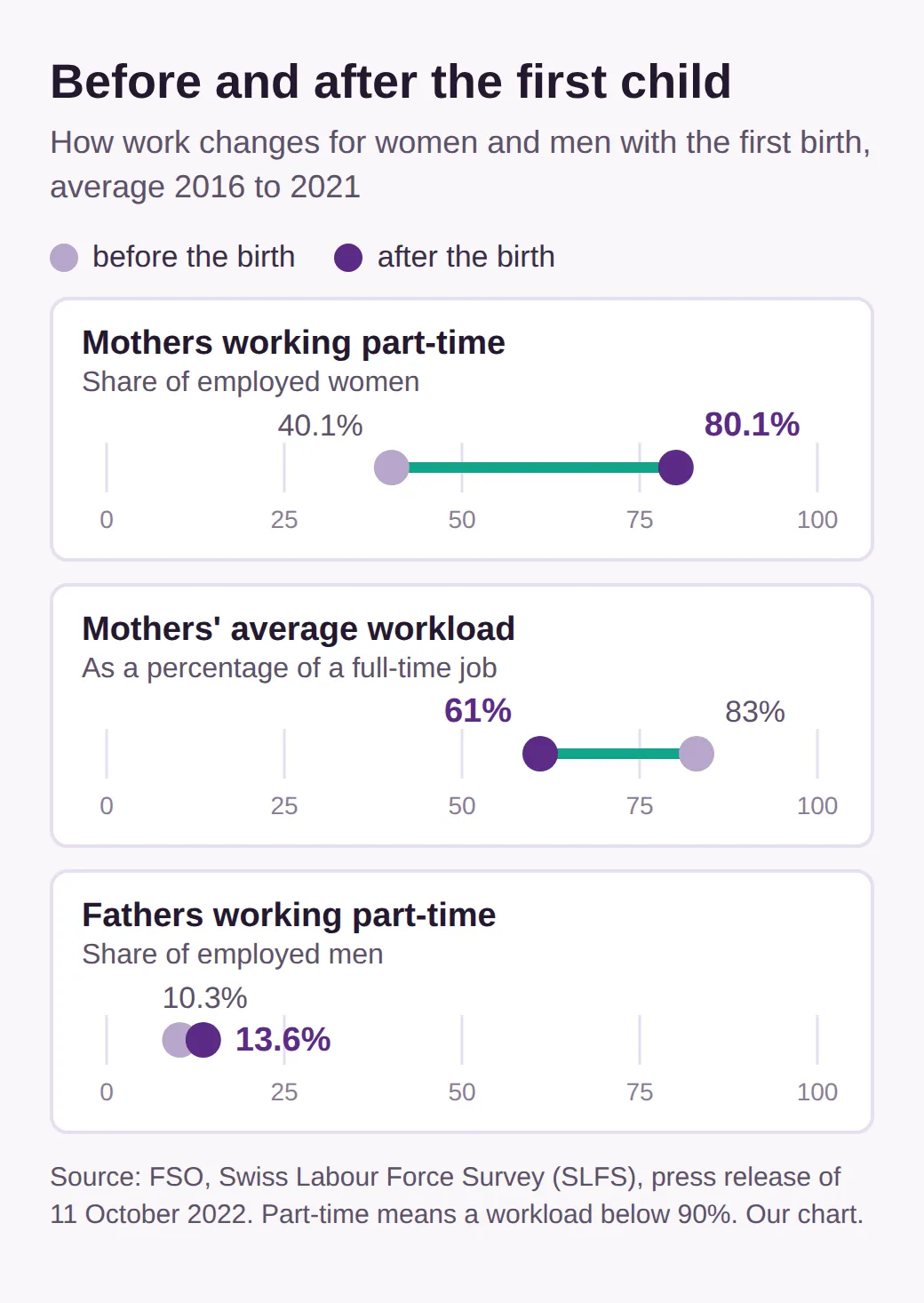
The figures show how common the step is. Mothers' average workload falls from 83 to 61 per cent after the first child, which the FSO puts at 1.1 fewer working days a week. For fathers, little changes. And almost one in nine women who were working or looking for work before the birth leave the labour market after their first child. More recent figures look the same: in 2024, 75.8 per cent of employed mothers whose youngest child was under four worked part-time, against 16.4 per cent of fathers (FSO, part-time employment 2024). So your employer has very likely heard this request before. The law doesn't force it to say yes, but it does give you a fixed timetable to plan around.
Your calendar from the birth
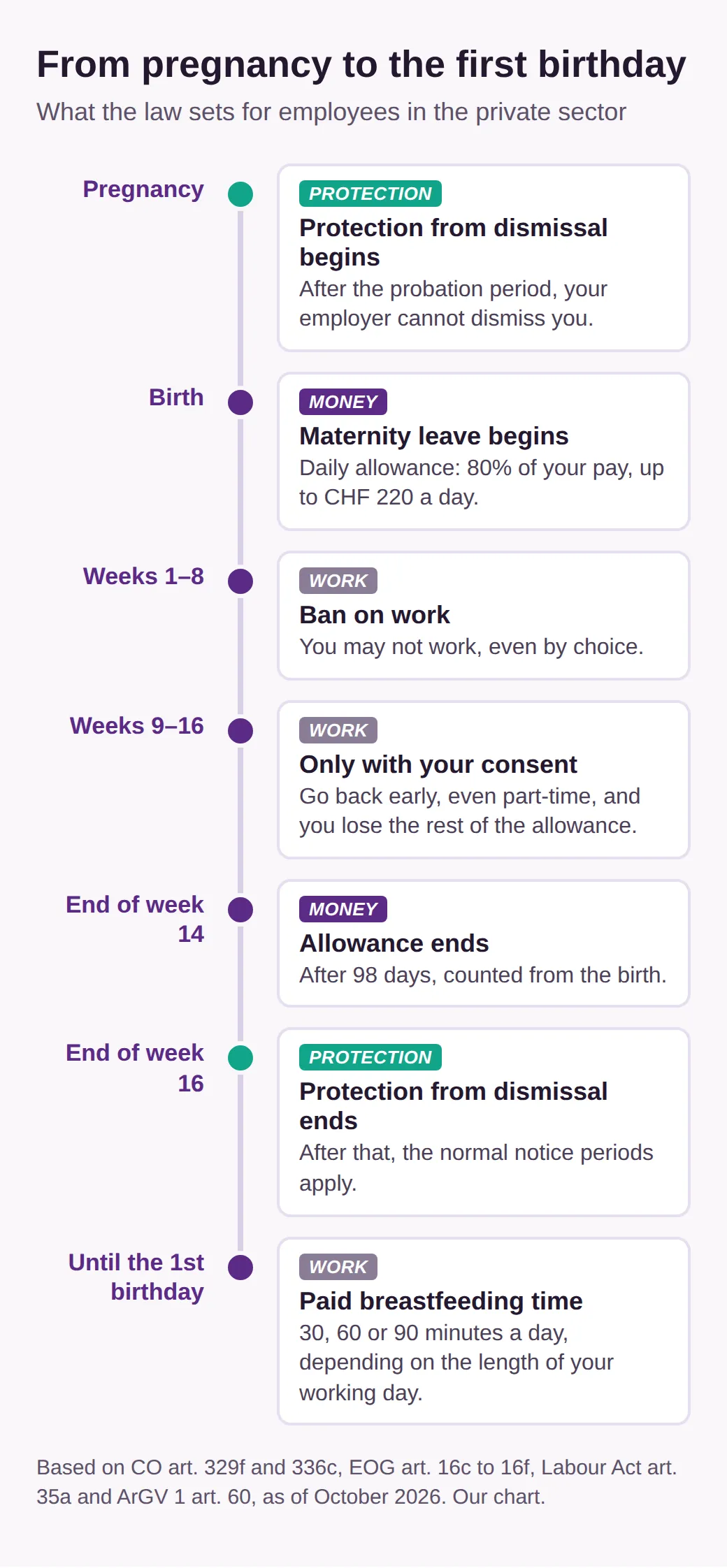
Four deadlines shape the months after the birth: the ban on work, the paid leave, the protection from dismissal and the paid breastfeeding time. They sit in four different laws and don't run for the same length of time.
14 weeks of leave that end the moment you go back
After the birth you're entitled to at least 14 weeks of maternity leave (art. 329f CO). It's paid through the income compensation scheme (EO): for 98 days you get 80 per cent of your average earnings, up to CHF 220 a day. To qualify, you must have been insured for the nine months before the birth and have worked for at least five of them.
Here's the catch if you'd like to ease back in gently: the allowance stops early as soon as you take up paid work again (art. 16d EOG). The law makes no distinction between 100 and 10 per cent. Start with half a day a week in week 10 and you lose the allowance for the remaining weeks. You're not allowed to work in the first eight weeks anyway, and after that only with your consent until week 16 (art. 35a of the Labour Act). So a gradual return is best started after week 14.
16 weeks of protection from dismissal, and where it stops
Once your probation period is over, your employer can't dismiss you for the whole of your pregnancy and the 16 weeks after the birth (art. 336c CO). Notice given during this time is void, so it has no effect at all. If your employer gave notice before you were pregnant, the notice period is put on hold and only resumes after the protected period. The law makes no exception for notice that comes with the offer of a new contract on a smaller workload. Say no, and your contract ends, so that counts as dismissal too.
What matters is what this protection doesn't do. It doesn't guarantee you part-time work, and it ends after 16 weeks. After that, the normal notice periods apply again: one month in the first year of service, two months up to the ninth year and three after that, each to the end of a month, unless your contract says otherwise (art. 335c CO). During probation there's no protection at all. So plan your conversation about part-time to happen well before week 16.
When and how to have the conversation
Have the conversation early, ideally while you're still pregnant. Your protection from dismissal already applies, and your employer has time to plan cover or a new way of splitting the work. The more concrete your proposal, the easier it is to say yes.
When an employer gets a request like this, it mostly wonders about three things. Who will do the work you no longer cover? Will you be there on the days that matter? And is this a one-off, or the start of a wave? You can answer all three before anyone asks. Propose a workload and the days you'll work. Say which tasks you could hand over, and to whom. Offer a trial period for the new set-up, say six months, followed by a review.
The federal rule is a good yardstick for a request that won't look excessive: 20 per cent less, but not below 60 per cent. Going from 100 to 80, or from 80 to 60, asks for exactly what the federal administration grants its own staff. If you want to go much lower, job sharing can be the answer, because your position stays fully staffed.
Put the result in writing, as an amendment to your employment contract. A short proposal by email before the meeting helps make sure you're both talking about the same thing:
Dear [name],
After my maternity leave, I would like to return on [date] at a workload of [80] per cent, working [Monday to Thursday]. The [example] task could be taken over by [name or team]. I suggest we review the arrangement together after six months. I'd be glad to discuss this proposal in a meeting before my leave starts.
Kind regards, [name]
Work out beforehand what a lower workload means for your pension. If your annual salary with one employer falls below the entry threshold, you're no longer compulsorily insured in its pension fund, and the fixed coordination deduction hits small workloads especially hard. Our article on part-time work and the pension fund explains exactly how that works.
There's one argument you can make even if your workload stays the same. The Labour Act requires employers to take particular account of staff with children under 15 when planning working and rest hours (art. 36 of the Labour Act). Your employer may only ask you to do overtime with your consent, and on request you're entitled to a lunch break of at least an hour and a half. That's no substitute for part-time, but it can make a working day with a daycare pick-up doable. On one point the law gives you more room: breastfeeding time.
Breastfeeding at work: paid minutes in the first year
If you breastfeed or express milk, your employer has to give you the time you need. In your child's first year, part of that time counts as paid working time (art. 60 of Ordinance 1 to the Labour Act): at least 30 minutes on a working day of up to 4 hours, 60 minutes on a day of more than 4 hours and 90 minutes on a day of more than 7 hours.
The SECO guidance (in German) on this rule, issued by the State Secretariat for Economic Affairs, spells out the details. The paid time is the same whether you breastfeed at work, express milk there, or go home or to daycare to feed your baby. Travel time isn't paid on top. Your employer may neither count the minutes against your overtime balance nor take them off your holiday. If you need more time, you may take it, but unpaid, unless you agree otherwise. Breastfeeding mothers may not work overtime either, and never more than 9 hours a day. A suitable room must be available for expressing milk, and according to SECO (in German), the toilet doesn't count.
This matters in the negotiation, because how you spread your workload changes your paid breastfeeding time. Here's an example with 60 per cent of a 42-hour week, which is 25.2 hours:
| Spread | Hours per day | Paid breastfeeding time per day | Per week |
|---|---|---|---|
| 3 days | 8.4 | 90 minutes | 4.5 hours |
| 4 days | 6.3 | 60 minutes | 4 hours |
| 5 days | 5.04 | 60 minutes | 5 hours |
In this example, five short days bring the most paid breastfeeding time and four days the least. Whether that matters more to you than whole days off is your call. The rule applies to every employer covered by the Labour Act. Those not covered include the federal, cantonal and municipal administrations, farming and private households (art. 2 of the Labour Act). The public sector has its own staff law, and at federal level it's a good deal more generous.
Federal staff: a right to 20 per cent less
If you work for the federal administration, you've had a right to a lower workload after a birth since 2013. The current wording is in article 60a of the Federal Personnel Ordinance (in German): parents may reduce their workload by up to 20 per cent, but not below 60 per cent. You have to claim it within 12 months of the birth, and the lower workload starts at the latest on the day after those 12 months end.
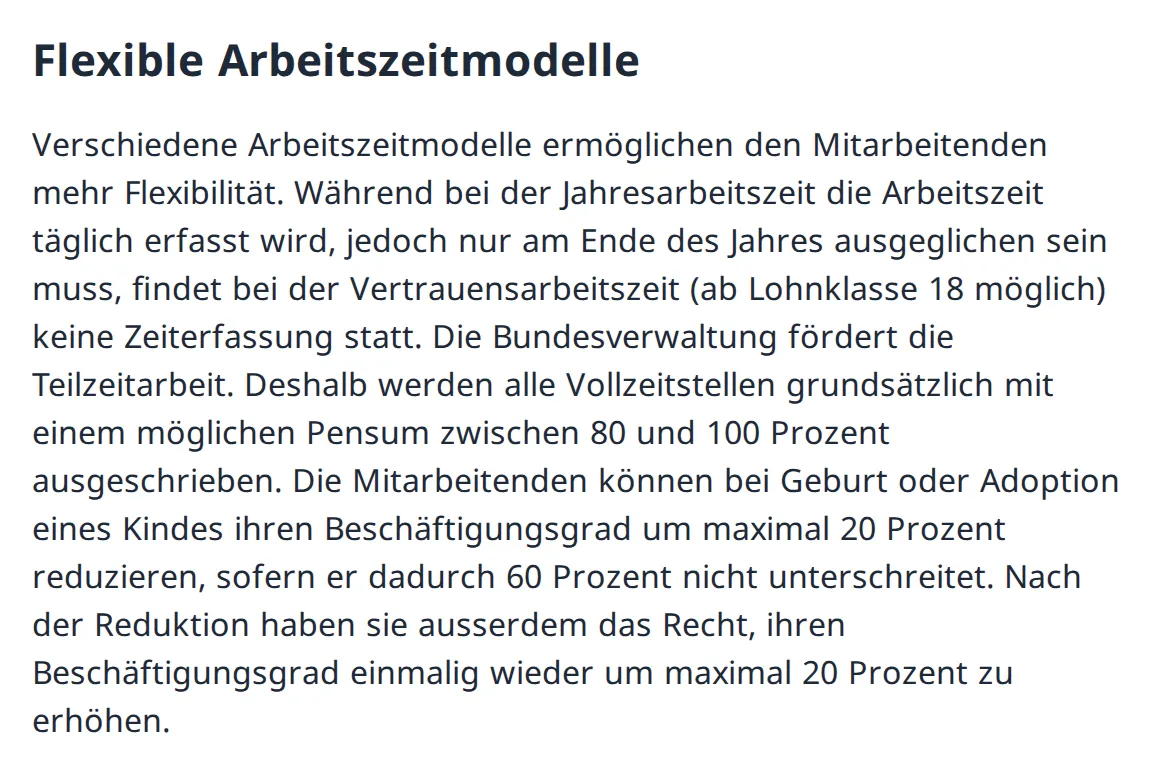
The way back is what stands out. If you've reduced your hours, you may later raise your workload once by up to 20 per cent. You have to apply within three years of the reduction, at least three months before the increase is due to take effect. That return is exactly what the private sector lacks: go down to 60 per cent there, and you have no right ever to get back to 80.
On top of that comes longer leave. Federal employees get four months of maternity leave on full pay instead of 14 weeks at 80 per cent (art. 60 of the Federal Personnel Ordinance). If you work for a canton, a municipality or a public hospital, their own staff law applies. Ask there for the regulations: the reasoning behind the 2019 initiative already pointed to cantonal and municipal administrations with similar rules.
When your employer says no
A no is allowed, and the law doesn't require a reason. Ask for the reasons anyway. There's often a problem behind it that can be solved, such as a particular weekday or a task nobody else can take on.
What's forbidden is treating you worse because you've become a mother. The Gender Equality Act bans any discrimination based on family situation or pregnancy, in how tasks are allocated just as much as in promotion and dismissal (art. 3 of the Gender Equality Act). You don't have to prove such discrimination; it's enough to show that it's likely (art. 6). If, say, your employer takes your projects away after you return, even though you're back at your old workload, that can fall under it.
If you're dismissed after week 16
The Zurich equality office also points out that if you don't want to continue the job in its previous form, your employer can give notice. Such a dismissal isn't automatically unfair. But if it's linked to your maternity, you can fight it. Object to it in writing to your employer before the notice period ends (art. 336b CO). If you can't reach an agreement, you have to file a claim in court within 180 days of your employment ending. A court can award you compensation of up to six months' pay, but it won't get you your job back. Before going to court, it's worth talking to your canton's conciliation authority for gender equality cases.
Quitting yourself: a word on unemployment insurance
If you resign without a new job lined up, unemployment insurance usually treats it as serious fault. You then lose 31 to 60 days of benefits, unless you had a valid reason (art. 45 of the Unemployment Insurance Ordinance, in German). Whether childcare counts as such a reason, the ordinance doesn't say; the unemployment fund decides. It's safer to have the new job before you resign. Easiest of all is a job that's advertised as part-time from the start: there's nothing to fight for, because the workload is in the ad. If you start with a new employer, remember the probation period: during it there's no protection from dismissal, not even if you become pregnant again.
Before your maternity leave ends
Put the dates in your calendar: the end of week 14, the end of week 16 and your child's first birthday. Check your collective labour agreement or staff regulations for rules on part-time, breastfeeding and maternity leave. Send your proposal for the new workload while your protection from dismissal still runs, and get the outcome confirmed in writing. If you're breastfeeding, tell your manager before your first day back so a room is ready.
And if the answer is no: you'll find a steady supply of part-time jobs across Switzerland on our site, with the workload already in the ad.
Common questions
- Can my employer reduce my hours after maternity leave without my consent?
- No. Your workload is set in your employment contract, and neither side can change it alone. If your employer wants you to work fewer hours, it needs your agreement or has to give notice and offer you a new contract. Notice like that is void during pregnancy and in the 16 weeks after the birth.
- Can my holiday be reduced because of maternity leave in Switzerland?
- No. The Code of Obligations expressly rules it out: your employer may not cut your holiday for maternity leave, or for up to two months of absence caused by the pregnancy. A collective labour agreement may only depart from this if it gives you at least as much overall.
- Do fathers in Switzerland have a right to part-time work after a birth?
- Not in the private sector. Fathers get two weeks of paternity leave, which they can take as whole weeks or single days within the first six months. At the federal administration, the right to reduce the workload by up to 20 per cent applies to both parents, so fathers too.
- What happens to maternity pay if my baby has to stay in hospital?
- If your baby stays in hospital for at least two weeks without a break straight after the birth, the daily allowance is extended by the length of the stay, and until the end of June 2027 by no more than 56 days. You have to show that, at the time of the birth, you already intended to go back to work. From 1 July 2027 the cap is lifted, and a hospital stay of at least two weeks by the mother also counts.
More posts
All posts
Part-time salary in Switzerland: hours, pay and hourly rate
How to calculate a part-time salary in Switzerland: what 60% or 80% means in hours, how to convert monthly to hourly pay and check an offer with Salarium.

Part-time accident insurance in Switzerland: the 8-hour rule
Under 8 hours a week, your job doesn't cover accidents outside work. How hours are counted, when your health insurer pays and what applies after a job ends.

Second job in Switzerland 2026: what your employer can ban
Second job in Switzerland: when your employer can say no, the working-time limits for both jobs together, and what changes for AHV and tax.