Job sharing in Switzerland: contract, pay and who offers it

At a glance
In job sharing, two people share one position and the responsibility that comes with it. Switzerland has no law on it: what counts is what you agree with your employer. The safest set-up is your own employment contract plus a written agreement for the pair. A 2023 survey found people already working this way in just over a quarter of organisations with at least ten staff.
Most guides on the subject list pros and cons and stop just where it gets serious for you: the contract, the pay, and what happens to your job when your partner leaves. To answer those, we read the 2024 study by the University of Applied Sciences and Arts Northwestern Switzerland (FHNW, in German), figures from the Federal Statistical Office (FSO), the job-sharing rules two cantons have written for their own staff, and a court ruling about a shared job in a cheese dairy in Valais.
What job sharing is, and what it isn't
Job sharing means you hold one job together, not two small ones. That is exactly how the FSO asks about it in the Swiss Labour Force Survey (SLFS): one position and its responsibility are split between two people, usually with a single job description. The FHNW adds that the tasks depend on each other and that both people are jointly responsible.
Job splitting is something else. There, a full-time position is cut into two part-time ones, and each person does their own part. You work side by side, but not as a unit. A brochure by the Familienfreundliche Wirtschaftsregion Basel (in German), a family-friendly employers' network, draws the line like this: in job splitting, two half-time jobs complement each other; in job sharing, you share the tasks and the responsibility. When the shared job is a management role, it's called top sharing.
The difference is more than a word. In job sharing you stand in for each other, you have shared goals, and some employers even appraise you together. That opens up roles to part-timers that would otherwise only exist full-time. It also ties you to a second person. Two surveys show how many people in Switzerland actually work like this.
How common is job sharing in Switzerland?
Looking at employers, it's no longer a niche. In summer 2023, the FHNW wrote to 5,000 organisations on behalf of the association PTO (Part-time Optimisation), and 1,064 gave usable answers. In almost 28% of them, people work in job sharing or top sharing. The figure is 30% in German-speaking Switzerland, 21% in the French-speaking part and 25% in the Italian-speaking part. Large organisations with 250 staff or more lead clearly at 44%, and non-profits (34%) are ahead of the public sector (30%) and private companies (26%).
Looking at employees, it's smaller. According to the FSO table on job sharing (in German), around 3.6% of all employees worked in job sharing in 2021. Among part-time employees working less than 90%, it was 9.5%: 10.3% of women and 7.0% of men. With children under seven, the share rises to 11.9%. People working between 20% and 69% share their job most often, almost 12% of them.
The two figures don't contradict each other. An organisation that has job sharing has, on average, just under six people working that way, so about three pairs. What stands out is something else. Among employers the model is growing: in almost half of those with job sharing, the FHNW found the number of pairs had risen over ten years. Among employees the share barely moved; in 2016 it was 9.8% of part-time staff.
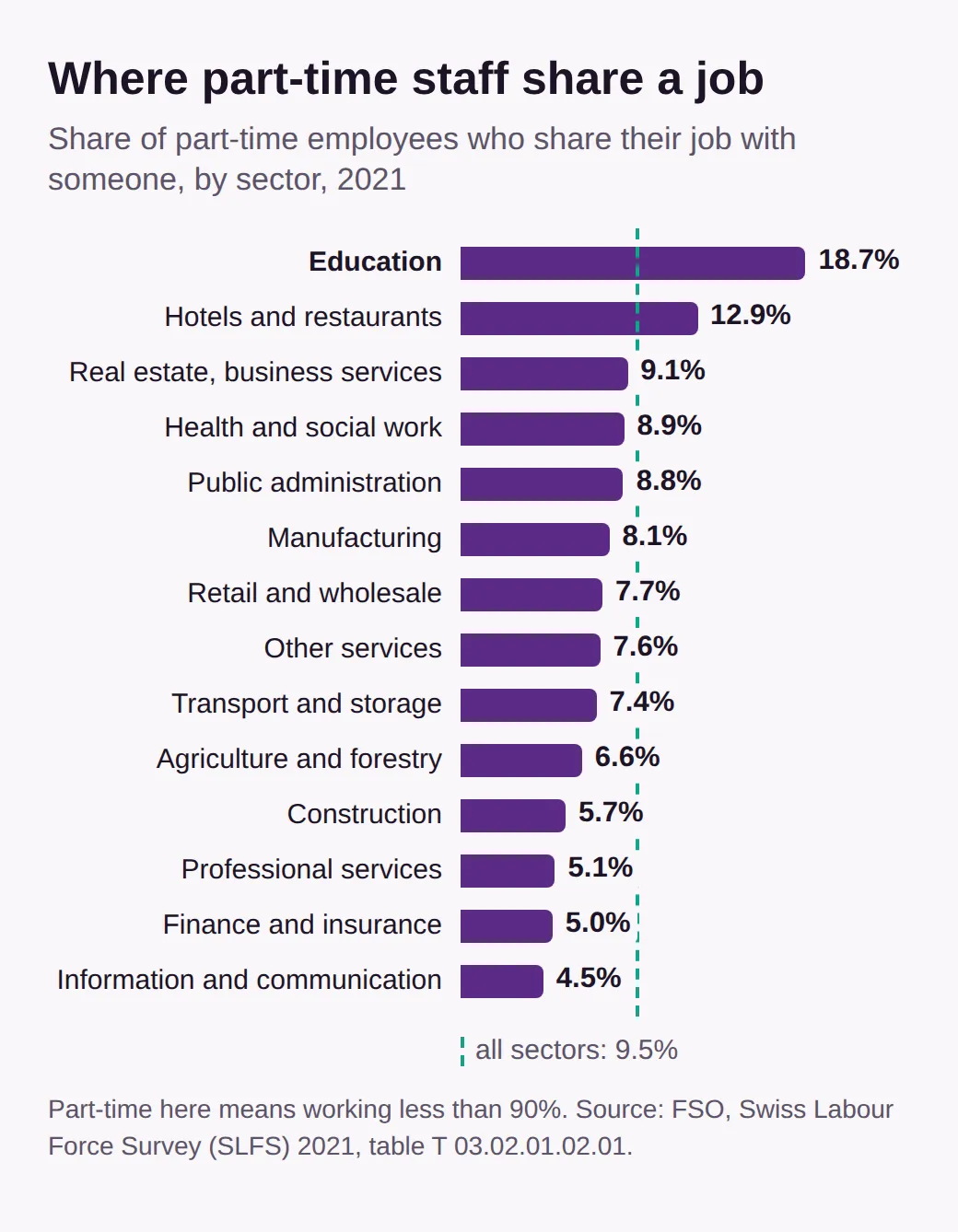
Your sector makes the biggest difference. In schools, almost one part-timer in five shares their job; in information and communication, and in banking and insurance, only one in twenty. That tells you where you'll have the least explaining to do when you suggest a job share.
Which employers offer job sharing
The well-known examples are large employers, public and private. The FHNW names Swiss Federal Railways (SBB), Swiss Post, Geneva University Hospitals (HUG), the legal expenses insurer CAP, the State Secretariat for Migration (SEM), Unisanté in Lausanne and the private bank Vontobel, which has also been run by two co-CEOs since 2024. Some cantons have written their own rules for their staff, such as St. Gallen in its staff handbook and Fribourg in a directive dated 23 November 2021 (both in German).
The health insurer CSS shows what it looks like day to day on its careers page, in a profile from 2021. In January 2020, two specialists applied together for a management role advertised at 80% to 100%. From September 2020 they ran the company's medical advisory service, four teams and 48 people, each of them working 60%. That adds up to 120% for one position.
The FHNW also asked the other 72% of organisations why they have no job sharing. The most common answer, given by 46%: too few requests. Second, at 41%: the job is hard to split. Higher costs were named by fewer than one in ten. For you, this means that where nothing is advertised, it's often because nobody has asked yet. Three sectors are worth a closer look.
Schools and teaching
Education is far ahead at 18.7%, and among women it's 20.8%. In no other sector are you less likely to get a blank look when you ask to share a job.
Restaurants and hotels
In hotels and restaurants, 12.9% of part-time staff share their job, and men (14.3%) do so more often than women (12.3%).
Hospitals, care homes and social services
In health and social work it's 8.9%, just below average. The sector is so large that this still means many jobs, and Geneva University Hospitals and Unisanté are two health employers on the FHNW's list. Which form your job share takes is then a question of the contract.
One contract or two?
Ideally two, one for each of you. The Swiss Code of Obligations (CO) covers part-time contracts but says nothing about job sharing. The Cantonal Court of Valais confirmed this on 7 November 2022 in a ruling about a shared job (in German): job sharing is not regulated by law, and its content depends on what the parties agree.
The case shows why this matters. From January 2020, a couple ran the cheese dairy and shop of a dairy cooperative on a fixed-term contract until 1 May. On 9 March both were dismissed with immediate effect. Each sued separately for their pay, one for almost CHF 30,000, the other for just over CHF 25,000. The cooperative defended itself with a formal argument: there was only one contract, with the couple as a group, so the two claims had to be added together. That would have put them over the CHF 30,000 limit for the simplified procedure at the labour court.
The court disagreed. The employer had filled in two contract forms and paid half the wages to each person separately. So each person had their own claim to pay and could sue alone. The summary dismissal was not justified. And because each of them had their own pay, the court also calculated it individually, by role: for the cheesemaker working 50%, half the minimum wage of a head cheesemaker, CHF 2,936 a month; for the assistant cheesemaker, half of her minimum wage, CHF 2,488.
The court cites the Federal Supreme Court, which recognises three ways of hiring a group.
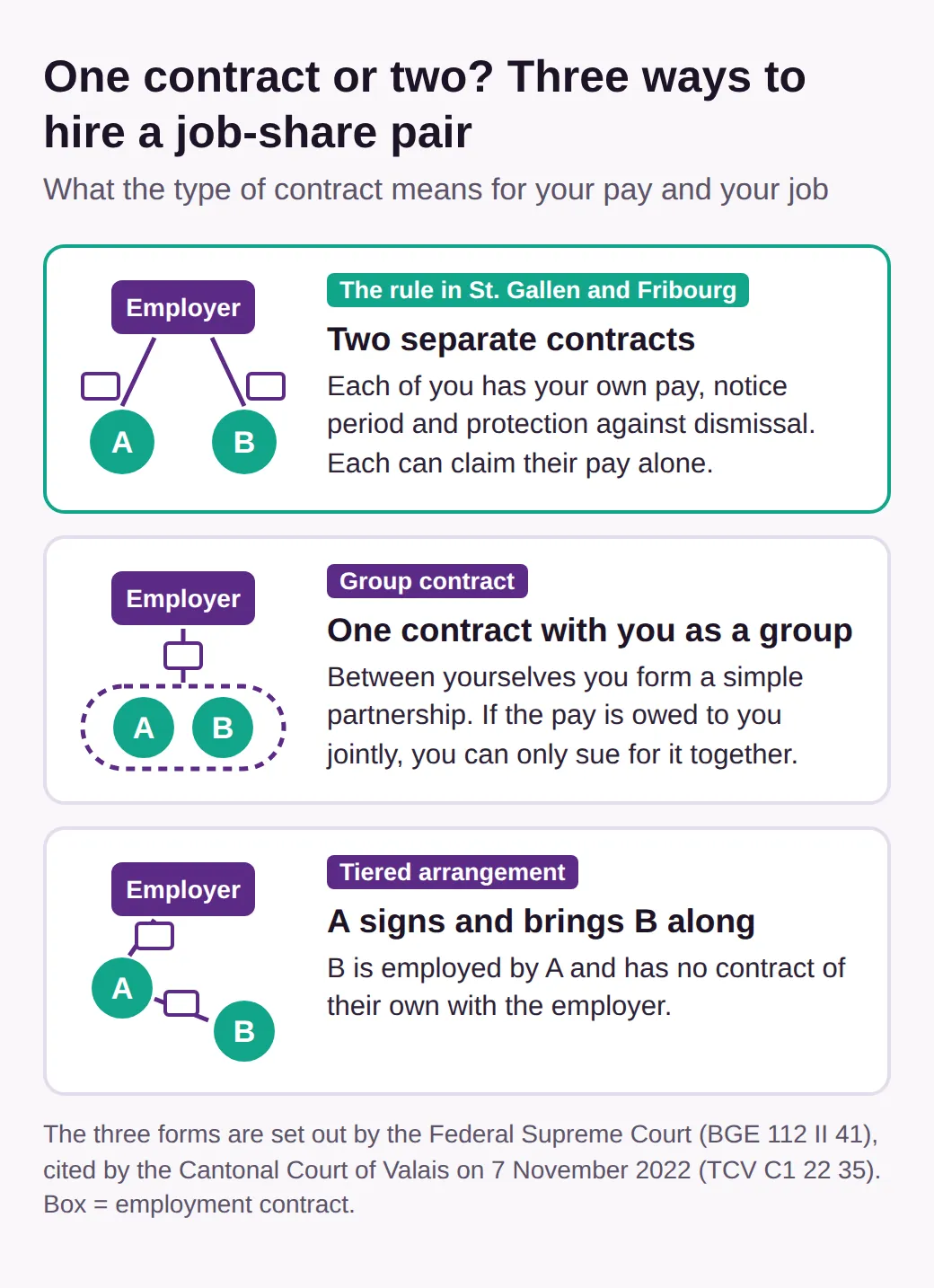
The first one is what counts for you. With your own contract, you have your own pay, your own notice period and your own protection against dismissal. St. Gallen and Fribourg require exactly that of their departments. Fribourg also requires a written agreement between the manager and the pair, covering among other things working hours, cover for each other, signing authority, what to do when you disagree, and what happens if one of you leaves. If you sign one contract as a group, the two of you form a simple partnership. If the pay is then owed to you jointly, you can only claim it together, and that is exactly what the dairy cooperative was counting on. But the contract type matters most on the day one of you leaves.
What happens if your job-share partner quits?
With your own contract, yours simply carries on. Your employer can only end it the way it ends any other contract: by giving you notice, with your notice period. Unless something else is agreed in writing, under Article 335c CO that is one month in the first year of service, two months up to the ninth year and three months after that, in each case to the end of a month. Protection against dismissal also applies to you personally. If you are ill or pregnant, after the probationary period your employer may not dismiss you during the protected periods in Article 336c CO, whatever your partner does.
The Canton of St. Gallen goes further for its own staff. Its staff handbook names three ways forward after one partner leaves, and rules one thing out.
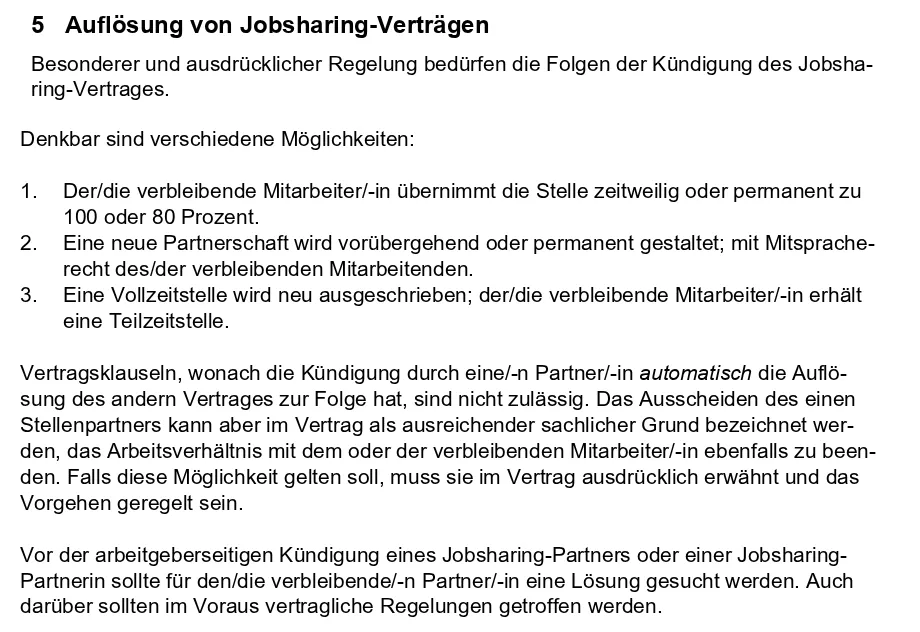
St. Gallen does not allow clauses under which one person's notice automatically ends the other contract too. The contract may, however, name the partner's departure as an objective reason to dismiss you as well, provided it says so explicitly. That applies to cantonal employees. The Code of Obligations is silent on job sharing, so at a private employer what counts is what your contract says. Read it carefully before you sign, and look for any sentence that links your job to your partner's.
Better still, settle the question in advance. St. Gallen's three options work as a template: you take over the job for a while or for good at 80% or 100%; you look for a new partner, with a say in who it is; or the full-time role is advertised again and you get a part-time job. A say in the successor costs the employer nothing and protects you from a pairing that doesn't work. Pay, cover and overtime deserve the same clarity.
Pay, overtime and cover in a job share
Your pay depends on your workload and your role, not on the pair. Fribourg's directive states that pay is calculated for each person individually, and the Valais ruling did exactly that. So the two of you can earn different amounts for the same job, for example because of experience or years of service.
On workload, there are two schools of thought. Fribourg's directive for cantonal staff allows a shared full-time position to add up to at most one full-time equivalent, and for management pairs the two percentages should in principle differ by no more than 20 points. Fribourg's own office for gender equality and family (in German), on the other hand, writes that coordination often makes a combined total above 100% necessary, and that the extra cost is largely offset by the benefits. The CSS pair came to 120%. So negotiate the handover time from the start, or you'll end up doing it unpaid.
In daily work, cover is the tricky part. If your partner is off for two weeks, their work lands on you. Whatever you work beyond your agreed workload is overtime under Article 321c CO. You have to do it as far as it is necessary and can reasonably be expected of you. Your employer compensates it with at least the same amount of time off if you agree, otherwise it pays it at a premium of at least 25%, unless your contract says otherwise in writing. That is why St. Gallen requires the contract to state whether you cover for each other only for planned absences such as holidays, or also at short notice when one of you is ill. Fribourg requires the written agreement to set out compensation for cover that lasts longer than usual.
As for mistakes, Fribourg makes the pair jointly responsible for the whole job. Either of you can be held personally responsible for acting against the other's view. Under the CO, Article 321e makes you liable for damage you cause yourself, intentionally or through negligence. So for important decisions, keep a note of who decided what.
One consequence many people overlook is the pension fund. Because each of you has your own contract, the fund applies the coordination deduction to each of you. Under the statutory minimum for occupational pensions this is CHF 26,460 in 2026, as the FSIO's key figures (Federal Social Insurance Office, in German) show. If your fund only applies this minimum, a full-time job paying CHF 90,000 has CHF 63,540 insured. Split half and half, it's twice CHF 18,540, so CHF 37,080 in total. From 2027 the deduction rises to CHF 26,880 (in German). How you can make up for this is explained in our post on part-time work and the pension fund. You also get the same number of weeks' holiday as full-time staff, just on fewer days; more on that in our post on holidays for part-time and hourly workers. Whether all this is worth it is something the organisations already doing it can tell you.
Pros and cons: what employers report
Most organisations report good experiences, with one recurring problem. The FHNW asked organisations with top sharing about their experience. 58% name higher job satisfaction among the pairs, 46% more motivation, and more than a third higher productivity and lower staff turnover. Most introduced the model to help people combine work and private life; almost two thirds say so.
On the other side, 32% have seen communication and coordination problems within pairs, and 26% more management effort. 28% report no negative experiences at all. These figures come from employers, not from the pairs themselves, and they concern management roles. A smaller follow-up survey of 22 organisations shows where things get stuck: the most common answer, at 37%, is that recruiting suitable pairs is rather difficult. By contrast, 90% find drawing up the contract easy or fairly easy.
For you, the balance looks like this. You get a job with responsibility on a part-time basis, someone to cover for you when your child is ill, and a colleague to talk decisions through with. In return, you give up some control. St. Gallen's handbook is unusually frank: people with big egos, or who struggle to share information and power, rarely make a harmonious pair. And because you share goals, your appraisal also depends on the other person's work. If you accept that, you still have to find the job first.
How to find a job-share position
Often not through a job ad, but as a pair. The Basel brochure describes the route like this: jobs are often not advertised as job shares; instead, two people who complement each other team up and offer themselves as a pair. The CSS pair also applied together for a job advertised at 80% to 100%. And since employers mainly cite a lack of requests, according to the FHNW, a strong joint application is often your best argument.
Find the right person first. Often that's someone you've already worked with and whose way of deciding you know. Then apply together with a proposal for how you'll split the job: who is in on which days, which tasks you do together and which separately, and how you hand over. The questions from the St. Gallen handbook make a good checklist, and the answers later belong in the contract or the supplementary agreement:
- Which tasks are assigned to one of you, and which do you share?
- How far can you organise yourselves, and when do you need your manager?
- When do your working hours overlap for the handover?
- Do you cover for each other only during holidays, or also at short notice when one of you is ill?
- What counts as overtime, and how is it compensated?
- What happens if one of you leaves?
If you already work for an organisation, you can propose the same thing internally, for example if you want to reduce your hours and a colleague is planning to do the same. According to the FHNW, large organisations are the most likely to have pairs already, and in schools and hospitality you'll have the least explaining to do.
Before you both sign
Ask for the draft of the supplementary agreement before you sign your own contract, and read the two together. If it says nothing about one partner leaving, propose a clause yourselves. Based on the St. Gallen options, it could read:
If one person in the job share gives notice, the other person's employment contract continues unchanged. On request, the remaining person may take over the position temporarily at 80% or 100%. They have a say in choosing a new job-share partner.
If your employer says yes, you have in writing what no law gives you. And if you're still looking for the right job for it, you'll find new part-time jobs across Switzerland all the time.
Common questions
- Do I have a legal right to job sharing in Switzerland?
- No. There is no Swiss law that gives you a right to it. The Canton of Fribourg even says so outright in its directive for its own staff: it supports job sharing, but there is no entitlement. So you can only propose it and negotiate.
- Can I job share with my partner or spouse?
- Yes, the law does not forbid it. The 2022 Valais ruling was about a couple who ran a cheese dairy together. What matters is that each of you has your own contract and your own pay. Then each of you can claim your pay alone, even if the relationship or the job ends.
- Do I have to cover for my job-share partner when they are off sick?
- Only as far as you agreed, or as far as it is necessary and reasonable. Hours beyond your agreed workload count as overtime under Article 321c of the Code of Obligations. Your employer compensates them with time off if you agree, otherwise it pays them at a premium of at least 25%, unless your contract says otherwise in writing.
- Do job sharers get a joint performance review?
- In the cantons of St. Gallen and Fribourg, yes. The review of goals and performance takes place with both of you and your manager, and the goals apply to the pair. Personal matters can be discussed separately. Private employers set their own rules, so ask before you start.
More posts
All posts
Part-time accident insurance in Switzerland: the 8-hour rule
Under 8 hours a week, your job doesn't cover accidents outside work. How hours are counted, when your health insurer pays and what applies after a job ends.

Part-time salary in Switzerland: hours, pay and hourly rate
How to calculate a part-time salary in Switzerland: what 60% or 80% means in hours, how to convert monthly to hourly pay and check an offer with Salarium.

Second job in Switzerland 2026: what your employer can ban
Second job in Switzerland: when your employer can say no, the working-time limits for both jobs together, and what changes for AHV and tax.