Part-time rate in Switzerland by industry and occupation

The numbers in brief
In Switzerland, 38.7% of people in work have a part-time job, meaning a workload under 90% (FSO, 2024). Part-time work is most common in arts, leisure and personal services (64.0%), in education (61.6%) and in health and social work (57.0%). It is rarest in construction (15.8%) and manufacturing (18.4%). Under the European definition, the rate is 41.5%.
Most articles on the part-time rate only repeat that first number, and the industry table that often gets linked is years old. We went to the source ourselves: the Federal Statistical Office (FSO) release on part-time employment in Switzerland 2024, whose full publication is available in German and French only, plus the latest tables from the Labour Force Survey and the FSO's job statistics up to mid-2026. That is where the ranking of industries and occupations comes from, along with the figures by gender, age and workload, and the answer to why two different rates keep turning up.
What the 38.7% actually measures
The figure counts people, not jobs, and it draws the line at 90%. It comes from the Swiss Labour Force Survey, or SLFS, a large survey of households. In the second quarter of 2024, 1.9 million people had a workload under 90%. Of these, 1.2 million worked between 50% and 89%, which the FSO calls part-time I. Around 700,000 worked less than half time, which is part-time II.
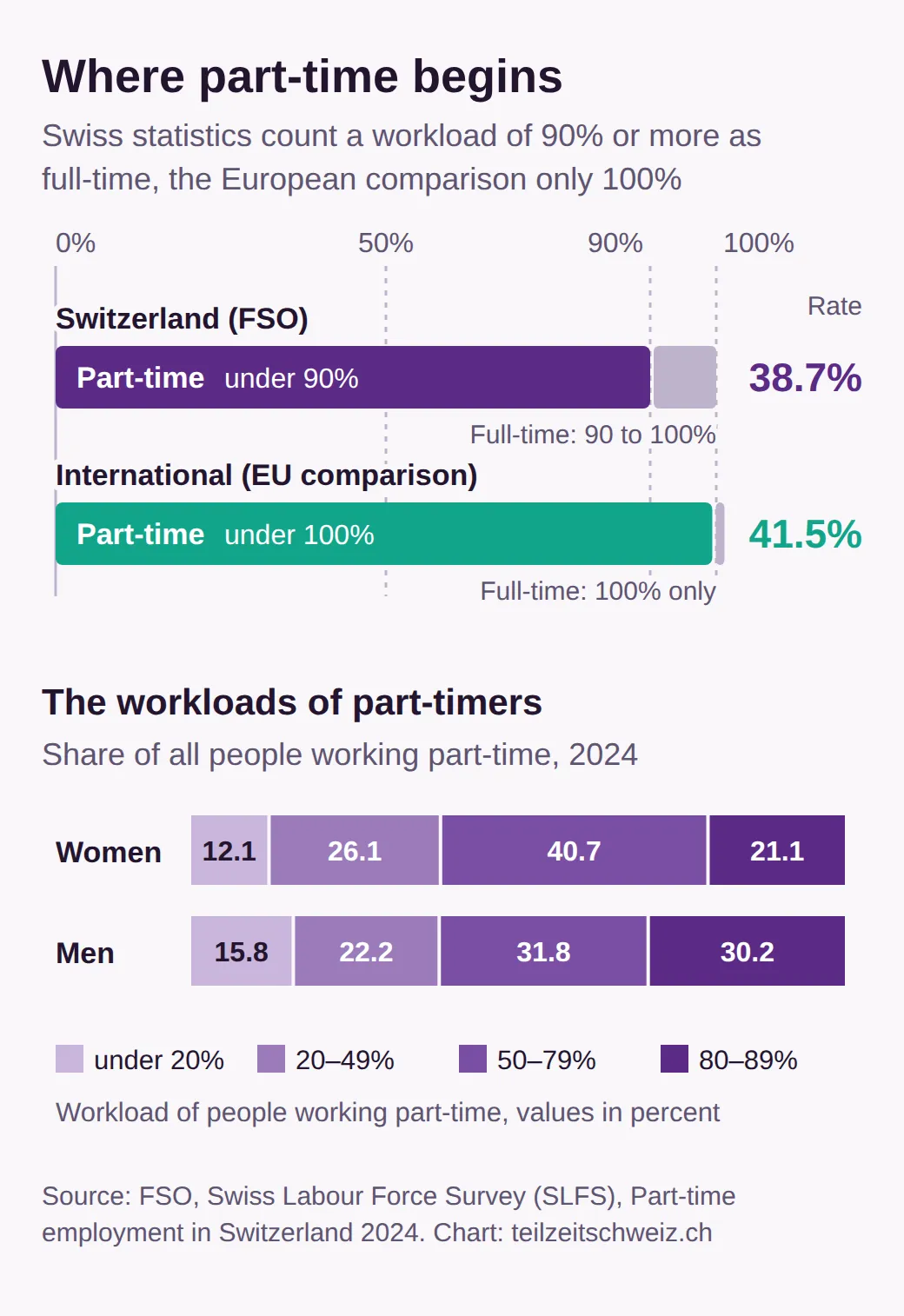
It matters who the statistics count as employed in the first place. According to the definitions at the end of the publication, a single paid hour in the survey week is enough. So if you only help out in a shop for two hours on Saturdays, you're in. Apprentices in vocational training, on the other hand, always count as full-time. And anyone working exactly 90% counts as full-time too. In 2024 that applied to 2.4% of all employed people, 3.1% of women and 1.9% of men. In 1991 it was just 0.6%.
The rate has risen a lot over the decades. In 1991 around a quarter of employed people worked part-time; by 2024 the share was 13.3 percentage points higher. Since then, little has moved. The FSO table on full-time and part-time workers (in German) lists 1.889 million part-time workers out of 4.886 million employed people for the 2025 annual average. That again comes to 38.7%. For the second quarter of 2026, the same table gives us 39.4%, against 38.9% a year earlier.
If you had a different number in mind, you're not wrong. You probably read the international one.
Why you often see 41.5%
Because Europe draws the line elsewhere. Internationally, any workload under 100% counts as part-time, so someone working 90% or 95% is already included. By that rule, Switzerland reached 41.5% in 2024. The gap to 38.7% is made up of people working between 90% and 99%, above all the 2.4% at exactly 90%.
Under the European definition, Switzerland ranks second in Europe, just behind the Netherlands at 42.8%. The EU average is 18.7%. In Austria 31.3% work part-time, in Germany 30.6%, in France 17.5% and in Italy 17.0%. At the other end is Bulgaria with 1.7%. Almost everywhere, women work part-time more often than men; in Switzerland it is 62.4% against 23.0%.
The latest figure under this definition is in the FSO's Labour market indicators 2026: in the fourth quarter of 2025 it was 41.9%, and 62.5% for women. The Netherlands were still ahead at 43.9%.
What this means for you, above all: never compare a Swiss figure with a European one. If you want to know where in Switzerland part-time work is normal, the national figure by industry helps most.
Which industries have the most part-time work?
In three service industries, around three in five people work part-time: arts, leisure and personal services, education, and health and social work. The FSO groups industries using the official General Classification of Economic Activities (NOGA). Overall, the services sector is at 43.7%, agriculture at 37.0%, and manufacturing and construction together at 17.5%.
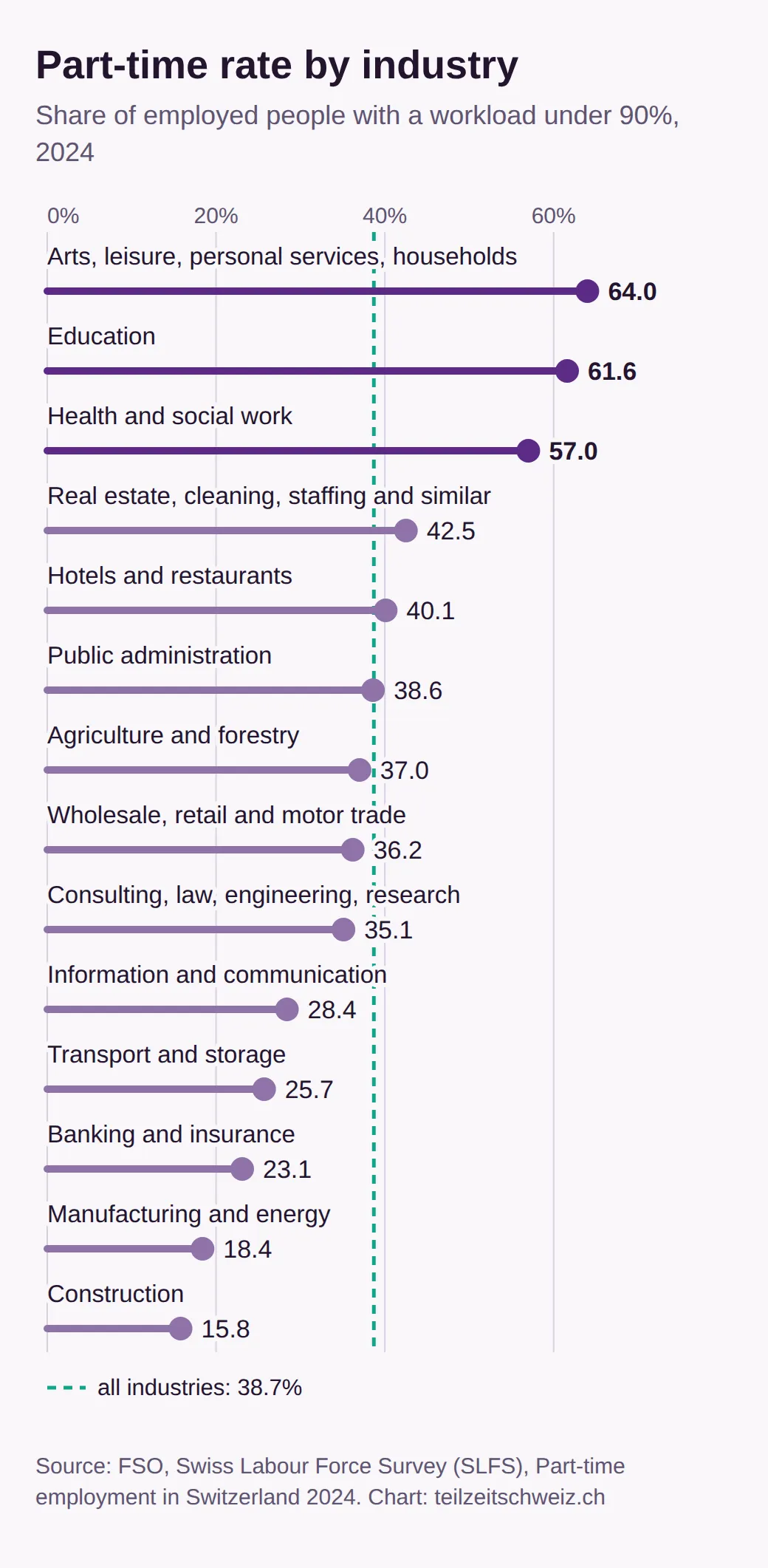
The top of the ranking holds for both sexes. The FSO says so explicitly: in these three areas, men and women both have their highest shares. So the high rate there is not simply down to the many women working in these industries.
Arts, leisure and personal services: 64.0%
At the top is a catch-all group. It covers arts, entertainment and recreation, such as theatres, museums, sports facilities and gyms; then other services such as associations, repairs, hair salons and laundries; and private households that employ staff. In the FSO chart by gender for 2025, women in private households have the highest part-time share of any industry, at over 80%.
Education: 61.6%
In schools, three in five people work part-time. The count includes everyone working there, from teachers to school administration. For your job search, that means part-time is the norm in schools, not the exception. How often teachers share a post is covered in our article on job sharing.
Health and social work: 57.0%
No other industry has as many jobs as hospitals, care homes, home care (Spitex) and social services: just under 900,000 in mid-2026. More than half the people there work part-time. The employer statistics, which we come to below, show the differences within the industry: in social work 67.5% of jobs are part-time, in residential care homes 62.2%, and in health care, with hospitals and medical practices, 59.7%.
Hospitality and trade: close to the average
Many would have expected more part-time work here. Hotels and restaurants, at 40.1%, sit only just above the average, and trade, at 36.2%, is even below it. Part of the explanation lies in the mix. Trade also includes wholesale and the motor trade, where most people work full-time. Hospitality lumps hotels and restaurants together. Split them, and the picture changes: in restaurants and bars 47.6% of jobs are part-time, in hotels only 31.1%. In retail, it's exactly one job in two.
Between these sits a group that rarely gets a mention: real estate and other business services, at 42.5%. It includes cleaning companies, security firms, travel agencies and staffing agencies. Temporary staffing agencies in particular have a lot of part-time work, with 54.0% of their jobs part-time.
Where full-time is still the rule
In construction and manufacturing, only about one person in six works part-time, 15.8% and 18.4%. Banking and insurance (23.1%), transport and storage (25.7%) and information and communication (28.4%) are also well below the average. Public administration, at 38.6%, lands right on the Swiss average.
It gets interesting when you split by gender. The FSO chart for 2025 shows that more than half of the women in construction work part-time, but only around a tenth of the men. In banking and insurance the share for women is just under 40%, for men around a tenth. So an industry's low rate is also down to the fact that many men work there. For women, part-time work is nothing unusual, even in construction.
For your search, this means there are part-time jobs in these industries, just fewer of them, and more often you'll have to bring up the workload yourself. The more detailed employer statistics show exactly where to find them.
How many jobs are part-time?
Around 42%. That is how many of the 5.698 million jobs reported by employers in the second quarter of 2026 were part-time, 2.388 million in all. The figure is in the FSO's press release on the job statistics, known as JOBSTAT (BESTA in German). It asks employers, not people, and counts every job separately. Someone with two part-time jobs appears twice. Here too the line is 90%, measured against the usual working hours at the employer. Agriculture and private households are not covered by these statistics.
The advantage for you: JOBSTAT splits industries much more finely. From the tables for part-time jobs and full-time jobs, we worked out the share for the second quarter of 2026:
| Area | Part-time share of jobs |
|---|---|
| Arts, entertainment, recreation | 69.2% |
| Education | 67.5% |
| Social work (excluding care homes) | 67.5% |
| Residential care homes | 62.2% |
| Health care | 59.7% |
| Staffing agencies | 54.0% |
| Retail | 50.0% |
| Restaurants and bars | 47.6% |
| Public administration | 44.0% |
| Hotels | 31.1% |
| IT services | 26.4% |
| Wholesale | 21.8% |
| Building and civil engineering | 13.5% |
| Pharmaceuticals | 10.8% |
The values are mostly a little higher than in the survey. One reason is obvious: anyone with two part-time jobs counts twice here. But the order is almost the same. The difference is clearest in trade: retail comes to 50.0%, wholesale to 21.8% and the motor trade to 19.0%. If you're looking for part-time work in sales, you'll find it in shops, not in wholesale. From industries, it's only a small step to occupations.
Part-time work by occupation
Sorted by occupation, the picture is similar. In 2024 the rate was highest among service and sales workers, at 53.7%, closely followed by elementary occupations at 53.5%. These include cleaners, kitchen helpers and helpers in warehouses and farming. If you're looking for a job in these occupations, you'll often find part-time work more easily than full-time.
The share is surprisingly high among professionals, as the FSO calls the academic occupations, such as teachers, doctors, lawyers or IT specialists: 43.4%. Clerical support workers, at 43.2%, also often work part-time. Technicians and associate professionals come to 35.6%, skilled agricultural workers to 27.7%.
At the bottom of the list are managers at 21.5%, plant and machine operators at 19.9% and craft and related trades workers at 14.6%. A second figure confirms that bosses rarely work part-time. Among employees with a management role, 24.0% are employed part-time; without one, 45.5%. That holds for women (44.1% against 64.7%) as well as men (12.1% against 24.0%).
Women, men and age
Women work part-time almost three times as often as men. In 2024 their rate was 58.4%, against 21.1% for men. Of all part-time workers, 71.8% were women. Since 1991, though, men's rate has risen more, gaining 13.3 percentage points against 9.2 for women.
With age, the rate rises almost steadily. It is highest past retirement age, when many keep working a few hours. From the FSO table for the 2025 annual average, we calculated the values by age and gender:
| Age | All | Women | Men |
|---|---|---|---|
| 15–24 | 27.4% | 35.3% | 20.3% |
| 25–39 | 33.0% | 50.9% | 17.1% |
| 40–54 | 39.5% | 65.1% | 16.0% |
| 55–64 | 42.6% | 67.3% | 21.1% |
| 65 and over | 85.0% | 91.8% | 80.2% |
| Total | 38.7% | 58.6% | 20.9% |
The curves differ for women and men. For men, part-time work is most common at the start and end of working life, during training and around retirement. In between, only about 16% to 17% work reduced hours. For women, the rate climbs sharply from 25 and then stays high.
The main reason is family. Of employed mothers aged 25 to 54 whose youngest child is under 25, 74.9% work part-time; for fathers it is only 14.3%. When the youngest child is between 4 and 12, the figure for mothers is 79.2%. Asked for their reason, 32.3% of women working part-time name childcare, against 11.8% of men (2024). Men, for their part, name education or training twice as often (14.0% against 7.7%). Around one part-timer in six simply has no interest in a full-time job, 19.1% of men and 17.3% of women. How to negotiate a lower workload after the birth of a child is covered in our article on part-time work after maternity leave.
What part-time workloads look like
For men, part-time often means almost full-time; for women, more often a mid-range workload. Of men working part-time, 30.2% work between 80% and 89%, against 21.1% of women. Women most often work between 50% and 79% (40.7%). Very small workloads under 20% apply to 15.8% of male and 12.1% of female part-timers; the chart above shows all four bands.
This, too, depends on age. Among part-time workers aged 15 to 24, 61.8% have a workload under 50%; past retirement age it is 80.7%. Between 25 and 64, around 70% of part-timers work between 50% and 89%.
The smaller the workload, the more often a second job comes into play. 15.0% of part-time workers have more than one job, compared with 3.6% of full-time workers. Below a 50% workload, it is 18.8%. What to watch out for with two employers is in our article on second jobs.
Small workloads have consequences beyond pay. Below a certain annual salary per employer, you are not insured with a pension fund; with few weekly hours, your employer does not insure you against non-occupational accidents; and with a very small workload, you may count as non-employed for OASI (AHV), the old-age and survivors’ insurance. So before you accept an offer, work out what the workload means in hours and francs. Our article on part-time pay shows how.
What this means for your job search
The ranking is a map. In schools, in health and social work, in restaurants and bars and in retail, around half of all jobs or more are part-time. That is where the choice is widest. In construction, manufacturing, banking and IT there are part-time jobs too, just fewer of them.
If you want to work in an industry with little part-time work, ask about a part-time workload rather than waiting for the right ad. The statistics show that women in exactly these industries work reduced hours far more often than men. So a lower workload is possible there; it's just less common. And if you're searching anyway: on our board you'll always find part-time jobs across Switzerland, sorted by field, for example in education, health care or hospitality.
Common questions
- Does an apprenticeship count as part-time in the statistics?
- No. In the Labour Force Survey, apprentices in vocational education and training count as full-time workers, even though they spend part of the week at vocational school. If anything, they pull the part-time rate of young people down.
- Does a job of just a few hours a week count as employment?
- Yes. Anyone who worked at least one paid hour in the week of the survey counts as employed. So a small Saturday job makes you a part-time worker in the statistics, more precisely in the group part-time II, with a workload under 50%.
- How many part-time workers in Switzerland want to work more?
- According to the FSO, 254,000 people wanted to work more in 2024 and could have started within three months. That is 5.0% of the labour force, 7.5% of women and 2.8% of men. Underemployed men mostly want a full-time job, underemployed women mostly a higher part-time workload.
- Where do the Swiss part-time statistics come from?
- From the Swiss Labour Force Survey (SLFS) run by the Federal Statistical Office. It started in 1991, has been quarterly since 2010 and covers around 100,000 interviews a year, plus about 20,000 with foreign nationals. Since 2021 people answer online or by phone. The figures are estimates and have a margin of error.
More posts
All posts
Job sharing in Switzerland: contract, pay and who offers it
How job sharing works in Switzerland: which contract protects you, what happens if your job-share partner quits, how pay works and who offers it.

Part-time accident insurance in Switzerland: the 8-hour rule
Under 8 hours a week, your job doesn't cover accidents outside work. How hours are counted, when your health insurer pays and what applies after a job ends.

Christmas Jobs in Switzerland 2026: Pay, Contracts, Sundays
Christmas job in Switzerland: what a fixed-term contract means, the Sunday and night supplements you are owed, and what the law does not guarantee you.