AHV contribution gaps in part-time work: the 2027 minimum
The rule up front
If you work less than half the usual hours, or less than nine months a year, the AHV (Switzerland's state old-age and survivors' insurance) checks whether the contributions on your salary, including your employer's share, clear two hurdles: the minimum contribution, and half of what you would pay as a non-employed person. Miss either one and you pay the difference. From 2027 the minimum contribution is CHF 541, which corresponds to an annual salary of about CHF 5,100.
Many guides on this topic give one number, 2.3% less pension for every missing year, and leave it there. Using the 2027 contribution table from the Federal Social Insurance Office (FSIO), we work through three cases with a small workload. We show when marriage or children protect you and when they don't, and how to use your free account statement to check whether you're already missing a contribution year.
When a small workload triggers the check
Only people who aren't in permanent full-time work are checked. According to the FSIO guidelines (in German) that the compensation offices work by, that means two groups: anyone who works less than nine months in a calendar year, and anyone who doesn't work at least half the usual hours. One day a week, or 20%, falls into this group. On the other hand, if you work 50% from April onwards, the AHV treats you as being in permanent full-time work, because that's nine months at half the usual hours. We showed how many hours your workload works out to in our post on part-time pay.
For this group, Article 28bis of the AHV Ordinance (AHVV, in German) applies. Your contributions on your salary, together with your employer's, have to clear two thresholds in a calendar year: always the minimum contribution, and on top of that at least half the contribution you would pay as a non-employed person. Contributions to AHV, IV and EO (old-age, disability and income compensation insurance) add up to 10.6% of gross salary, and your employer pays half. That's the rate AHV leaflet 2.03 uses as of 2026, and the Federal Council's announcement for 2027 doesn't give a new one.
If you fail the check, you pay contributions for the whole year as a non-employed person. That sounds more expensive than it is: on request, the office credits the contributions already deducted from your salary (Article 30 AHVV). So you only pay the difference, plus administrative costs of at most 5% of the contributions. You have to make the request and prove the contributions on your salary, for example with your salary certificate.
There's one catch: often none of this happens by itself. Your employer settles its accounts with its own compensation office and knows nothing about your assets. As a non-employed person you belong to the compensation office of your canton of residence, and AHV leaflet 2.03 is clear: if you're not yet registered with an office, you have to register yourself, and it's your responsibility to meet your obligation to pay contributions. How much is at stake depends mainly on one figure that has nothing to do with your job.
What non-employed people pay from 2027
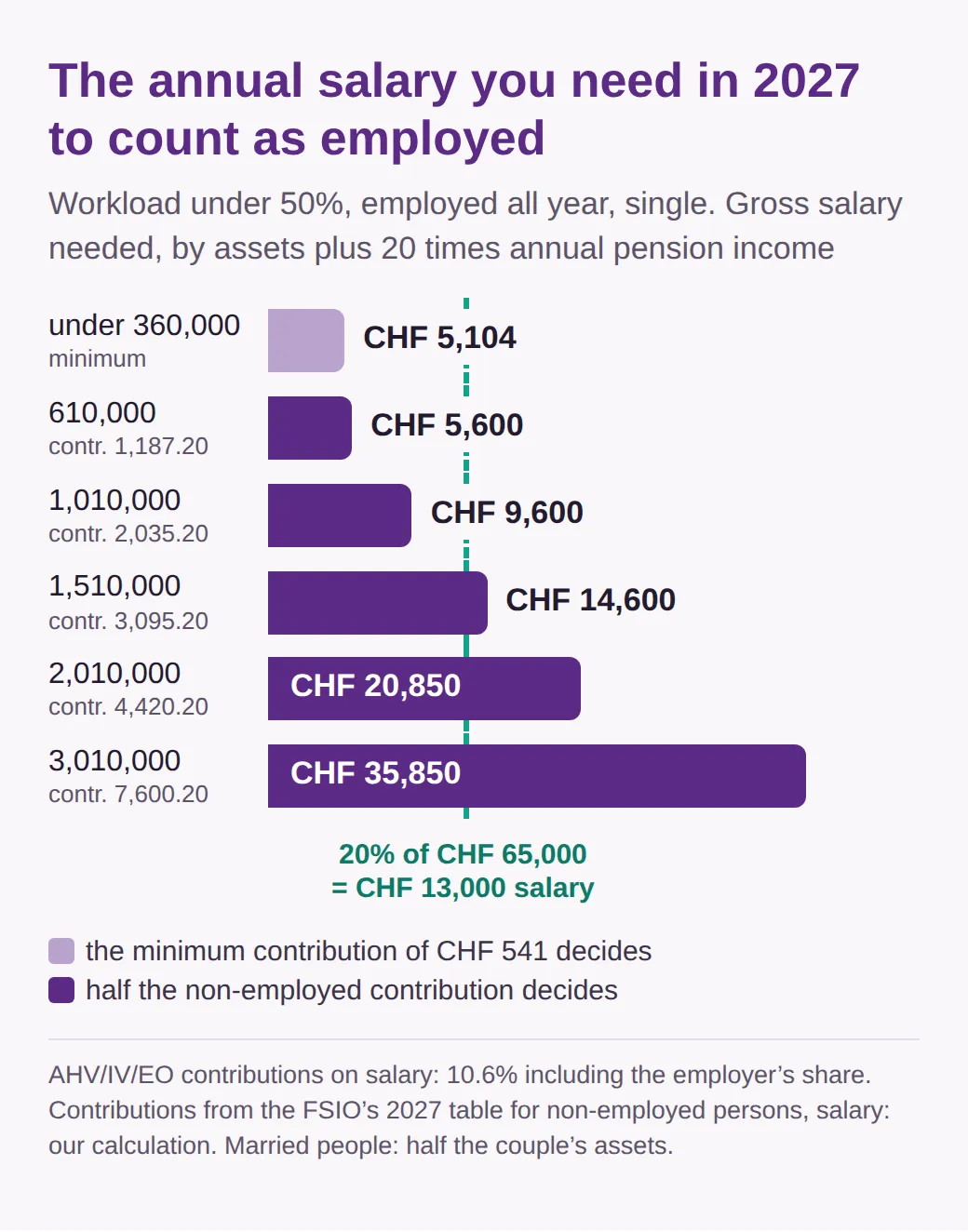
The contribution for non-employed people depends on assets and pension income, not on salary. On 2 October 2026 the Federal Council decided to raise the minimum contribution from CHF 530 to CHF 541 from 1 January 2027, as the FSIO press release (in German) states. The full scale is in the 2027 contribution table (in German): CHF 541 for assets below CHF 360,000, then CHF 657.20 from CHF 360,000. After that, every further CHF 50,000 adds CHF 106, and from CHF 1,760,000 it adds CHF 159. The maximum contribution of CHF 27,050 applies from CHF 9,160,000. The office rounds your assets down to the next lower step.
According to leaflet 2.03, assets include savings accounts, securities, property and the surrender values of life insurance policies, minus debts. Pension fund and vested benefits savings don't count. If you have pension income, it's multiplied by 20 and added to your assets. Pension income doesn't only mean pensions: it also covers maintenance you receive for yourself after a divorce, daily allowances from health or accident insurance, and study grants. Married people use half of the couple's assets and pension income.
| Assets plus 20 times pension income | 2027 contribution | Half of it |
|---|---|---|
| under CHF 360,000 | CHF 541.00 | CHF 270.50 (the minimum applies) |
| CHF 1,010,000 | CHF 2,035.20 | CHF 1,017.60 |
| CHF 1,510,000 | CHF 3,095.20 | CHF 1,547.60 |
| CHF 2,010,000 | CHF 4,420.20 | CHF 2,210.10 |
So with modest assets the minimum contribution decides, because half of CHF 541 is less than that. From CHF 610,000 the half rule takes over, and then the salary you need soon grows beyond what a small workload pays.
Worked through: three cases with a small workload
The rule is clearest in figures. Take a job that pays CHF 65,000 full-time, of which you do 20%: one day a week and CHF 13,000 a year. On that, CHF 1,378 goes to AHV, IV and EO, half from you and half from your employer.
If you don't have much in assets, that's the end of it: CHF 1,378 is well above the minimum contribution of CHF 541, you count as employed and you don't need to do anything. That's the normal case. The same job looks different if you've inherited CHF 1.5 million. The office rounds down to the CHF 1,460,000 step, and as a non-employed person you'd owe CHF 2,989.20. Half of that is CHF 1,494.60, and your CHF 1,378 isn't enough. For the year you pay CHF 2,989.20 minus CHF 1,378, so CHF 1,611.20, plus administrative costs.
The second case comes from leaflet 2.03 itself. A woman divorces in March and receives assets of CHF 1 million. Until the divorce she received CHF 1,500 a month in maintenance, after it CHF 1,000. From April she works 20% for CHF 800 a month. Her ex-husband didn't pay twice the minimum contribution that year, so the comparative calculation applies to her. Her salary of CHF 7,200 brings in CHF 763.20 in contributions. Her maintenance for the year comes to CHF 13,500; times 20 that's 270,000, which together with her assets makes CHF 1,270,000. Using the 2026 table in the leaflet, she owes CHF 2,544 as a non-employed person. With the 2027 table it would be CHF 2,565.20, half of it CHF 1,282.60. She fails, and once her salary contributions are credited, CHF 2,565.20 minus CHF 763.20 leaves CHF 1,802 that she pays herself.
The third case is about small jobs. If you earn CHF 250 a month with one employer, so CHF 3,000 a year, the contributions come to CHF 318. That's less than the minimum contribution. With modest assets you owe the difference, CHF 223, or else you're missing the year. If your salary with one employer stays at CHF 2,500 or less in a year, contributions are only deducted if you ask for them (Article 34d AHVV). What that means for seasonal work is in our post on Christmas jobs. If you have several jobs, the contributions from all of them count together, as with second jobs.
Fortunately, many people never have to do these sums. If you're married, you're often protected already.
Married: when your contributions count as paid
If your husband or wife pays at least twice the minimum contribution on their own salary, including the employer's share, your contributions count as paid (Article 3(3) of the AHV Act, AHVG, in German). From 2027 that's CHF 1,082, which a salary of about CHF 10,200 a year already reaches. This also applies to registered partnerships, and for the whole year in which you marry or divorce.
For part-time workers this protection goes further than many people think. The FSIO guidelines give an example: a married woman works one day a week, and her husband pays more than twice the minimum contribution. She only owes the contributions on her salary, however large the couple's assets. There's no comparative calculation. And the year counts as a full contribution year towards her pension, because the law counts years in which the spouse paid twice the minimum contribution (Article 29ter AHVG).
The protection has a gap, and it hits couples where the partner also works only a little. He has to count as employed himself. In the leaflet, a 63-year-old man works 10% for CHF 8,000, and his wife doesn't work. The couple have CHF 500,000 in assets and CHF 75,000 a year in pensions. Because he fails the comparative calculation, he pays as a non-employed person, and then he can't exempt his wife. With the 2026 figures, she pays CHF 2,014 herself.
Unmarried couples who live together get no such exemption. Income splitting doesn't close a gap either. When pensions are calculated, the incomes from the years of marriage are divided in half (Article 29quinquies AHVG) once both partners have reached retirement age, or on divorce. That evens out low and high salaries, but it doesn't turn a missing year into a full one. Credits for children cut both ways too.
Children under 16: the credit counts, the duty to pay stays
For every year in which you have parental responsibility for a child under 16, you get a child-raising credit (Article 29sexies AHVG). It isn't money but income added to your record, and it raises your future pension. It equals three times the annual minimum pension at the time you retire. With the minimum pension of CHF 1,280 a month that applies from 2027, that would be CHF 46,080 a year. Married couples split the credit in half. For unmarried or divorced parents with joint parental responsibility, an agreement or the authorities decide, and if there's neither, it has gone entirely to the mother since 2015 (AHV leaflet 1.07, in German).
More important for gaps: a year with a child-raising credit counts as a contribution year. If you have a small child and barely work, you don't lose a 44th of your pension because of it. You don't have to apply for the credit; the office only adds it when you claim your pension. So keep any agreement you make about the credits.
There's one thing the credit doesn't do, though. According to leaflet 2.03, it doesn't release you from paying contributions as a non-employed person. So the office can still ask for the minimum contribution or the difference from the comparative calculation. The same goes for care credits, which you get when you look after relatives who receive a helplessness allowance. Those, however, you have to claim in writing every year (Article 29septies AHVG). If you're reducing your workload after having a baby, there's more in our post on part-time work after maternity leave. If a year is missing despite all this, it gets expensive.
What a missing year costs
You have a full contribution year if you were insured for more than eleven months and paid the minimum contribution, or if a credit or the exemption through your spouse applies (Article 50 AHVV). For a full pension you need the same number of contribution years as everyone born in your year, usually 44.
If you're missing one, you get a partial pension. The table in Article 52 AHVV sets it at 97.73% of the full pension for 43 out of 44 years. With the pensions from 2027, at most CHF 2,560 and at least CHF 1,280 a month, a missing year costs about CHF 29 to 58 a month by our calculation. Because the 13th AHV pension is a twelfth of the annual pension, it drops by the same proportion. Together that's about CHF 378 to 755 a year, for life.
Set against that is the price of closing the year: CHF 541, once. After 10 to 19 months of pension, the gap has already cost you more than the contribution. So paying it is almost always worth it. Which leaves the question of how long you have.
Paying late: five years, then the gap is permanent
The compensation office can only claim contributions, and you can only pay them, if a ruling sets them within five years of the end of the contribution year (Article 16 AHVG). For 2021 that means the ruling has to be issued by 31 December 2026. For 2022 the deadline runs until the end of 2027. After that, the AHV won't take your money, even if you offer it. So if you suspect a gap in 2021, get in touch before the end of 2026. There's one exception for contributions as a non-employed person: if the tax assessment for the year only became final late, the deadline ends one year after the year in which that happened. Don't rely on it.
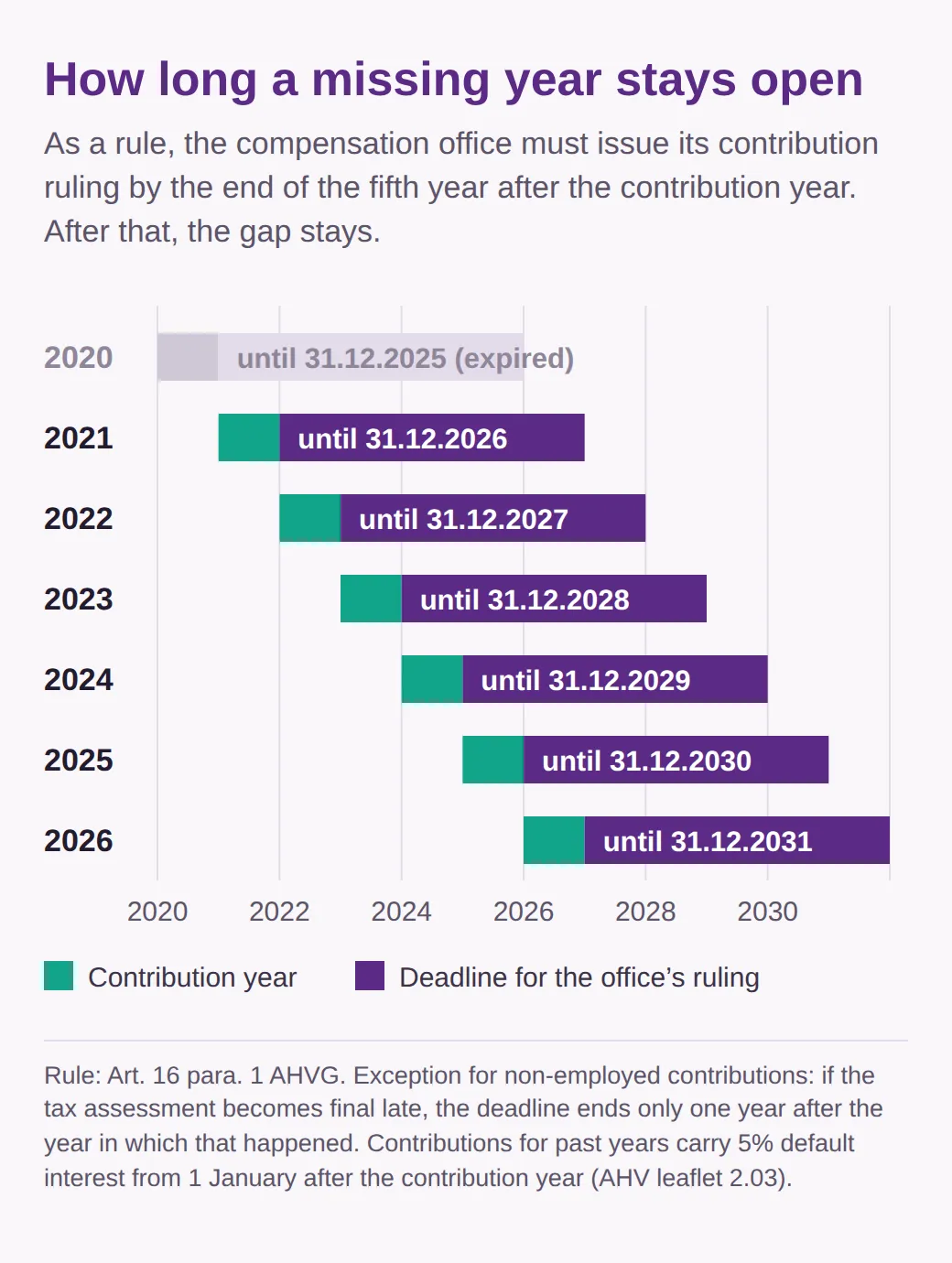
Waiting doesn't make it cheaper. Contributions for past years carry 5% default interest a year, from 1 January after the contribution year in question. So contact the compensation office of your canton of residence as soon as you suspect a gap. It checks the year and sends you a ruling with the amount.
For older gaps there are two routes. If you paid contributions before 1 January after your 20th birthday, during an apprenticeship for example, those years fill later gaps (Article 52b AHVV). And since the AHV 21 reform, you can close gaps after the reference age: if you keep working in the five years after it, earning at least 40% of your previous average income and paying at least the minimum contribution, the office will take these contributions into account once, on request (Article 29bis AHVG). Whether you have a gap at all is shown in a document that costs nothing.
Ordering and reading your account statement
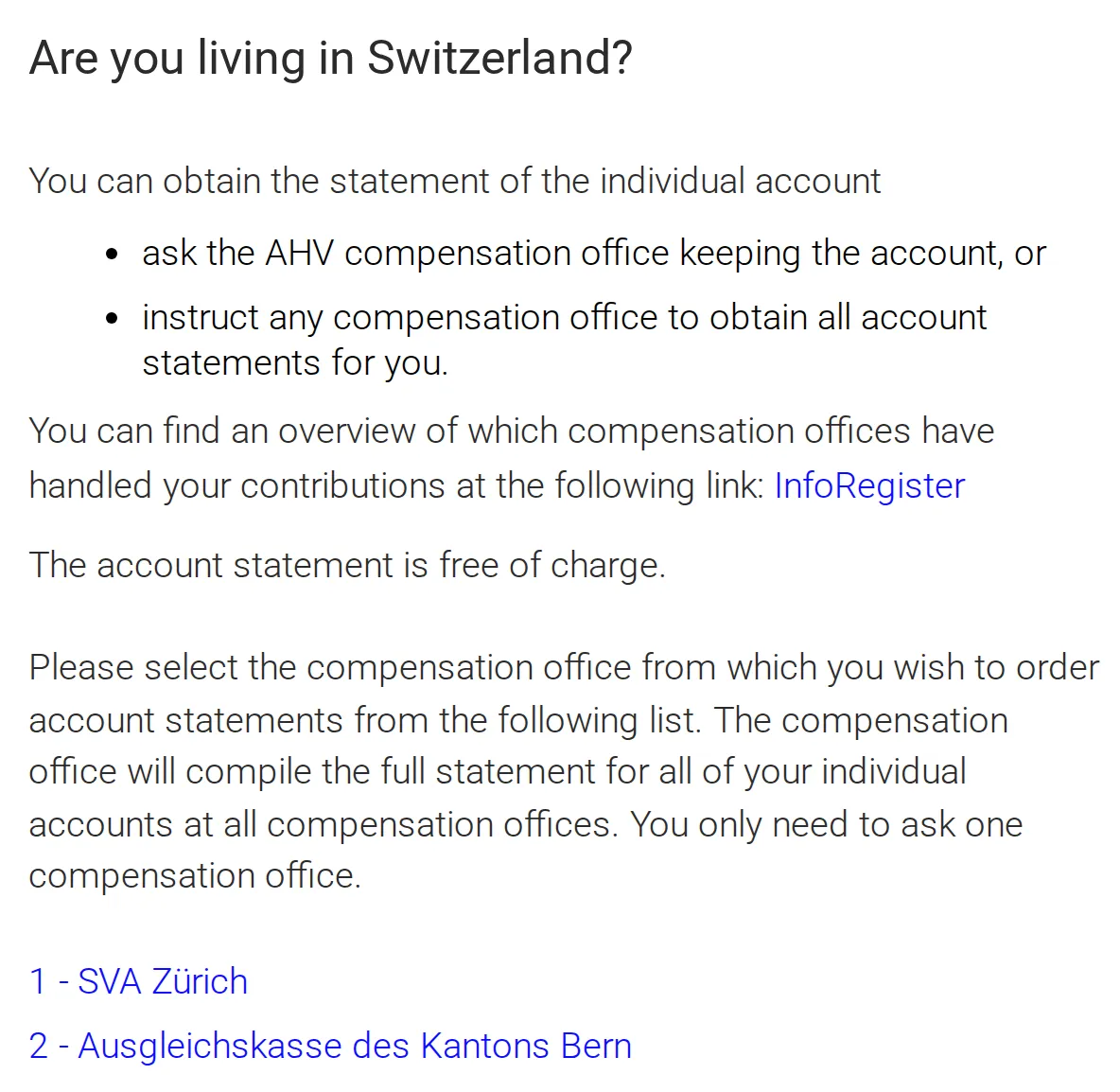
In your individual account, IK for short in German, the AHV records each year the income on which contributions were paid. You order the statement with the order form on ahv-iv.ch. You choose any compensation office, and it gathers the entries from every office where you've ever had an account. The InfoRegister on the same page shows which offices those are.
In the statement, look at the years from the year after your 20th birthday onwards. A year with no entry is suspicious, and so is one with a very small salary, if no spouse paid twice the minimum contribution that year and you had no child under 16. If you paid the 2027 minimum contribution as a non-employed person, an income of CHF 5,103 appears for it, as the FSIO contribution table shows. If you find a mistake, you can ask the compensation office to correct it within 30 days of receiving the statement (Article 141 AHVV). After that, it's only possible if the mistake is obvious or you can fully prove it.
If you suspect you failed the comparative calculation for a year, a short message to the compensation office of your canton of residence is enough:
Dear Sir or Madam,
In [year] I worked part-time at [percentage]% and earned CHF [amount] gross. Please check whether I owe contributions as a non-employed person for that year, and credit the contributions deducted from my salary under Article 30 AHVV. My salary certificate is enclosed. AHV number: [number].
Kind regards, [name]
What to do next
Get your account statement and check the years from the year after your 20th birthday, starting with the oldest one that's still open; for 2021 the deadline runs out on 31 December 2026. If you work less than half-time and you're single, do a quick check: if your salary brings in more than CHF 541 in contributions, so about CHF 5,100 a year, and your assets plus 20 times your pension income are below CHF 610,000, you're on the safe side. If you've inherited money, or you receive maintenance or a pension, the chart above shows the salary you need.
Often the simplest lever is the workload itself. Work at least half-time for at least nine months and the comparative calculation doesn't apply at all, and even a little more salary can be enough to pass it. More salary also means a higher pension. What a small workload means for your pension fund is something we've worked out in our post on part-time work and pension funds.
Common questions
- Do I pay AHV on a small job under CHF 2,500 a year?
- Only if you ask to. If your salary with one employer stays at CHF 2,500 or less over the whole year, your employer deducts no AHV contributions unless you want them. Without contributions, the job doesn't count for the AHV, and with no other income you count as non-employed. The limit doesn't apply to work in private households or for theatres, orchestras, media and similar businesses.
- Does my partner's AHV cover me if we're not married?
- No. The exemption through twice the minimum contribution only applies to married couples and registered partnerships. If you live together without being married, each of you is assessed separately. If you earn little or nothing, you have to register yourself with the compensation office of your canton of residence and pay at least the minimum contribution.
- Can I pay more into the AHV to get a higher pension?
- No. As a non-employed person you pay exactly the contribution in the table, and the AHV doesn't accept higher voluntary contributions. What you can close are missing years, and only for the last five years. Otherwise, only a higher salary with contributions paid on it raises your pension.
- Do my pension fund savings count as assets for AHV contributions?
- No. Retirement savings and vested benefits in the second pillar aren't part of the assets the compensation office uses to work out your contribution as a non-employed person. What does count includes savings accounts, securities, property and the surrender values of life insurance policies, minus debts. The figure used is your assets on 31 December according to your tax assessment.
More posts
All posts
Part-time salary in Switzerland: hours, pay and hourly rate
How to calculate a part-time salary in Switzerland: what 60% or 80% means in hours, how to convert monthly to hourly pay and check an offer with Salarium.

Part-time accident insurance in Switzerland: the 8-hour rule
Under 8 hours a week, your job doesn't cover accidents outside work. How hours are counted, when your health insurer pays and what applies after a job ends.

Second job in Switzerland 2026: what your employer can ban
Second job in Switzerland: when your employer can say no, the working-time limits for both jobs together, and what changes for AHV and tax.